- China’s First United Front
The First United Front (FUF) in China, from 1923 through 1927, combined Communists and Nationalists into a singular Guomindang (KMT) organization. Its initial intent was to eliminate Imperialist and Warlord influences residing in the country that had persisted since the 1911 Nationalist Revolution that rejected Imperial rule. The alliance served as an incubator for the Chinese Communist Party (CCP), asserted KMT political dominance, and also satisfied Soviet goals. This essay will discuss the ideological context of what a United Front is, and then discuss its deployment in the FUF as it represents one of the first examples of the technique applied at a geopolitical scale. Focus will be given
to the specific reasons that the FUF was largely a catastrophic event for the CCP, as the implementation demonstrated that the technique was effective for the Soviets who continued work toward refining it.
A United Front was formally described by the Communist International (Comintern) in 1922 where they declared that groups of disorganized workers must unite into larger groups with a common aim of eliminating the influence of any organization that had mislead the working class (Comintern 1). Later in that document, more details are discussed as to the extension of this concept as it applies to both Political & Industrial United Fronts. The framework was meant to offer a tool to promote Communist success against Capitalism and Western Ideologies by using the tactic in the context presented. The timing of the presentation of this document against the formation of the FUF suggests that there was a dispute in Communist leadership, which may have perceived that the technique wouldn’t be suitable for obtaining Communist goals. This was a major motivation for the Soviet influence in the formation of the FUF, as building the smaller communist party in China was considered to be a good opportunity to enact the newer ideological pursuit.
The alliance between the CCP and the KMT precipitated from a Soviet directive delivered by Henk Sneevliet (Maring) to the CCP that it should join the KMT. Maring was the Comintern representative who was overseeing the CCP relations. As Ah Xiang writes in a paper regarding USSR / Comintern relations, “On August 17th, 1922, at the Second West Lake Meeting … Maring forced through the July 18th Comintern presidium’s directive [instructions from the Executive Committee of the Communist International to its Representatives in South China], which was brought to China on a shirt he wore, for the CCP to join the KMT…” (Xiang 6, courtesy Google Translate). This indicates that the motivations for the CCP to join the KMT was a Soviet initiative. This process was completed in 1923, where Xiang continues by writing that, “Maring … pushed through the Comintern’s May 1923 directives to have the CCP collectively … enter the KMT as a bloc-within at the CCP’s third congress that was held in June 1923.” (Xiang 8). This is the formal moment in which the alliance was created.
The initiative to accept the CCP members into the KMT was suggested to KMT leadership by Maring beginning in 1921. As David Barrett writes in a discussion about Hu Hanmin, a political advisor to Sun Yatsen, “In December 1921 Maring … may have made suggestions to Sun about the need to reorganize his party, and may have proposed some form of co-operation between it and the CCP.” (Barrett 35). Barrett later indicated that the Soviets offered numerous incentives to the KMT in exchange for doing this. These incentives included weapons, money and the signing of the Sino-Soviet agreement, which would have been highly beneficial to KMT economic interests and will be discussed later. From these references, it can be understood that the First United Front began as a Political United Front between the KMT and the CCP under Soviet direction. The Soviet selection process for uniting these parties had lead to them identifying the KMT as a suitable incubator for the CCP which was only just formed in 1921. This satisfied the first objective of the United Front methodology, which was to combine smaller groups into larger groups. Their unified goal was then to eliminate the influence of various parties that had resisted GMT authority.
These target parties included competing Chinese factions which were vying for various forms of control over land, property or people. Domestically, this included warlords in the countryside and gangs in the cities. The KMT and CCP worked with the Soviets and the Japanese in order to secure various arms and goods needed to maintain their military advantage. The focus of KMT efforts at the time were to stabilize Shanghai, Guangzhou and Nanjing. In the cities, there was a secondary Industrial United Front (as it was described by the Comintern) that the CCP had enacted through Labor Unions established by the KMT. The importance of this Industrial United Front to the CCP can be derived from a new approach taken by Mikhail Borodin (Maring’s 1923 replacement advisor). This approach is discussed by An Xiang who writes that, “Borodin’s strategy was to have the CCP take control of all the local organizations of the KMT, develop a step by step plan to combat the KMT right-wing … and accelerate the inevitable split of the KMT left wing from the KMT right wing. (Xiang 14). These local organizations became the Farmers’ Bureau in the countryside, while the cities established Labor Unions. In both areas, this front struggled against gang and warlord control of the local labor markets.
Receiving Soviet support required the continued cooperation between the CCP and the KMT, in exchange for the weaponry that was used to consolidate power under the KMT leadership. This is explained where Barrett writes that, “Borodin must be assigned a role of some significance, since he was not only supreme adviser to the government, but the supplier of its arms.” (Barrett 49). It would be through a combination of this support and the formation of outlets discussed above that enabled the CCP to directly engage the Chinese population on more peaceful terms. This combination lead to the mass dissemination Communist ideology across the cities and countrysides as the warlords and gangs were defeated or incorporated into the KMT with a lot of popular support resulting for the CCP. This is supported where Xiang discusses the CCP initiative to control the Labor Unions in the cities in writing that, “The communist Labor Secretariat … in 1924 relocated to Shanghai from Peking, and in the cloak of the KMT-CCP collaboration and by means of hijacking the KMT’s Shanghai Executive Bureau, took
control of the KMT’s Shanghai Federation of Labor Unions.” (Xiang 7).
The control of these labor unions was in line with larger Communist ideology of a need to
secure the interests of the working class proletarians. Xiang later discusses the CCP initiatives in the countryside in writing that, “On July 3rd, 1924, communists pushed through their agenda to have the KMT organize the Farmers’ Bureau under the KMT central executive committee as well as launch the farmers’ Movement Training Institute.” (Xiang 14). This formed a two-pronged approach where CCP fronts were established in the major locations of unrest, and their ability to have control over training the peasants became a viable avenue to spread CCP ideology. With this organizational arrangement,
domestic affairs were more ordered. Geopolitical effects that arose from managing this alliance were to follow.
Xiang later discusses that regional politics lead to negotiations which included Japan, the
Soviets and China in jointly coordinating the maintenance and security for the Chinese Eastern Railway, which was considered to be critical infrastructure for trade as well as national defense (Xiang 17). The issue with this was that the railways and trains were paid for by the Soviets. The vested Soviet stake in the infrastructure and the issue of how they were to co-manage the Chinese railways lead to their actions in the Sino-Soviet agreement, which renegotiated previous agreements made by regimes which were no longer leading their respective countries. Xiang indicates that, “The Sino-Soviet Agreement nominally nullified all Conventions, Treaties, Agreements, Protocols, Contracts, etc …, concluded between the Government of China and Tsarist Government.” (Xiang 19). The removal of these restrictions were a major motivator for the KMT to agree to signing the agreement. There was a separate addendum to this agreement that was signed secretly by the Soviets and Japanese that effectively neutralized the part of the Sino-Soviet agreement that Chinese leadership had signed, which is mentioned in Bruce Elleman’s essay on Soviet diplomacy where he writes that, “a protocol counteracting this promise remained secret,” in referring to the addendum (Elleman 469).
In 1926, a political advisor to the late Sun Yatsen, Hu Hanmin, returned from Russia. Hu’s
experiences are summarized by Barrett: “Hu said his Moscow experience taught him how
extraordinarily secretive the Soviet leaders were about their plans, a characteristic which Borodin fully shared. As for the Chinese Communist Party, it had a dual nature on the one hand it lived as a parasite on the [KMT], while on the other hand it continually fomented social unrest.” (Barrett 60). Hu’s understanding solidified the approach that KMT leadership followed towards the CCP shortly after his return. It’s likely that if Chinese leadership became aware of the secret addendum to the Sino-Soviet agreement, it would have been a result Hu’s time in Moscow. The disclosure of this information to Hu would have revealed the contradiction to the drafted Sino-Soviet agreement that China had entered into, and is likely a reason for a lack of more direct Soviet intervention toward the actions that the KMT later took in initiating the White Terror movement.
The death of Sun Yatsen in 1925 lead to the CCP-KMT relationship deteriorating after his
replacement with Chiang Kai-shek. In Modernization and Revolution in China, Dr. Grasso writes that, “Sun Yatsen had been the unifying force within a party of disparate views. His death revealed a cleavage between two major factions that was never overcome” (Grasso 58). This point is important because it shows that without the previous leadership to drive the KMT to follow the expected course, much of the lingering KMT resentment toward the CCP came to the surface. The ensuing pivot in Nationalist politics to focus on the stalled Northward movement, along with the cities needing a consolidated power to stabilize them and the realization that foreign interests had more concern with the railroad than the CCP at the time were just a few of the major parts of what lead to the breakdown of the FUF, but the scope of this essay has been to consider these few key points. These events precluded the KMT dissolution of the KMT-CCP agreement, which was summarized by Dr. Grasso who again writes that, “The First United Front ended with the near annihilation of the CCP. During the next decade, although the foreign imperialists and several warlords remained unsubdued, Chiang Kai-shek and his party would dominate China.” (Grasso 60). This began with the White Terror movement
that drove the CCP from the country for the following decade.
In summary, the push to unite the KMT and the CCP by the Soviets was never meant to produce anything other than a strong Communist party with the CCP leading China, while testing a ideological tactic at a geopolitical scale. The FUF served to illustrate how wartime techniques, such as United Fronts, evolve in order to adapt to globalized efforts including multiple foreign sovereign nations. This hybrid war tactic enables a few major parties to engage in an ongoing civil war that’s fought covertly and with minimized outbreaks of violent repressions. It simultaneously leverages often violent efforts in repelling outside forces such as those that are uniformly identified by the major parties to be a threat. This tactic has been a common tool in many political parties to date and continues to be utilized to achieve new goals, but these approaches are outside the scope of this writing.
Works CitedBarrett, David P. “The Role of Hu Hanmin in the ‘First United Front’: 1922-27 on JSTOR.” JSTOR, The China Quarterly, 1982, www.jstor.org/stable/653620. Accessed 20Oct2025.
Comintern, Communist International. “Theses on the United Front of Labor [1922].” Marxists.org, 29May1922, www.marxisthistory.org/history/usa/parties/cpusa/1922/0529-cec-unitedfronttheses.pdf. Accessed 20Oct2025.
Deal, Jacqueline, and Eleanor Harvey. “CCP Weapons of Mass Persuasion.” Andrew Marshall Foundation, 2022, www.andrewwmarshallfoundation.org/wp-content/uploads/2022/12/CCP-Weapons-of-Mass-Persuasion-Advance-December-2022.pdf. Accessed 20Oct2025.
Elleman, Bruce A. “Soviet Diplomacy and the First United Front in China on JSTOR.” JSTOR, 1995, www.jstor.org/stable/189387. Accessed 20Oct2025.
Grasso, June M., et al. Modernization and Revolution in China. 6th ed., Routledge, 2024.
Xiang, Ah. “USSR / Comintern Alliance with the KMT & the CCP.” Republican China, 27Mar2012, www.republicanchina.org/USSR-Comintern-KMT-CCP.pdf. Accessed 20Oct2025. - Life in Revolutionary China: A Film Study
Zhang Yimou’s film To Live (1994) portrays what typical life in China during the Chinese
Revolutionary years may have been like as folks adapted to sweeping policy changes. Yimou’s primary audience are English-speaking intellectuals who are looking for a larger exposure to modern Chinese culture. In adapting his film from the book, Yimou emphasized relatable aspects which ensured that an average viewer may more easily engage with the types of struggles that the Chinese people had been dealing with during the periods covered in the film. The film covers the time from the formation of the CCP until the middle of the Cultural Revolution. The film serves as an effective historical narrative due to its adherence to historical accuracy regarding events that took place that portray the effects of Chinese government policymaking on its constituents. It was on this historical narrative that Yimou directed the dramatic storytelling of the fictional, but relatable, Xu family.
While recovering from his past life as a gambling addict, Xu Fugui was conscripted into the Nationalist (Guomindang) counter-revolution. This policy of conscription lead to splitting families apart and in doing so he was abruptly separated from his mother, wife and children. This was discussed when he says, “But who will look after my wife, my kids, my old mother?” (To Live 29:00 – 29:05).
There was no solution for this known to him at the time, and the policy exposed individuals to the loss of their family support systems which left them vulnerable. During his conscription he was captured by the Communist forces and then once again conscripted, but this time as an entertainer where he would put on his shadow puppet shows for the army. He was eventually released and returned home. This policy of conscripting counter-revolutionary forces by the CCP, rather than killing them, was a direct result of Mao’s beliefs about thought reform. Dr. Grasso discusses the approach to this ideology in Modernization and Revolution in China by writing that, “The CCP learned that it was more efficacious to have the damned serve socialism through compulsory labor than as fertilizer. Those who were at least ready to work should be spared, said Mao…”. (Grasso 96). The realization of this idea lead to folks such as Xu Fugui staying alive after having been captured. It also enabled him to return home to his family. This policy was reflected in the film when Lao Quan says, “Better to wait and become a POW. The Reds send POWs home.” (To Live 33:40 – 33:45). The more humane approach toward human life garnered high levels of appeal in Mao’s constituents.
Xu Fugui’s return home revealed many political changes, which he quickly adapted to. One policy of the CCP that was immediately revealed to him was how his family was taken care of in his absence. In a conversation with him, his wife Jiazhen says, “The new government paid for mother’s burial, and gave me this job delivering water.” (To Live 44:45 – 44:52). The centrally planned structure that the CCP was following at the time mirrored the Soviet style which structured work by having bureaucrats dictate what kinds of jobs people would receive from the government. Centralized policies such as this wouldn’t be rejected until the Great Leap Forward (Grasso 117). This policy offered little
room for career mobility, but in exchange offered a more secure life for many people. The entire family, including the children and then later her husband, were assigned the job in the movie. Jiazhen stressed that the work had impacted the children’s lives leading to them not getting enough rest.
Another policy that affected the Xu family was the classifying of people into different classes such as working class or landowners. With Xu Fugui’s past as a wealthy landowner, the Xu family had to conceal, dismiss or denounce their history a few times in the film. This was shown in the scene where Xu Fugui witnessed that Long’er, whom Fugui had lost his home to through a gambling debt, had been shot five times due to resisting having his home taken away. The moment revealed to Xu Fugui that by losing his home, he was spared from being labeled as a landlord in the revolution. He describes the importance of this when he says, “If I hadn’t lost my house to him, that’d have been me.” (To Live 49:40 – 49:50). These classifications, and the organizations such as Red Guards and Peasant Organizations which enforced the policy, served to break down traditional life through societal upheaval that Mao Zedong had kept under control by rewarding folks through a process of land reallocation after the landowners were killed by CCP officials.
During the Great Leap Forward (GLF) scenes, the use of communal kitchens were included in the film. CCP policy leveraged communal kitchens in place of personal kitchens in an attempt to more efficiently feed people. The CCP also benefited from metal cookware donated by families, which was smelted for war efforts. This donation was a source of pride in the local community as per the scene where they all woke up from partying the night before to a lump of smelted metal being paraded through the street on its way to a foundry for processing (To Live 1:06:55 – 1:08:10). This smelting was often performed using child labor, where Fugui’s son was a worker at one of the factories.During a work shift, his son was killed in an accident after having fallen asleep for having worked so many days in a row that he was too exhausted to stay awake. This policy was part of the Great Leap Forward, where the CCP had encouraged people to work extreme hours. This was summarized by Dr. Grasso who writes that, “The frantic pace of the work on these furnaces was matched in regular factories, where machines ran night and day as some workers vacated their homes and simply moved into the plants so they could labor around the clock.” (Grasso 118). The film scene served to show the impact that many
families had to endure, which often included injury and exhaustion in order to fulfill GLF expectations.
In conclusion, Zhang Yimou’s film portrays what typical life in China during the Chinese
Revolutionary years may have been like. Yimou accomplished this by emphasizing relatable aspects of normal life, a few of which were discussed in this essay. The story told was built on a historically accurate narrative in which many of the effects of policymaking by the Chinese government could be seen and understood. It stressed the effects which impacted every single person in China at the time.
Works CitedGrasso, June M., et al. Modernization and Revolution in China. 6th ed., Routledge, 2024.
To Live [China: Huozhe, 1994]. Dir. Zhang Yimou. Wr. Yu Hua and Lu Wei. [Based on the novel Huozhe by Yu Hua.]. Perf. Ge You [Fugui] and Gong Li [Jiazhen]. Golden Frog Srls., 2023. https://www.youtube.com/watch?v=HorOrml6hKg. Accessed 07Oct2025.
- Mao Tse-tung: Rise to CCP Leader
Mao’s policies appealed to the peasant class because from WW1 to the end of WW2, the Chinese people were subjected to severe economic oppression by an ex-imperial class, a nascent nationalist government and usurious warlords. Mao was able to channel a relatable narrative that focused around giving the peasants land and access to education in exchange for their loyalty and participation in the revolution that he lead. Mao’s narrative outlined numerous classes which all imposed their autocratic authority on the peasant class. In his Observations, He described this group as, “The patriarchal-feudal class of local tyrants, evil gentry and lawless landlords [which] has formed the
basis of autocratic government for thousands of years and is the cornerstone of imperialism, warlordism and corrupt officialdom. To overthrow these feudal forces is the real objective of the national revolution.” (Tse-tung para. 9). This quote is important because it clearly delineates classes of people that were at odds with each other through the revolution.
The ideology that Mao presented incorporated both nationalist and communist aspects and was very agreeable to the peasantry which was already rejecting Confucianism as a result of being exposed to other religions. Recognizing this ideological struggle, in speaking to the peasants Mao made the point on the gods that, “… if you had only Lord Kuan and the Goddess of Mercy and no peasant association, could you have overthrown the local tyrants and evil gentry? … You have worshiped them for centuries, and they have not overthrown a single one of the local tyrants or evil gentry for you!” (Tse-tung para. 43). His point here was that he was justifying the actions of the peasants in rejecting their past adherence to religious beliefs, and by extension their traditional culture. Further ideological reformations included convincing the peasants that the landlord class didn’t follow the Three Peoples Principles and this in part justified the redistribution of the land of absentee landlords to the people.
This process moved the power over the land from those classes to the peasant associations. Per Wm. Theodore de Bary in Sources of Chinese Tradition, the Three Peoples Principles were, “nationalism, democracy, and the people’s livelihood.” (de Bary Pages 358-397). These values formed the ideological core of Mao’s revolutionary peasant class whose livelihood was perceived to be at risk.
The Chinese peasants were faced with exorbitant taxation that lead many of them to assume usurious loans. It was often the case that they couldn’t pay the loans back and the peasants would then lose their properties. Mao indicated that the peasant associations reduced this burden on the peasants when he wrote, “the exorbitant levies imposed on the peasants when the local tyrants and evil gentry dominated rural administration, e.g., the surcharge on each mou of land, have been abolished or at least
reduced.” (Tse-tung para. 69). Further, the rejection of filial piety, new marriage laws, restructuring the family unit, changes in property ownership, and the erosion of patrilineal tendencies were all pursuits already being taken on by the peasantry – to Mao’s surprise which he recounted in his Observations.
Mao’s focus on individuals rather than classes showed that he believed that class reform was a natural consequence of thought reform. This was because he seemed to believe that individual circumstances would lead to an unavoidable association with a lower, middle and end of any societal structuring. Mao’s promises of individual peasants having access to land, food, education and more offered them hope in the midst of their being pillaged by warlords that the Nationalist government (Guomindang) could no longer maintain authority over. By molding individual values to a collectivist approach (through the peasant associations), all centered around the Three Peoples Principles, peasants came to exhort authoritative power of their own as a class. This was fundamental to Mao’s narrative which hinged on developing a national identity to base the CCP on. The peasants and CCP used this authoritative power to remove abusive landlords from power through various reforms. In a memo to President Truman, Edwin Locke summarized that these reforms, “include redistribution of land to eliminate absentee ownership; drastic lowering of farm rents; abolition of usury; abolition of tax extortion and official corruption; better wages, treatment, living conditions, and education for workers and peasants and their families.” (Locke Para. 7). These reforms were incredibly popular with the peasants and secured their support for Mao.
Once the countryside had been made to operate independently of Mao’s direct support, the CCP moved on to removing the Guomindang from leading China and installed a communist system of government. Here, Mao’s success was also largely due to the Guomindang no longer having the financial means to support itself after having lost much territory (and taxes) to the CCP. Additionally, as Dr. Grasso writes in Modernization and Revolution in China, “The Nationalists’ insistence on sacrificing all economic, social, and political reform to mount a military campaign that would eliminate the Communists as a political force was a price too high for China’s nascent bourgeoisie to pay.” (Grasso Page 91). Due to the resulting financial shortfalls, the Guomindang had no further ability to continue financing itself which lead to them fleeing to Taiwan. This error in selecting a correct approach, along with others discussed, resulted in the CCP winning the Chinese civil war.
In conclusion, the transition to socialized agriculture instead of landowners, the formation of cooperatives (communes & soviets), and the economic collectivization all lead to creating a new communist national identity in China. The blending in of communist ideological perspectives that focused on thought reform and land redistribution cast Mao’s approach as a different flavor of communism. Mao’s strategy of rewarding the country folk with the land from absentee landlords and many others lead to them not being dependent on the more distributed form of government that relied on the peasantry and its wishes. The costs of keeping the countryside safe were paid for collectively by the local peasant associations. Financial issues were major factors in the outcome of the Chinese civil war.Works Cited
de Bary, Wm. Theodore, et al. Sources of Chinese Tradition : From 1600 Through the Twentieth Century, Columbia University Press, 2001. ProQuest Ebook Central,
https://ebookcentral.proquest.com/lib/bu/detail.action?docID=908711. Accessed 23Sep2025.
Grasso, June M., et al. Modernization and Revolution in China. 6th ed., Routledge, 2024.Locke, Edwin A. “Memorandum by Mr. Edwin A. Locke, Jr., Personal Representative of President Truman in Charge of the American Production Mission in China, to President Truman.” U.S. Department of State, U.S. Department of State, 20 Aug. 1945,
https://www.history.state.gov/historicaldocuments/frus1945v07/d307#fn:1.5.4.12.14.10.3. Accessed 23Sep2025.Tse-tung, Mao. “REPORT ON AN INVESTIGATION OF THE PEASANT MOVEMENT IN
HUNAN.” Marxists.Org, Mar. 1927, www.marxists.org/reference/archive/mao/selected-works/volume-1/mswv1_2.htm. Accessed 23Sep2025. - Can Sports Deny Educational Opportunities?
Mosley’s argument is that sports are harmful to black Americans due to exploitative effects on black people, and also that there is a racial issue in that it highlights issues with genetics being a basis for racial ideology. The argument is very agreeable, but Mosley’s process of coming to these conclusions is more what I have an issue with in that while Mosley makes a good point that sports can be leveraged as a tool used by one group in order to harm a cultural group, he doesn’t make a great point that sports are harmful to black Americans.
Mosley opens up with a discussion on attributing racial characteristics to sports in which he makes the point that racial differences based on genetics amount to endorsing racism by equivocating the line of reasoning with, “eugenic thinking in the early and middle nineteenth century,” in citing Entine (Mosley 297). Mosley discusses topics such as nazi ideology, eugenics and more having led to legislation that was race-based and caused more problems. He uses these examples to build his point that genetics and race have no real justification to be used to justify that a group of individuals had some basis by which they could “play sports better” than other groups. He frames his argument by citing that, “We are led to infer that just as the genetic makeup of Europeans predisposes them to have higher IQs, the genetic makeup of Africans and African Americans predisposes them to greater manual dexterity and athletic potential.” (Mosley 298). This frame, Mosley says, “undermines the importance of training, access, early exposure, social reinforcement and the like.” By making black youth believe that sport is their natural domain, this belief channels their energies and talents away from technical and academic areas.” (Mosley 299).
My issues begin where Mosley writes, “By diverting the energies of black youth to the least productive areas of modern culture, more lucrative opportunities are reserved for those who are not black.” (Mosley 300). This is no less racist of a consideration than his previous arguments against it, and even Mosley failed to make any substantiative point that athletics an an ‘unproductive area’ that results in less lucrative opportunities. Mosley only defends his position from an anti-genetics stance that relies on “hard work and training” as being more responsible for success. This is agreeable in itself, but it doesn’t really address the issue at the center of his argument because hard work and training can make people both athletic and intelligent.
He has not outlined the capacity of human talent in his argument and has needlessly confined his discussion to humans being either smart or athletic, but not both. Mosley’s argument that “sports are damaging” is more valid than his argument that “sports are damaging to black America”, because he didn’t select a specific educational opportunity that a Black American had missed out on due to sports. His rejection sports, because intelligence exists, suggests that physical talent is correlated with some pretentious dichotomy of human mental talent and athletics – two otherwise totally uncorrelated activities. That people may only have a physical talent, or only have a mental talent and most humans have no capacity for both is a confining thought. Mosley posits the general idea that some disambiguous white cultural group, through celebrating the physical capabilities of their peers, to somehow be a guise or front meant to keep the black American race of people in some ‘subservient’ place. This is inherently a racist thought in that the argument is built upon the solution that nobody ought to play sports and instead all people should be smart and pursue intelligent efforts.
Mosley avoids discussing the idea that Affirmative Action policies adopted by the US government ensured that black Americans were represented in sports, and this discussion is sorely missing in his section where he discusses the cherry picked data differentiating runners and jumpers from swimmers. Had he discussed that instead of concluding with the issue at hand being spectator sports then his argument may have been substantiated a bit. That being said, Mosley made a reasonable argument, with black people in mind, that the people being selected to represent a sports market, are being harmed by this sports market, but failed to make the case that sports harm “black America” specifically.
Mosley reveals a bias against science-based arguments in writing that science, “has not been an objective, value-free enterprise, and [that] the biological sciences have typically been more instrumental than descriptive.” (Mosley 301). The issue is that his argument should have differentiated between scientific applications and scientific studies. Whereas the studies are often instrumental and more accessible regarding readability, actual scientific applications themselves generally have not been turned into instruments. The problem here is that by lumping all of science into some class of “modern propaganda” he shows his own bias. This is evidenced when he writes, “The exploitation of Africans has been justified by reference to biblical texts, and now by measurements in laboratories and contests.” (301). The issue is that this point has not been substantiated or explained, further revealing the theological aspect of his argument here as he presumes the reader to know what this means, inherently, and is thus gauging his audience incorrectly. Then he says that scientists should be unbiased, as judges are, which shows how unfamiliar he is with what a scientist is. It’s the job of scientists, as inherently biased beings, to pursue the creation of unbiased scientific studies which addressing bias. His theological argument continues when he writes, “Yet one of the main contributions of the new wave in the philosophy of science…” (301). He is under the misconception that science is a pure belief-based system rather than a hybrid empirical-belief based system, here.
In conclusion, Mosley makes many points that constitute a good discussion on how sports can be leveraged as a tool to inflict harm on cultural groups. He shows that he retains a slight bias toward science, and doesn’t substantiate his argument in that sports itself isn’t really shown to harm black America. Mosley offers a false dichotomy that negates the discussion on human capacity for both intellectual and athletic talent that is abundantly perceived in many modern athletes today.
Works Cited
Mosley, Albert “Racial Differences in Sports:What’s Ethics Got to Do with It?” Sports Ethics an Anthology, Blackwell Publishing, Malden, MA, 2006, pp. 297–303.
- Game Logic in Sports Competitions
I think the shift to game reasoning is not problematic, so long as the society that the game reasoning is abstracted from is inherently an impositional society where individual nature is inhibited in favor of causing them to display exhibitional behaviors that are advantageous to a perceived higher moral authority that people share subservience to.
Let moral reasoning be the standard set of morals that one develops by living in a just society which is rule-governed, where people differentiate right actions from wrong actions and develop beliefs that guide what actions they take. Game reasoning, then, is described in Bredemeier’s article when quoting Erving Goffman who, “has described play activities as [being] enclosed within a unique “social membrane” or conceptual “frame,”” where Bredemeier says these activities ensure that, “Sport is set apart both cognitively and emotionally from the everyday world.” (Bredemeier 218). Bredemeier concludes that, “the fundamental structure of moral reasoning remains relatively stable in nearly all situations,” in the transition from standard moral reasoning to game reasoning (Bredemeier 220).
Bredemeier presents two descriptive viewpoints for the relationship between the two types of reasoning. The first Bredemeier summarizes as, “subordinating everyday morality to game reasoning. For him, an opponent is a player, not a person. This objectification of opponents reduces an athlete’s sense of personal responsibility for competitors.” (Bredemeier 219). For the second, Bredemeier says that, “The transformed morality that occurs in sport does not take the place of everyday morality; rather, it is embedded in the broader, more encompassing morality of daily life.” (Bredemeier 219). The latter is the focus of this discussion.
The reason that the transition isn’t problematic is because actions taken already don’t always track the absolute morals that guide one’s taken actions. There are instances where individual circumstances will yield different outcomes to different situations. This is due to different expectations of consequences of one’s actions. By following implied morals developed through interpreting authoritative law that was written in order to maintain peace in a functional moral society, one typically subscribes to interpretations in pursuit of perpetuating perceived advantageous outcomes. If individuals didn’t believe the authoritative body that they were subservient to was going to render punishment for taking immoral (often, illegal) actions that it would typically penalize an individual for, then an individual may tend to favor individually advantageous outcomes, instead. In these cases, the costs of one’s actions, which still carry some enhanced risk of aggravating the state, may lead one to perceive that the paying through surrogate punishment incurred is less than the cost of performing the action.
As Michael Smith says in a discussion on relating domestic violence to sports violence, “the severity of the penalties for violence provided by the law are widely regarded within the legal community, as well as the sports community, as out of proportion to the seriousness of the illegal acts.” (Smith 212). As Smith was discussing the proportionate costs of sports violence, what’s implied here is that instead of serving years in prison for aggravated assault and battery charges, the penalties incurred by athletes in sports for ‘illegal actions’ are instead similarly diminished (although the state is still justified in charging these people in many cases). This isn’t to imply that actions don’t have consequences, just that the typical realized consequences are reduced. Rather than serving jail time through what may otherwise be interpreted as aggravated assault by the municipality under which a crime took place, players are instead given a few minutes in a penalty box, or move back a few yards on a field, for accosting another player. Why this is, is a larger discussion that’s outside the scope of this abridged discussion of the human capacity to perform operations under the imposition of additional rule sets based on uniquely-tailored moral valuations in which there are reduced threats of penalties being imposed for otherwise immoral actions normally judged by the state. That these deviant actions taken still result in most involved being able to return to the larger order at the conclusion of the sports event generally satisfies the state’s criteria of maintaining an overall peaceful society is critical.
In support of this, Smith provides an example where he wrote, “because these aggressive urges must be vented, the argument goes, if not one way then another, prohibiting fist-fighting would result in an increase in the more vicious and dangerous illegal use of the stick.” (Smith 208). The ‘vent’ in the game is a societal value as the sports competitions mirror a vent for the spectators in that just as more violent acts may happen in different ways in the game; so too may more violent and less controlled acts happen in society, were it to be the case that each instance of a broken law in society external to it were rendered unto the offender. The point here is that it’s a societal value that the state doesn’t retain absolute control over individual lives, as it doesn’t have the requisite resources in order to impose such control (this, too, is a societal value). That sports athletes aren’t charged for the crimes they may be perceived to have committed during a competitive sports competition is an example of this value. This has implications, such as whether or not people transition into ‘alternative reasoning’ at their jobs, too.
In conclusion, the transition between alternative sets of reasoning by people isn’t unique to sports. This transition reflects individuals having additional sets of rules imposed on them, beyond the typical expectation of those expected in a normal situation. The particular nature of the transition results in outcomes that may be problematic, but these typically exhibit regard for societal values which may or may not be problematic.
Works Cited
Bredemeier, Brenda Jo, et al. “Values and Violence in Sports Today: The Moral Reasoning Athletes Use in Their Games and in Their Lives.” Sports Ethics an Anthology, Blackwell Publishing, Malden, MA, 2006, pp. 217–220.
Smith, Michael. “What Is Sports Violence?” Sports Ethics an Anthology, Blackwell Publishing, Malden, MA, 2006, pp. 199–216.
- Role Models in American Sports Competitions
Randolph Feezell writes, “Celebrated athletes are role models, not moral exemplars.” (Feezell 32). He justifies them as being role models by indicating that they become lusory objects when playing sports, under his own criteria. Feezell defines a lusory object as, “…an object whose meaning or significance cannot be understood independent of the way in which the game is defined and interpreted in terms of its lusory means and lusory goals, that is, its rules and conventions.”(Feezell 31). He compares athletes to actors in a movie and suggests that their participation in sports includes more than an aesthetic appeal. Feezell discusses that these lusory objects, “whose meaning and significance are internal to the world of the sport in which they excel,” is due to them playing in an autotelic domain of the sports competition with its own rules and bounds. (Feezell 32).
Feezell says that the reason that athletes can be role models is because first, that there exists some threshold of knowledge that must be had in order to consider the athlete to be a moral exemplar where the knowledge creates the model to be modeled. Second, because he says, “… exemplarism wants celebrated athletes to recognize their moral influence on others, it cannot object to the notion that celebrated athletes have a special influence on how others, especially young athletes, understand the ethical aspects of sports participation.” (Feezell 33). Feezell concludes with discussing that because of these points, athletes are to be role models but not moral exemplars (Feezell 32).
While I do agree that athletes are role models, I disagree with Feezell’s rationale about that and absolving them of moral exemplar status. Anyone in pursuit of making any sound moral judgment cannot reduce a person to a lusory object; in the context of Feezell’s argument, the spectators can’t pass legitimate moral judgments on lusory athletes for the same reasons spectators can’t pass legitimate moral judgments on lusory baseball bats. By creating a special class of elite people and calling them ‘lusory objects’, Feezell doesn’t absolve them of the moral responsibility that all extant people carry equally at all times in any reasonable society to pursue actions that ought to be deemed morally exemplary. What I mean here is that the only kind of ‘Barry Bonds’ that can be a ‘lusory object’ is his likeness such as found on baseball cards or similar merchandise.
I vehemently disagree with Feezell when he writes that, “Our sports heroes should be thought of more as imagined objects or fictional characters in a drama, whose character and exploits we admire within this illusory domain, rather than persons whose life outside of sports is exemplary, noteworthy, or even interesting.”(Feezell 31). To suggest that it’s appropriate to ever consider that it’s morally appropriate to dehumanize any human being in this way is to install a level of unjustified control into a spectator which reduces their individual agency and free will. This mechanism enables spectators to view another person as an object, depending on the narrative into which they’re placed, onto which any moral or immoral action may then be justifiably be taken. This eerily resembles the same human flaw that Stanley Milgram identified in his book Obedience to Authority, where people engaged in normative situations that caused them to unknowingly take unethical actions. To limit one’s perception of the authenticity of another human being because of another human beings authority who perpetuates the behavior reveals that Feezell may have not fully considered the implications of his argument.
Because a spectator believes they can reduce a person into a lusory object suggests that it’s not because the other is a lusory object. It’s because they’re perceived as a lusory object by the spectators who are willing to live vicariously through another human being, or any other individual reason, that the behavior becomes normative and seems to exist to substantiate Feezell’s argument. Feezell compounds his error when he writes, “…the epistemological problem arises because we simply do not know enough about our sport heroes in order to believe that they are moral exemplars whose life or conduct in general is worthy of imitation.” (Feezell 32). Feezell thought this because his argument is posited on the dualistic paradigm of there only being “lusory”, and “not lusory” people as a normative case, on which his definition of role model is constructed. This lacks the requisite overlap of ipsative criteria held by individuals to which this purportedly compiled information is evaluated against. While there’s a threshold of knowledge that’s relevant to making such a decision, there’s not some singular threshold of acquired knowledge that causes someone to become a moral exemplar. Feezell’s argument makes the spectator a library of information, incapable of passing rational moral judgments. It’s important that both the knowledge and criteria overlap with spectators’ internal valuations in such a way that the evaluation leads to “TRUE” in the case of answering to whether or not the celebrated athlete is a, “moral exemplar whose life or conduct in general is worthy of imitation,” as Feezell writes (Feezell 32). Due to this disconnect, I’d say that Feezell’s argument is missing critical information that could possibly be better made by expanding his definition of ‘lusory’.
If there are more than the set of objects that are lusory or not lusory, what are both of these the respective subsets of that would include the subset of what all the players actually are, that may suggest some intermediary state between lusory and not lusory? In the case of professional wrestling like the the WWE, individual attitude becomes super-lusory, and this is called kayfabe. This word is not easily understood in the context of the English language due to constraints stemming from English thought and that may have actually been Feezell’s most overlooked point. Feezell’s suggestion that there’s a flaw rooted in the linguistic effects of the English language is quite astute when he wrote, “It is a failure of our language, or rather our linguistic sensitivities, that we refer to the person, qua father and husband, with the same name as the lusory object.” (Feezell 31). While objects may be lusory for various reasons, athletes don’t really fit into Feezell’s definition. This suggests that a more complicated process is happening which might be more aptly discussed in the context of a discussion that includes kayfabe and English linguistics. The discussion is outside the scope of this paper.
In conclusion, Feezell isn’t alone in his lapse in logic with his attempt to make the case that people can be objects in the same way baseball’s are objects. These flaws in logic have previously enabled people to egregiously conclude that it’s possible to depersonify a human being in such a way that moral actions may be taken against them such they’re somehow absolved of judgment. This appears to be rooted in the linguistic structure of the English language that facilitates this type of behavior. In being naive to this, Feezell bridged the gap in his own logic by discussing idea of athletes having “heightened responsibilities”. Further investigation into his salient argument on those grounds may reveal a link that may possibly better justify his argument.
Works Cited
Feezell, Randolph. “Celebrated Athletes, Moral Exemplars, and Lusory Objects.” Journal of the Philosophy of Sport, vol. 32, no. 1, May 2005, pp. 20–35, https://doi.org/10.1080/00948705.2005.9714668. Accessed 06Apr2025.
Milgram, Stanley. Obedience to Authority. Harper, 1974.
- There’s a Spoon in Your Head
I think that performance enhancing drugs are compatible with the ideal conception of sports. Simon’s idea of sports being a, “mutual quest for excellence through challenge,” implies that if all athletes had some sort of relative class where they could compete, then PED’s would still fit within the ideal concept of sports (Simon 179). Evaluating people as bodies rather than as persons through depersonifying economic valuation of them may further enable more precise valuations in the overall context that includes an ideal valuation which must address the idea that environmental toxins create harmful effects that limit the ability to reasonably evaluate athletes from an ideal perspective because all bodies react differently to the amount of environmental toxins they are exposed to over their lives. This may inhibit the talents of some athletes and have no affect on other athletes.
There are many ways that Simon discusses as to why PED’s may be incompatible which include that there’s no ideal definition of PED’s, that PED’s may harm their users and may have coercive effects to other players, informed consent cannot be obtained in their administration, relative efficiency of bodies varies greatly in response to usage and that it’s disrespectful to other persons to use them and doesn’t truly test the ability of one sports team against another. Simon rejects the idea that using PED’s are coercive, and in general chose to argue that PED’s are not compatible with the ideal conception of sports due to their relative effects on bodies not being consistent, and that their usage is disrespectful to other players. I do agree that their usage is disrespectful under most circumstances, and that they generally don’t inflict a level of harm that’s morally reprehensible, but disagree with his argument that PED’s aren’t compatible with the ideal conception of sports due to inequality of efficiency regarding efficacy of using PED’s.
Simon didn’t attempt to suggest an ideal definition of what a PED is and in doing so left out discussion regarding the temporal proximity of administration of the drug to the moment in which a player competes. While it would be breaking a rule to see someone taking PED’s a few days before a game, it may be a totally different moral discussion if they took the same drug years ago so that they could compete. There is an acceptable window of time that is specific to individual circumstances in which it’s morally justifiable for a person to use a PED with respect to the time in which themselves as a future athlete would compete. What that time frame is is outside the scope of this discussion.
Simon’s discussion on efficiency and efficacy of PED’s from one body to another neglects substantial performance-impeding effects that are imposed on all athletes from their environment. These effects reduce them from some baseline. The economically-driven facilitation of an environment that’s inherently inhibitory to human talent and acts as a negative selection force is essentially reverse-doping and reduces the overall capability of a population to produce individual talent sufficient to meet the ever-escalating ideal criteria that one must pass in order to enter these major leagues. What I mean is that it’s possible to produce better players now is through economically incentivizing further reductions in the quality of all environments capable of producing athletes. I don’t think anybody affected by this wants this to happen and therefore, to me, it makes sense to reduce this selective force on the population as a whole by creating multiple economic niches of professional sports rather than facilitate the extreme pressure to produce more competitive athletes in a single professional division.
My issue here is that in the same way Simon argues that doping results in a competition of how ones body responds to doping rather than how people compete against each other, this reverse-doping produces identical, but inhibitory, effects as there are people that are affected differently by hormone disruptions. Implications for would-be athletes to having disruptions to their bodies that may impede their athletic ability is implied in a CNN article that discusses that there’s about 0.2 ounces of plastic in peoples heads assuming a brain is about 3 pounds and, “That’s the equivalent of an entire standard plastic spoon.” (LaMotte para. 4). I measured a fork, it’s 0.2 ounces and so I can only imagine what it would be like without one of these things in my own. LaMotte continues in discussing effects on health in saying that, “plastics are associated with harms to human health at every single stage of the plastic lifecycle.” (LaMotte para. 17). This all implies that there are people who may otherwise have been athletes who arguably have had their chances denied to them! Is this fair to them, whom we will, can and may never know whom they are and were? Are they justified in using PED’s? I think so under certain rules and I think they very much deserve their chance in a different professional category as a result of societal values; not due to some sort of inherent disability or personal pursuit of their own fault.
In conclusion, PED’s are compatible with the ideal conception of sports. This may be done through introducing new classes in professional leagues in which mutually informed consent can be obtained such that the “mutual quest for excellence through challenge” can be pursued by competing on an equal playing field (Simon 179). There are many reasons to believe that the ideal conception of sports isn’t compatible with PED’s, but few of these arguments are logically sound, and the argument about it being against the rules to do so doesn’t address whether or not using them is morally acceptable.
Works Cited
LaMotte, Sandee. “Human Brain Samples Contain an Entire Spoon’s Worth of Nanoplastics, Study Says.” CNN, Cable News Network, 3 Feb. 2025, www.cnn.com/2025/02/03/health/plastics- inside-human-brain-wellness/index.html. Accessed 30Mar2025.
Simon, Robert L. “Good Competition and Drug-Enhanced Performance.” Journal of the Philosophy of Sport, vol. 11, no. 1, May 1984, pp. 6–13, https://doi.org/10.1080/00948705.1984.9714408. Accessed 30Mar2025.
- On the Compatibility of Good Sports Contests and Economic Interests
Fraleigh defines a good sports contest as, “meeting, together, standards supplied by the nature of the sports contest itself and the two cited standards”, where the first of those two standards is that a sports contest is a, “voluntary, agreed upon, human event … [with] socially approved tactics and strategy,” with the purpose to, “provide equal opportunity for the mutual contesting of the relative abilities of the participants … [from] the moral point of view (Fraleigh 53). Fraleigh defines economic interests to be constrained in cases where, “such a value depends upon things external to the contest as well as that internal-to-the-contest-necessity of known equally competent opponents.” (Fraleigh 58).
By arguing that the inherent value in the sports contest is the receipt of the knowledge of the relative abilities of the folks involved which may be more or less valuable based on individual priority, Fraleigh makes an assumption that poor performers and cheaters aren’t able to fully provide this knowledge (Fraleigh 54). Fraleigh culminates in discussing economic valuation when he writes, “However, to maximize the instrumental value of all sports contests for profit making, the characteristic of known equal opponents is essential.” (Fraleigh 58). This is important because he omits his previous discussion on closure being that extrinsic value on which the intrinsic value of knowledge of relative ability is the function of which maximizes this value. The valuation of the closure may maximize the instrumental value of sports contests, because the valuation rests on the losing or winning of a team when omitting gambling outcomes from economic discussions. This implies that a bad sports contest may have higher instrumental value in some cases and contradicts Fraleigh’s argument (this is a viable discussion after recently witnessing this years Superbowl sports contest myself).
By assuming that the good performing team isn’t subjected to he same test when playing against poor performers, Fraleigh neglects his stated valuation that the inherent value is in the outcomes of the sports contest as he discusses the knowledge of the relative abilities being intrinsically valuable. Because an outcome of any sports contest is that this knowledge is created to an extent in all sports contests that have at least started, the measure of how incompatible economic and ideal valuations are in sports contests is what causes these ideological modalities to compete. This is because the individual interests motivates all spectators to conclude that a sports contest was good or not (players are also spectators). This perceived balance between the two ideological valuations is the simultaneous measure of their incompatibility with each other and their compatibility with external human interest over time. That Fraleigh misses this point of view appears to be due to a his opinion that sports has an intrinsic value. An individuals external valuations may hold simultaneous partial valuations of each ideological valuation which may be perceived as compatibility with each other.
Fraleigh’s proposed intrinsic value of knowing the relative abilities may also be asserted to be test-independent in the scope of his argument as he’s not built an argument regarding the crucial nature of how the ‘test’ is correlated to outcomes of any sports contest (the knowledge of the relative abilities). This is something that even a good-performing team may not be able to fulfill against another good-performing team because if someone’s got a headache and is only performing at 99% of their 100%, then this fails the criteria of “complete and accurate knowledge” that Fraleigh presents (Fraleigh 56). This impacts his argument in that the granular approach he applies using a good, bad or neutral sports contest should instead be considered using a different approach that uses mathematics to discuss exactly what percentage of people must agree to constitute that ‘closure’ has been found.
Where Fraleigh indicates whether or not “closure” is achieved is important, as it may be a more appropriate measure by which to gauge inherent value of the sports contest because closure is more reasonably experienced based off of if a winner or loser can be identified by all the spectators. This suggests that a threshold of spectators must accept the outcome of the sports contest to. Fraleigh seems to be aware of this as he writes, “a contest which has the prospect of being an even match is more marketable than one which does not,” which implies that an even match may often result in ties (Fraleigh 57). To satisfy ‘confirmation of closure’ roles, spectators may find that may be economically or ideally advantageous to design sports contests to result in ties often if the extrinsic value of closure would be more valuable as a result. This economic valuation perspective takes the stance that the outcome of the game in being able to decide winners and losers, rather than Fraleigh’s notions of relative ability, is a more appropriate concept by which to value the outcome of a sports contest from an economic perspective rather than an ideal one.
In conclusion, there are multiple competing ideological valuations of sport that fundamentally conflict with each other but are each compatible with human values. This may lead to redundantly valuing the same sports contest where foundational ideas about two valuations may appear to be compatible due to a dualistic thought process. There are many different manifestations of valuation methodologies and Fraleigh’s highlighted two more noticeable iterations here. This omits recent, broader economic developments (including gambling) that reflect a Western ideology in transition away from socio-capitalistic modality. He’s also omitted a discussion incorporating historical ideal valuations of sport going back thousands of years.
Works Cited
Fraleigh, Warren P. “An Examination of Relationships of Inherent, Intrinsic, Instrumental, and Contributive Values of the Good Sports Contest.” Journal of the Philosophy of Sport, vol. 10, no. 1, Oct1983, pp. 52–60, https://www.doi.org/10.1080/00948705.1983.9714400. Accessed 23Mar2025.
- On Externalism as it Pertains to Sports
I think that externalism best describes the role that sports fills in Western ideology because it seems to be the prevailing way they are conceptualized in most discussions. My understanding of externalism as it pertains to sports is that there are values held by a culture such that one could determine whether or not a society is capitalistic, socialistic, sexist, racist or more, which all can be directly discerned by the way that the sport is played. These values relate to Jan Boxill’s notion of competitive sports as a, “competition in a mutual challenge to achieve excellence (Boxill 2). This excellence therein referred to is generally that which is to be showcased by the sport and is also valued by the larger society in which the sport takes place.
If a society values guys with big muscles or tall men, then one would expect to see both of these present and overly-represented with respect to a normal sample of a population in the most popular sports that society enjoys and plays. This is the case for both basketball and football in the USA. As Boxill writes, “Sport is a microcosm of society, complete with all its conflicts, assets, and defects.” (Boxill 9). What this means is that it’s because these two values originate from the external Western ideology that the more popular sports are expected to have both of these types of people. As cultural values shift over time, one may expect the popularity of the sport to respond commensurately to some factor representative of how much that value is showcased by the sport(s) which for these two is how prevalent those types of people are seen in the sport. Folks may make observations about Western ideology in relation to whether it is sexist, or not, based on these values which are showcased in these sports.
I think externalism better explains the role of sports in Western ideology because people are the source of values and the reason for these values changing over time is that people are intellectually constrained by their changing societal circumstances. I think it was incredibly important that in his discussion of broad internalism, Robert Simon made a point that instead supports externalism when he wrote, “What gives moral force to the virtues and excellences required in sport is their connection within the practice to respect for certain qualities of human beings.” (Simon 10). This statement means that it’s because of inherent values external to sports that comes from people, that folks will showcase in sports the values that one will find in their society which are used to best play the game that is being played. Simon later made another astute insight that, “the best explanation of why some principles, premises, or other justifiers to which we appeal are regarded as deep is because they have at least provisionally passed intellectual tests that confer normative force upon them” (Simon 14). This is because circumstances will dictate the intellectual framework by which people will perform intellectual tests. These circumstances in society will change over time depending on different factors that are external to sports, and so too will the outcome of these tests when applied to different sports.
In conclusion, externalism provides a better description of the role of sports in Western ideology than broad internalism. This is because humans are the main source of values in sports and society, which are external to both. Arguments for broad internalism may actually support externalism as a concept more than an argument for itself.
Works Cited
Boxill, Jan. Sports Ethics: An Anthology. Blackwell Publishing, 2003.
Simon, Robert L. “Internalism and Internal Values in Sport.” Taylor & Francis Online, Journal of the Philosophy of Sport Volume 27, 2000 – Issue 1 , 19Jan2012, https://www-tandfonline- com.ezproxy.bu.edu/doi/citedby/10.1080/00948705.2000.9714586scroll=top&needAccess=true. Accessed 16Mar2025
- Regenerative Medicine
Why is there a rejection of peptide usage among the general population? People are offered to be cut up or are told to follow incredibly ineffective routines that all too often don’t really solve their issues. The things are often able to be eaten or injected. There are fewer objections to eating animals that have been injected with antibiotics and immunizations, and many people seem to think that there is no need to apply this same methodology to themselves for chemicals that are far more safe. The lack of marketing, the lack of good information, the lack of what can be cured are a few factors. Folks might
have heard of the weight loss peptides such as tirzepatide and semaglutide. These are two of thousands of compounds with even more uses. Preventing hair loss can be corrected with a copper GHK-CU peptide. There are many that can act as a nootropic. There are peptides that ease the appearance of aging such as NAD+. There are even ones that can aid in recovery, such as in the case of tendinitis.
According to a leading Medical news publication, “Peptides are naturally present in protein-rich foods. It is not necessary to take peptide supplements or use topical sources of peptides.” (Leonard 2023). The way that this is worded is misleading to me. For one – when is it not necessary to take the supplements? All the time? The open-ended statement lead myself and certainly many other folks to dismiss what otherwise could be very important opportunities in their life. Just last year I was told I had De Quervain’s tenosynovitis in my right wrist and would need a De Quervain’s release surgery in order
to restore the mobility in the wrist. The sickness is essentially an inflammation of the tendon that runs from the bone in your arm to your palm, somewhere. In there the tendon runs through a hole of cartilage in the wrist that enables fine motor precision movements under load, so basically when you are holding something, that you can rotate it around freely for any reason you please is due to the ability to have no restriction on that tendon as it slides through that channel.Occasionally, inflammation or scarring can build up in such a way that parts of either the
channel itself or on the tendon string. The enlargement or swelling of either of these can cause contact between the two surfaces that cause inflammation due to rubbing. As this builds up over time, the inflammation and the normal usage of the wrist can get so bad that nothing be picked up. I let it go on for about ten months before I’d see an orthopedic surgeon who confirmed the diagnosis and recommended surgery as the amount of time that had elapsed was beyond a typical expectation for it to heal without surgery. I put it off for a few reasons but during that time was informed of two peptides called BPC-157 and TB-500, which showed incredible promise for recovery for me (Chang 4) & (Maar
9). I used both of these for a couple of weeks, and before the month was over with my wrist was getting better. Before the end of the year the issue was gone. I had a full recovery.
Returning to the article mentioned earlier, Medical News Today is a highly credible news
agency, leaning toward a “Pro-Science” rating (MBFC 2024). It’s incredible to me, still unbelievable, that fifty dollars worth of chemicals that aren’t discussed anywhere other than outside of this country & medical system as solutions to these kinds of problems. I was told that I would need to take up to a month off of work, get physical therapy and risk going through a surgery that wasn’t even needed. Why do these doctors have so few tools available to them? The doctor never mentioned peptides, the only thing he mentioned he could offer was corticosteroids and NSAIDs during the first months for
treatment. It turns out that the doctors aren’t allowed to recommend these as solutions, and despite them being available for sale in every single modern country, the general disclaimer as to why they aren’t available for sale is because, “not all peptides make it to the last stage of clinical trials.” (Rathi 2024). As a ‘translation’ here, this typically means that there exists no opportunity for a company to be able to properly monetize a solution despite having 99% of the safety and efficacy data. As I’ve been a part of medicine industry for 20 years and could discuss this at exhaustive lengths, I’d like to keep discussion on patent law, clinical drug trials and what may prevent the bringing of these drugs to market away from the main focus of this paper and instead focus on regenerative medicine applications.
For my solutions, I stumbled on them from a random bodybuilding forum online at
https://www.professionalmuscle.com. Despite an entire medical team that included a primary care doctor, a surgeon and a few nurses that nobody had mentioned these things that bodybuilders use commonly. It reminds me of a time just two years ago, when I started having air leak from my tires. I didn’t know what was going on. I brought it to the place that sold me some new Michelin’s and they told me there was nothing wrong with the wheels that they could see, but at the time I was flying around a lot for work and so I parked it and when I got back two weeks later two of the tires had lost about 5-10 psi. It was not enough to cause much issues at the time, so this goes on like this for a month or two, I fly out and come back and put 5-10 psi into the tires each time. About three months of this goes on before I brought it to the same place and they told me they would take a look at them. I got told there was nothing wrong with the tires but they replaced one of the TPS sensors. So I left, and then came back a week later and they were still losing air. This goes on for about another six months, me bringing it to random places to fix it only to find out that whatever they told me was a lie or just wrong.
One guy told me he pulled a piece of bone out of the tire! While this was going on, I’d moved from San Antonio to New York around that time and was parking in a parking garage for a while and the folks that maintained the garage drove by and asked me
what was going on. I told him this story about taking the thing to like 4 or 5 places all keep telling me nothings wrong with the tires. The guy tells me that he’s got the best tire guy that I’d ever find and I should go there. I figured it would be worth it to try, and it turns out that I had two cracked rims and it would cost me 150 dollars to fix it up and I haven’t had a problem since then. The other folks were trying to sell me some rims at one point and it was then that I realized that the reason they didn’t tell me that I had cracked rims even though they would happily sell me a whole wheel for 600 dollars each was because I was just taking the truck to the wrong place. They didn’t make any money on fixing rims, they made money by selling rims.
I guess this kind of relates a little bit to my doctor issue, because had I gone to a different
doctor, I would have probably been told the same thing. I don’t know what made me look for tendinitis issues on a muscle building forum online, but I’m glad I found it. I don’t think it will be the case that the 10-15 years of training these doctors get would be able to keep up with the rapidly changing field of synthetic peptides. I think that it’s more likely to be the case that they just don’t know of what these things can do, rather than they didn’t tell me about them. It would be a waste to think that it would have instead have been so them & the insurance folks could make thousands of dollars when all I needed to
spend was fifty dollars.
I believe that these types of chemicals are just the beginning of regenerative therapies that can be used to avoid invasive and potentially risky surgeries. Possibly in my case it was just that I was lucky, definitely in some areas I was. One particular issue is that due to the chemical composition of these compounds, I don’t believe they are able to be patented profitably for use in commercial sales and because of this it’s a lapse in patent law that seems to be preventing the interest in these from being picked up by larger manufacturers. I guess there is a lot of social issues as well, like faith in the healthcare industry – many folks would have and have gotten the surgery instead. My biggest fear in
surgery is that my mom went in for a spinal fusion and ended up with a dropped foot that left her in a worse physical shape than before. I don’t hold a grudge against the industry – everyone knows that surgery comes with risks. I don’t even think at the time when she had gotten the surgery that these types of compounds had been available as small-scale single-use biomanufactuirng techniques were still largely unavailable unless in a lab or mass-scale manufacturing model. Either way, the event and the change in life I had seen for my mother had lead me to seek any other alternatives prior to proceeding with the same thing.
In conclusion, there are risks that come with using traditional methods of healing a body that are generally outside the domain of regenerative medicine. A lot of folks are faced with treating their immediate issues and this lacks a holistic approach that may yield better results. There are a lot of reasons for viable drugs to not make it to the market despite most of their safety and efficacy data being available. Had I opted for the surgery I would have been pecking away at the keyboard with the points of my fingers for a while instead of buzzing right through the keystrokes I know so well already.
Works Cited
Chang, Chung-Hsun, et al. “The Promoting Effect of Pentadecapeptide BPC 157 on Tendon Healing Involves Tendon Outgrowth, Cell Survival, and Cell Migration | Journal of Applied Physiology.” Journal of Applied Physiology, 01Mar2011,
journals.physiology.org/doi/full/10.1152/japplphysiol.00945.2010.
Check, Media Bias Fact (MBFC). “Medical News Today – Bias and Credibility.” Media Bias/Fact Check, 21Dec2024, mediabiasfactcheck.com/medical-news-today/.
Leonard, Jayne. “Peptides: What Are They, Uses, and Side Effects.” Medical News Today,
MediLexicon International, 16Oct2019, www.medicalnewstoday.com/articles/326701.
Maar, Klaudia, et al. “Utilizing Developmentally Essential Secreted Peptides Such as Thymosin Beta-4 to Remind the Adult Organs of Their Embryonic State-New Directions in Anti-Aging Regenerative Therapies.” Cells, U.S. National Library of Medicine, 28May2021, pmc.ncbi.nlm.nih.gov/articles/PMC8228050/.
Orthoinfo. “De Quervain’s Tenosynovitis.” OrthoInfo, 01Feb2022, orthoinfo.aaos.org/en/diseases–conditions/de-quervains-tendinosis/.
Prisk, Victor. “TB-500 Exposed: The Risks Outweigh the Benefits.” Prisk Orthopaedics and Wellness, www.orthoandwellness.com/blog/tb-500-exposed-the-risks-outweigh-the-benefits. Accessed 25Feb2025.
Rathi, Kumar. “Are Peptides Legal – Legality Status for Each Country.” Muscle and Brawn,
31Aug2024, muscleandbrawn.com/peptides/are-peptides-legal/. - Nature Then and Now
Both Percy Bysshe Shelley’s Ozymandias and Marcus Aurelius’ Meditations are great examples of complementary literature that spans a time frame of 1650 years of stoic thought. To read from the translated words of Aurelius and apply them as context to which Ozymandias is written about personifies the sonnet in a way that Aurelius expressed very well. This is because one of the primary themes of his books which dwelt on impermanence and unavoidability of human societies being inseparable parts of nature that they both come from and return to. Despite Shelley having written the sonnet about Pharaoh Ramesses II, it can also be imagined that the same traveler depicted in the sonnet may also be a Roman telling the same account.
In Ozymandias, the vacuous nature of a visual setting can be imagined alongside an impressive absence of an entire empire that had once existed. In Meditations, Aurelius recounts the nature of what leads to such a statue and its current state of affairs as perceived by folks at later dates. The impression of a great loss is one that folks may be left with after having read of Ozymandias. These impressions may be put to ease by reading Aurelius’ Meditations where he writes, “Everyone’s life is but a moment, but though yours is nearly finished, your soul does not reverence itself but places your felicity on the souls of others.” (Aurelius B.II 4:40 – 4:53). Here Aurelius would make the point that while the physical objects of an empire may crumble, it’s through the loss of leadership that the retained the essence of what brought it about then becomes imbued into the “souls of others”.
It’s easy to lose sight of all that which may have happened previously, in order to bring about interactions such as that which was depicted in Ozymandias where a traveler recounts the statue bearing an inscription that said, “Look on my works, ye mighty, and despair!’ Nothing beside remains.”(Shelley). This type of demeaning sentiment is to be expected as Aurelius writes, “Accustom yourself as much as possible on the occasion that if anything being done by any person, to inquire within yourself, for what object is this man doing this? … For indeed, there is no more use in these parts without the cause which moves and checks them than in the weavers shuttle and the writers pen and the drivers whip.” (Aurelius B.X 29:38 – 30:30). A reader may otherwise be lead to suppose that the point being made in Ozymandias is that the works of leadership are useless because they will end up devoid of the respect of the population and even be left abandoned by nature (note the choice of a desert).
From Aurelius’ viewpoint this opinion would be no different than trivializing a dead “drivers whip”, as it’s not simply what can be seen such as objects that had no tangible impact. Instead, it’s something that’s passed on to people and it’s more the case that objects like statues are evidence that that process had taken place. In support of this he writes, “What is the nature of all sense objects, … How worthless and contemptible and sordid and perishable and dead they are. All this it is a part of the intellectual faculty to observe, and to observe further.” (Aurelius II 8:50 – 9:18). Aurelius felt it was adequate to indicate that one must consider the implications of that which they see rather than simply looking at what they observe. Where it’s written in Ozymandias that, “…Tell that its sculptor well those passions read which yet survive, stamped on these lifeless things” (Shelley), it’s evident here that both Shelley’s and Aurelius’ have similar impressions on the legacy of leadership. Those ‘objects’ never once had life to begin with and it’s not the case that an empire or statue representative of it once was alive and is now somehow dead. It was implied that the still-living people are the legacies of Empires, through ‘felicity’ with Aurelius and ‘passions’ with Shelley.
People in great civilizations often find ways to relate to nature as a natural byproduct of their being perceived as so great in the same way that objects are a natural byproduct of strong leadership as previously discussed. The point that Aurelius makes to support this is where he writes, ‘Now it is in my power to let no badness be in this soul. Nor any desire nor any perturbation at all, but looking at all things I see what is their nature and I use each according to its value. Remember this power which you have from nature.” (Aurelius VIII 13:40 – 14:00). He means that the power that is in nature is equivalent to the power that good leadership imbued in his civilization for a time. Because this is the mindset of the very last “Pax Romana” emperor, right before the decline of the Roman Empire, is important because it reflected the overall mindset of the leadership at the time (Rideout para. 1). Aurelius was able to provide a very concise and complete viewpoint of what the “peak” of Roman civilization felt like, not long before before its decline.
Is this mindset a way of life, or simply a convenience, where ubiquitous discussions on nature’s grandeur in relation to society and people and how it ought to pacify them is wrought? How is it that he could not see more, then, for himself or Rome? What may have been his limitation, this emperor who requested that people ‘observe, and then observe further’? Aurelius seemed astoundingly convinced that the Roman Empire had peaked, on every sensible level and it shows in his writing that he was quite convinced that the next steps for Rome were a return to nature as if were a requirement and not an expectation. It seemed to be a more recent shift in Roman thought that explored particularly what nature did with decay, which was different from what was seen in Ozymandias which provided a viewpoint after which nature had already reincorporated an empire. Shelley wrote of a statue of the what’s said to be the greatest Pharaoh of the Egyptian empire, Aurelius is considered to be one of the greatest Roman Emperors. Possibly it was the case that the wildness of nature Aurelius spoke of, which convinced him most of the coming fall, was from the struggles with the Germanic barbarian tribes in the Marcomannic Wars that lead to the fall of Rome (Rideout para. 10). The philosophical labeling of his Meditations unfortunately omits this context.
The general impression is that this cyclically temporal congruence with nature itself to both people and society is an idea that many folks in great empires have and is possibly a natural byproduct of their grandeur. That Aurelius seemed so focused on the impending reincorporation into nature of anything and everything implied that the same mindset was shared by the general Roman population. Aurelius implies this when he writes on nature, “… everything within her which appears to decay and to grow old and to be useless, she changes into herself, and again makes new things from these very same so that she requires neither substance from without nor once a place into which she may cast that which decays.” (Aurelius VIII 25:27 – 26:26). He made this comment on comparison to some wood shavings in a woodworkers shop. The implication is that once an empire (or person) is so full of these things that decay or are wasted, nature would ‘change into herself’. Because the strength of the barbarian forces were known, it’s unlikely that Aurelius alone would have had the thought that ‘nature’ (barbarians) was already there to reclaim the Roman Empire, as it was no longer possible to cast away more ‘wood shavings’ (that which was unwanted in Rome), without further benefiting the already imposing armies on their borders.
In conclusion, both of these pieces of literature displayed the shared mindset of not just two authors, but also two or three entire empires. Ozymandias may initially seem to mock lost empires, but on closer inspection says much to their benefit. While it is consequential, the presence of a desert setting implies that nature moves separately from the physical objects of an empire that decay in reincorporating the passions of the empire into itself. Both works are complementary literature in with themes of pervasive stoic thought. Aurelius’ Meditations makes the point that it’s the gain in ‘soul’ which is the legacy of leadership in an empire, and not the physical objects of it. Both of these works were written at times in which both authors lived toward the end of the ages of the respective empires in which they lived. Their shared mindset seems to be a byproduct of empires having existed, and a lot more history can be discussed outside these pieces of literature.
Works Cited
Aurelius, Marcus. Meditations. Narrated by Duncan Steen, Audible, Naxos AudioBooks, 2010. Audiobook, 12 Books. https://www.audible.com/pd/Meditations-Audiobook/B004IBRMZS. Accessed 18Feb2025.
Rideout, Moshe. “When Was Ancient Rome at Its Peak – Ancient Rome.” Explore the Past, Enrich the Future, 3 Dec. 2023, https://www.learnancientrome.com/when-was-ancient-rome-at-its-peak/. Accessed 18Feb2025.
Shelley, Percy Bysshe. “Ozymandias.” Poetry Foundation, Poetry Foundation, 2025, https://www.poetryfoundation.org/poems/46565/ozymandias, Accessed 18Feb2025.
- Middle Class
The ongoing erosion of the human middle class which incorporates an emphatic, often romantic, entrainment of of the living and intelligent formations of nature into the foundational identity of these same folks has fostered meritocratic (plutocratic) social dynamics which don’t always align with this digital millennium. This misalignment is evidenced by a high retention of collective intelligence of this group that identifies as middle class, but which retains less collective control over the material stake in ownership of things that was more common in the recent past than now. This means that that ownership has been replaced with freehold/residence of or within an object and the actual ownership of the object or objects that constitute economic control rests invariably within the control of approximately three conglomerates within the western world. In short, a bunch of pretty smart people own approximately nothing short of their immediate possessions, intellect and debt. This happened for many reasons, one of such being that middle class folks were sold the idea they could purchase the ability to incorporate aspects of nature into their identity in exchange for a reduced impact and entrainment onto actual Nature, such as often takes place through the exchange of material wealth.
This process of creating that which is for sale and trading it to those in pursuit of that which is for sale is a very repeatable process in which aspects that can be found in nature might be simulated and “packaged” for sale. Such as if one would like to “tend to animals”, this desire can be simulated through technological advances in which there is very little impact or interaction with actual nature at the cost of fidelity. For the sake of constraining this essay, the fields of applied microcavity plasma science & optical plasma computing will be cited and not discussed as examples of advances that will permit light to be flashed on any surface and for a time the resulting system will permit capabilities indistinguishable from standard computers. These technical applications may pair with life such as it further expands towards reaches that Nature’s not currently perceived in such as incorporations of divinity as seen in totally unnatural settings as experienced through a computer. This simulation includes simulated worlds such as forum posting or game-playing, assembled digital personalities such as giving the progressive stimulation that one might feel as if they were walking through the woods and interacting with nature, at least in effect. This pivot has already begun to reformulate the individual experience toward new domains such as transhumanism.
On the consideration of “excess of personality” or “excess of” anything is approximately a pursuit in individual power. An example here is that this pursuit, in some respects, is undifferentiated from the pursuit and acquiring of excess money. One differentiator here being that money is more commonly accepted as a medium of exchange, whereas an exchange of personality has far fewer opportunities. It’s not just an abundance of ones’ available time to spend in nature, traveling or anything as nearly as much as it is that ability to hit some threshold in which there’s less reward perceived in doing something else than doing that which is accessible and available that is a constraint to which nature is able to offer to a person. This implies an overlap of indifference between any individual tasks that may be done being attributable to one or the other. It’s important to understand that the clarity from nature walks is very similarly described to the clarity that folks describe in meditating or even watching television, and the clarity itself is the original source of all known value in this world and is not further discussed at this time.
The individual adaptation of ones’ own mind to reap those rewards perceived in others enjoying something else is a simple expression of The Tyranny of the Majority that tend to think that it’s solely the milieu that precipitates the individual rather than their individual perspective of what, exactly, that milieu is. The resulting idea that a persons identity may hold power commensurate to the amount of nature they’ve enjoyed precipitated the idea of striving for the convenience of simply owning nature over experiencing it. This later became a matter of necessity as the individual capacity to earn, as well as their ability to enmesh their identity in nature, yielded compounding returns that induced hall effects in resonant populations with shared aspects of foundational identity. This permitted those that had first collected excess wealth or personality to then sell it to those that came there afterwards in pursuit of it, leading to a Tragedy of Commons as folks chase escalating prices that outpace their stride.
The middle class has no direct analogue in nature because nature presents a dominance hierarchy that incorporates all species. It’s a human social construct for which the concept of a “human middle class” with definable characteristics exists. This point, too, is well discussed outside this essay and is unfortunately not in scope here. Possibly, there are many examples and it’s the case that they are not often enough studied so that the perceived social dynamics often get oversimplified. The relative size of the group that’s being studied is important. Looking to natural examples, if one were to consider all of the honey bee colonies that existed in the world, it could be presumed that all the queens observed are considered to simply a middle class of beings in relation to all of humans that enjoy the results of their produce at will. Here, it’s more the case that the living beings as insects are subservient to those that enjoy their efforts as mammals – to which every single human being would easily fit into a type of nobility or even a monarch class, bordering having godlike power relative to the bees. The point here is that that class consciousness in this small example is a relative phenomenon to which the simple application of a changed mindset might otherwise yield a different understanding in which it would be hard to make sense of much of anything at all without this context established.
It may be said then, at this point, that it was not through divine rule, nor coordinated democratic movement that placed humans at the tier in which they are relative to a bee. It was their natural morphology that aligned them as such. Then, in relation to our own human organization – what then is it receives that which may be the fruits of our own productive efforts? Returning to the point of view of a bee, it would not be of any sense to think of this to be any other than a queen bee or a larvae for a few days that eats exclusively the royal jelly. How many millions-of-years could they have flown aimlessly until realizing they could pick a queen and make a hive? The reality is that all the honey may be taken at most any time through another class of beings in nature’s dominance hierarchy.
Can this also be true in the case of the human beings? This situation is also analogous to ants which cultivate fungus for which humans have no taste taste for, possibly to their fortune. It would also be true of many other species not discussed here. There is to suggest that there really is no actual class system and any perception of such is actually a manifestation of the dominance hierarchy found in nature. Wealth tends to accumulate at the top of the human hierarchy, because of the way in which it’s perceived by humans. There is no known being which receives that which is is produced by humans, and therefore leaves the perception of an Ouroborotic need to simply “eat ones own tail” as is in a few such recent cases. Some folks in this generation who are set to inherit billions of dollars, but then don’t want this at all and intend to divest per Kate Lindsay who writes, “Their rejection of the money they’re entitled to stems from the deeply held beliefs of many Gen Zers and millennials — a sense that great wealth should serve a greater good.” (Lindsay para. 3). What then will soak up all this excess personality as mentioned earlier, and excess wealth? It appears to be the case that Artificial Intelligence will do as much, which will also likely originate the same surrogacy simulation of nature that was discussed earlier as well due to it being unlikely that the machines will look to divest themselves of humanity any time soon.
As the focus moves away from human social dynamics, the dominance hierarchy of life in which human beings as a species regarding where they fit into it is set for change. The result is that there already is a lessened focus on the class systems in worldwide thought and more on what this dominance hierarchy will look like once these robots do come. One question is whether or not the robots will sit firmly between different castes of humans whereby they are used to separate the rich from the poor in exactly the same way and for exactly the same reasons the human middle class had done previously? Or another, whether or not the entirely of the robots will reside in a tier above all human beings? Possibly the same relationship may exist as is observed currently with bees and humans will mirror that relationship that may come to exist between robots and humans. Possibly even then, there will be multiple overlaps in the dominance hierarchy for some time between the two.
In conclusion, this essay has discussed that there was a human middle class that recently dominated labor, intelligence and wealth to an extent. This essay suggested that all three of these will be handed to artificial intelligence and it suggested that there exists precedent in nature to understand that a focus on a 3-tier social system isolated from nature is not a natural phenomenon. It covered that nature typically has a dominance hierarchy in which all species’ roles are accounted for, and that the creation of the human middle class precipitated a misalignment in which a meritocratic accumulation of wealth could be collected. This essay has also suggested that there are aspects in nature that were cultivated in order to both create this middle class and empower it. This was proposed to be through continued substitutions in which foundational aspects of identity such as perceivable in natural settings tend to result in reduced human involvement over time once such aspects become ingrained in the middle class identity. This philosophical walk through social dynamics as they relate to the past and future, alongside how nature acts presently may act as a sufficient beginning to pursue topics herein discussed in this essay.
Works Cited
Eden, J. Gary. “Advances In Microcavity Plasma Science and Applications.” YouTube, YouTube, 14Feb2024, https://www.youtube.com/watch?v=cwoTyu1Q8xg. Accessed 12Feb2025.
Lindsay, Kate. “They Inherited Billions from Their Parents. They Don’t Want It.” MSN, 10Feb2025, https://www.msn.com/en-us/money/news/they-inherited-billions-from-their-parents-they- dont-want-it/ar-AA1yGDJy. Accessed 12Feb2025.
Rodriguez, Jesse. “Optical Computing with Plasma: Stanford PhD Defense.” YouTube, YouTube, 05Jul2023, https://www.youtube.com/watch?v=Mdh2pLwsK8Y. Accessed 12Feb2025.
- These American Cities
What is going on, in these American cities? The wind picks up and they burn, then the news reports losses surpassing hundreds of billions of dollars and even worse is the loss in life. It’s clear that these cities are not experiencing Natural Disasters. Nations that claim to be able to destroy the world are certainly the same groups that can also then recognize that that which is within their control to avoid. Should “nature” be permitted to do as it pleases, and be permitted to return the concrete to the vines? If not so, then there are just disasters, a view shared by the United Nations which makes the claim that there are only Natural Hazards. This is supported where Bridgette Balthasar makes the point that despite Natural Hazards, “Disasters are not natural occurrences.” (Balthasar para. 1).
There are hurricanes here, and there are typhoons elsewhere that already cause incredible amounts of damage. The type of disaster that’s no longer “natural” is a disaster caused through burning and fire alone. Withing the same organization as Bridgette above, The United Nations says that these are, “disasters that result from natural hazards, like wildfires or desertification, that have a devastating effect on natural resources, laying waste to ecosystems and wildlife habitats.” (UNDRR para. 4). It’s not even discussed that a fire disaster should occur in a city. How is it that these American Cities that are so close to the water, catch on fire and burn to the ground? Los Angeles and Maui are the most recent in just the past two years. I had a few ties to both of these, with my parents having spent their honeymoon in Lahaina, and I’d just made it to the West Coast not less than 6 years ago for the first time in my life where my sister now lives. My sister had just moved to LA, and I’m to return there shortly. I’m told now that those same places I drove through just a few years ago all have burned and have since been swept away like a tumbleweed. Possibly it’s the same wind of change that carried her there that also fans the fire of destruction there today.
This is a catastrophic event and various discussions have revealed to me that people perceive their issues to be due to natural causes, and refer to the situation as a Natural Disaster. People have heard this mindset, originating from Europe, and seem to have rejected it. Even the news refers to it as, “a display of almost Orwellian doublespeak.” (Kent para. 2). It’s almost as if the idea were to be so transient that the same wind that stoked the fires, sent the idea passing from one ear to the other without having stopped in-between. The rejection of the idea is that these disasters are a societal issue is likely the root of the accusation. Finding a cause for these issues may go on for some time, and it may appear to be easy to simply place such a blame on a societal failure in the same way one might blame the wind being taken out of their own sails. Ships burn, too.
Still, it’s hard at times for me to witness this destruction and disagree. Folks have offhandedly said to me that it’s due to the more liberal Democratic nature of the city. Opposing this idea is that Sydney, Australia, happens to be much further along this political alleyway than California. To compound this, Australia is world renowned for its bushfires which have a history stretching back hundreds of years of recorded history. Not once in that time has it ever been recorded that Sydney has lost its entire north side and has been left with over 250 billion dollars in damages, as a result of these Natural Hazards. As the New York Post says, “The catastrophic Los Angeles wildfires that have reduced entire neighborhoods to piles of ash are estimated to have caused damages and economic losses between a staggering $250 billion and $275 billion.” (Reilly para. 1). Common reports might be that the Australian bushfires have taken over the beaches in Sydney, which recently have, “raged through 100 hectares of bushland,” according to 9NEWS (Hohne para. 1). Generally, these Natural Hazards prompt evacuations, but no damage is permitted that’s comparable to that which is seen in these American Cities. So, is it just places I don’t have any ties to, then? These sums of money are higher than the GDP of more than 50% of US states and territories.
I’m purposefully not accounting for less manageable Natural Hazards such as hurricanes, tornadoes or earthquakes. The control of fire and the wind that carries it where it ought to not go is very much within the domain of control of man as evidenced by our peers in this world that don’t let this happen to them. In exercising this control, they spend less money, live in more dangerous conditions, and do so while following even further ‘extreme’ political stances than the most ‘extreme’ US state. Folks have pointed toward the wind, erroneously and more often than not. I too, once thought it was the wind that carried me somewhere. We don’t legislate the fire, it wasn’t the money that was being spent on preventing the fire, and it’s certainly the case that fire-starting is already outlawed – do we now move then to ban the wind, remove the air that we breathe? It’s wind, too, that carries the seed from a plant to the soil in which it grows. At what point does a finger need to be pointed at until it happens upon removing ourselves, that we get out of our own way?
A couple years back, I was kayaking on the man-made Jordan Lake in North Carolina. I’d been on the lake many times before, but that day it was a bit choppy. I ended up going away from shore anyways, and ended up beached about a mile away after not being able to overcome the wind in order to get back. I landed, made a phone call, drank a drink, found some trash, a key and some shells and next thing I knew I was flying to Texas the next day. In this case it was on seeing a driving influence from that same wind that caused me to see value in making a change which didn’t only beach me once that day, but then once again it did so a bit later. It was with the wind I imagined to be at my back that propelled me in such a direction. This was a pure hallucination though. In all cases it was the jet propulsion from the plane that I paid incredible amounts of money to overcome the actual wind resistance to me going there, that got me from where I was at to where I was going. In this case I’d say that cash was “gone with the wind”, too.
What was the case was that my thought of holding myself accountable to imaginary tethers that bound me to the area for six years were never there to begin with had eroded. The realization that I had the free will to do as I pleased, either lock the cell up again or leave. The irrational idea of sitting in an unlocked cell lying in wait of something, at that moment, had come and passed with the same wind that found me beached ashore on that day and I’d decided to accept this unique wind for what it was. The same wind in which I found a breath of life, though, is one and the same as the one that tends to interconnect every one thing – even the solar wind carries matter and energy from the Sun to the Earth.
There are tropes in which one deals with the wind where one paddles against the wind, or spits into it. In one case a progressive effort is confounded by the wind blowing opposite to one’s intended direction of travel. Another case involves the futile application of a relieving effort is thereby thwarted, for whatever reason, and thereby defiles the originator of the effort. In these cases, the element that ordinarily connects something to something else, instead leaves one connected to themselves, so as invite an opportunity for introspection or reassessment of a futile attempt to confront a Natural Hazard of nature. It wasn’t until some time later, that I’d come to stop blaming the wind for my having been beached on that day. It was a lot of other things, but it wasn’t that.
How this same wind’s permitted to take away these American Cities that not a single other country will permit to have happen of their own, is not the same way as in the Fall where it’s only the wind that can know when it is that any particular leaf is to be taken from any particular tree. In this case, there are resources to make sure that these American Cities don’t blow about in the wind so carelessly. The point here is that “fire to cause such levels of devastation in this civilized world” as a concept is so far outside of the scope of the consideration for any other country that it was presumed by the United Nations to not even need to be mentioned in their literature on “Natural Disasters not existing”, in that it’s already understood that fires are not a class of Natural Disaster. There are less people in Los Angeles, than Sydney, so it’s not a people issue. These American Cities burn, but the will of these people to do anything different remains as steeled as ever.
In conclusion, the level of fire damage to these American Cities being claimed is summarized by the amount of money it would take to rebuild, the losses of what was there, and the total lives lost. This number is an order of magnitude higher in these regards, but no discernible reason for this to happen at all is apparent. There are cities that are twice as large, half as well funded, have twice the population, are windier, are more politically ‘extreme’, and any number of conditions that indicate that these American Cities have little justification to burn in the way that they do. In these cases, our peers have determined that what is happening is not a Natural Disaster as reported by the United Nations. The various considerations on which the national climate, or mentality, rest seems to lack a buffer from the wind here.
Works Cited
Balthasar, Brigitte. “Words Matter: Stop Using the Phrase ‘Natural Disasters.’” PreventionWeb, 15Feb2023, https://www.preventionweb.net/news/words-matter-stop-using-phrase-natural- disasters. Accessed 05Feb2025.
Hohne, Josh. “Residents Wake to Thick Blanket of Smoke after Sydney Bushfire.” Sydney Northern Beaches Bushfire, 9News, 22Sep2024, https://www.9news.com.au/national/sydney-northern- beaches-bushfire/07f47468-c057-4f52-b5ea-fbf620101ee8. Accessed 05Feb2025.
Kent, Simon. “U.N. Says Mind Your Language — ‘No Such Thing as a Natural Disaster.’” Breitbart, 01Jan2024, https://www.breitbart.com/europe/2024/01/01/u-n-says-mind-your-language-no- such-thing-as-a-natural-disaster/. Accessed 05Feb2025.
Reilly, Patrick. “La Wildfires Have Caused More than $250 Billion in Damages and Economic Loss: Report.” New York Post, New York Post, 15Jan2025, https://www.nypost.com/2025/01/15/us- news/la-wildfires-cause-more-than-250-billion-in-damages-and-economic-loss-report/. Accessed 05Feb2025.
UNDRR. “No Natural Disasters.” United Nations Office for Disaster Risk Reduction, 28Nov2023, www.undrr.org/our-impact/campaigns/no-natural-disasters. Accessed 05Feb2025.
- Taste and Smell
All too often, folks use descriptions that refer to human senses through elevated language to start conversations about things that have nothing to do with senses. This can be on referring to a genre as having a flavor or insinuating that one may have a taste for an author or media outlets variety. The practice is so common that it’s made a situation that’s out of control. That the senses have some applicability to anything outside of their explicit purposes which are unique to the individual applying them appears to be an unaddressed mistake since the emergence of the Western middle class. This was lead by English prose writers that carried the habit over from their day-to-day smalltalk. The answer to “why did you like that movie” being “it’s like that cheeseburger I once ate”, can really only be a human approach toward describing anything which often confuses people trying to make sense of what’s meant. This isn’t meant to trivialize the experience of being human, and instead is an attempt to highlight the unique experience of something that ought to be held in much higher regard.
The dictionary definition of taste is, “to ascertain the flavor of by taking a little into the mouth.” (Webster). Still there are expressions that are common in writing such as when one “has a taste for something”, or “eats one’s own words”, or “drinks it up”. Folks use these when not applying their ability to say what they mean. Doing this isn’t wrong, but they often refer to context that’s inaccessible to the reader, when used in writing. It was originally in the discussing of small talk that these sayings became common. This type of speech is used to direct where a conversation may go based on another persons response, or otherwise elicit a response through the body language of the other person they were talking to in order to figure on what should be talked about next.
On referring to a various authors last name (here, Jones), when it’s said that, “I’ve got a taste for Jones”, it’s not then remotely appropriate to bring the discussion toward the explicit implication that some action that includes the exhumation and subsequent slow-roasting of Jones’ bones for the actual eating of Jones. It’s instead meant that, were it to be the case that ones mind through ones own senses of thought, taste and hearing were all collectively a hypothetical “mouth”, they’d prefer to place Jones’ content in that mouth as just as they would like to place a cheeseburger into the literal mouth their face. This generally sounds strange to actually write or otherwise say out loud, so folks generally apply figures-of-speech to carry their point across to the reader.
While folks have different tastes for different cheeseburgers, in all cases the content of Jones is always going to be the same thing. Sometimes there are translations, but this is outside the scope here. In the case of a cheeseburger, never once was it actually the same cheeseburger that was consumed twice. In the case of literature, it’s the interpretation of the content that varies in such a way that folks get different thoughts and opinions of Jones that are different that of a cheeseburger. The ability to form such a strong opinion which is enabled by their ability to apply critical thought to Jones’ work. In no cases can one “return” to an eaten cheeseburger that is one and the same it was previously. If one were to do as much, then upon consuming it, they’d not likely have have an entirely different opinion on what it was in the same way one can come back to Jones’ content just the next day and think differently about it. The trivialization of any concept in this way can inadvertently cause readers to entirely miss the authors point.
In the past there was an appropriate place for these sayings, such as in poetry and other works of alliterative fiction. James Sutherland, in discussing prose, astutely points out that prose writers have, “That ‘fastidiousness of taste’ which ‘shrinks from familiar and idiomatic phraseology’ [which] had made itself felt in eighteenth-century poetry at a rather earlier stage than in its prose … there seemed to most of the poets and critics good grounds for a corresponding elevation of language.” (Sutherland 107). What this means was that there was an understanding that the types of elevated language that included allegories to human senses had an agreed upon place where they were appropriate to use.
This agreement seems to have been abandoned in the modern writing of anything on the internet where these elevations adorn simple communications as if they were a form of poetry. This isn’t necessarily a bad thing either, nor are they wrong in doing so, but this has changed the interpretation of what is and is not meant to be appreciated for phraseology, and what is and isn’t meant to convey a more direct point. Sutherland mentions a few authors and their periodicals such as Joseph Addison’s prose style in his own Spectator and Jonathan Swift’s A Modest Proposal (1729). Both use these sayings in their wording, including Sutherland himself. Addison presents a style that incorporates higher language in describing that there are, “Rules for the Acquirement of such a Taste as that I am here speaking of,” where he wasn’t talking about food at all (Addison para. 7).
Swift uses a more vulgar incorporation of the human sense of taste when he writes, “their flesh was generally tough and lean, like that of our schoolboys by continual exercise, and their taste disagreeable,” in using the periodical content as an allegory to highlight the audacity of the British Parliament at the time in which he implied people were better off selling their children for food (Swift para. 17). A reference to Michel de Montaigne’s On Cannibals (1580) would be appropriate in trying to make the point that within 150 years between these writings, these axioms were placed into periodical prose. This may have been an attempt to suggest to a lower intelligence reader that they, too can make their own points in words by copying the style of the author. Contrary to this, Montaigne writes, “They make use, instead of bread, of a certain white compound, like coriander seeds; I have tasted of it; the taste is sweet and a little flat.” (Montaigne 154). He does this in a way that does not demean the individuals, nor anyone, nor does he also belittle his own capacities in doing so. A comparison of this to Swifts’ and Addisons’ styles here should reveal some differences in thought across time.
While Sutherland discusses Addison, who implies “palatability and taste” are relevant to finer aspects of writing such as in Addison’s Spectator No. 409, his analysis is irrelevant in this modern internet age. This is because most Western folks are subject to such a vast variety of foods that the implications of “taste and refinement” are washed out. Other more recent classes of folks such as AI may not even have the requisite machinery with which they could taste anything at all. If one makes a reference from cuts and selections of an author that one likes and then spices and prepares those cuts in such a way that they find palatable, the distilled essence of the authors that Addison’s referring to are just a summary of the footnotes they’ve left of them in their own imperfect mediums. When used to discuss a topic with a large audience, endearing phrases becomes unintelligible generalizations for which a specific example may have been a better choice.
The point here today is that there are billionaires that love fast food, it’s often the poor and indebted that pursue foods and smells they cannot afford through “high end restaurants” and “expensive perfumes”. Dog food can be higher quality than a lot of human food. The reference point for what’s acceptable for the application of this class of maxims has, in this era, often become an impediment to reading in trying to decipher the authors meaning when using attributions of taste and smell. This is supported by a recent study on the taste of food (here, hot sauce) where they found that, “the subjective taste of the sauce is a product of both the actual and expected spiciness,” (Rawat). By extension of using the analogy to taste in writing, each instance of one’s understanding of the written word of another will also be necessarily based on context that has nothing to do with what’s written. That “refinement of taste” has any correlation with some contrived hierarchy of tastes and smells is inapplicable to most writing now, except in specific cases such as poetry or fiction. To continue in this assertive manner is more of an appropriation, at this point, rather than a useful application of the written word.
Works Cited
Addison, Joseph. “The Spectator No. 409. On Good Taste” FullReads, 1712, https://fullreads.com/essay/no-409-from-the-spectator/. Accessed 28Jan2025.
Montaigne, Michel de. ‘Of Cannibals’. The Complete Essays of Montaigne – Donald M. Frame Translation, 1958th ed. https://bu.leganto.exlibrisgroup.com/leganto/readinglist/citation/34088842270001161/file/viewer. Accessed 28Jan2025.
Rawat, Sachin. “Your Mind Shapes How Food Tastes before the First Bite.” Big Think, 13Jan2025, https://www.bigthink.com/neuropsych/your-mind-shapes-how-food-tastes/. Accessed 28Jan2025.
Sutherland, James. ‘Some Aspects of Eighteenth-Century Prose’. Essays on the Eighteenth Century, Presented to David Nichol Smith in Honour of His Seventieth Birthday. https://bu.leganto.exlibrisgroup.com/leganto/readinglist/citation/41078425430001161/file/ viewer. Accessed 28Jan2025.
Swift, Jonathan. “A Modest Proposal.” University of Oregon Renasence Editions, 1999, https://pages.uoregon.edu/rbear/modest.html. Accessed 28Jan2025.
Webster, Merriam. “Taste Definition & Meaning.” Merriam-Webster, Merriam-Webster, 26Jan2025, www.merriam-webster.com/dictionary/taste. Accessed 28Jan2025.
- On Meekness
One thing that stands out to me about essay writing as an exercise in ones freedom of speech is that the request to write such, without a narrowing of the scope, surreptitiously clashes with learning how to effectively “fit a bit of oneself into a pre-determined mold” for a little bit of time. I’ve spent more than enough time plainly logging my own days like Josephus, only for me to be doing this during a time in which most things are already recorded. Each interaction with this world has got a history traceable to what was sensed by someone or performed on the world. Everything that’s said, heard, done is currently being recorded in ways that it has not been done before. Soon enough, dragnet monitoring of what folks think without their need to elaborate will be commonplace too.
The senses of smell and taste are possibly the ones least able to be recorded. Other senses have digital analogs to those found in biological life, but I’ve yet to experience an easily reproducible synthetic smell that was smelled at a past time through digital means that offers the same variety that I might be inundated with by walking through a city block. Or rather, the variable sensations one might get by consuming a box of blueberries as not one is the same. It’s just not the case that such things are reproduced here with the same fidelity that any living thing can attest to having experienced exactly that, compared to that way in which a voice is heard from a recording or to see ones actions from a video, or that one may vicariously experience the thoughts of another from their written words. What this means to me, when considering that form of life which is currently being sowed on these machines through various agglomerations of “neural networks” using “deep learning” amounting to “Artificial Intelligence”, is that these are not likely to be “senses” that these things will be attributed with for quite some time to come.
This isn’t to establish some sort of humanist dichotomy that favors one over the other and the point here is that they’ve not been given an avenue by which they can currently say that they’ve certainly smelled a smell before and such capacity is well out of range of anything digital, I think. I wonder if it will bother anyone that they will see, hear, think and feel for quite some time before things are tasted or smelled, by these robots. Despite this one relatable apparent handicap, these things are still believed to quickly become more intelligent than people. It stands to reason that things in this world happen to be valued based off of these types of sensory input, which then drives demand for any particular thing depending on the commensurate applicability of a specific sensory aspect in relation to the things total value. This, then, would expect to lessen the relative value of the senses of touch, sight and hearing to the relative valuation of taste and smell.
I read a transcript of an oration of a person a while back, while she was speaking the same words. It’s unlikely I’ll find a citation or the video, such is the nature of social media to have such an academic gap. She made a comment that implied that was the job of rich people to convince you, as the viewer of her video, that you were to enjoy your own personal heaven when you are dead and gone, rather than enjoy that one they enjoy right now. At the time I assumed this to be due to the existence of extreme monetary wealth, their enjoyment of some heaven I don’t know. Since then, I see that the statement had momentarily made me short-sighted and think differently about it after a number of weeks. All of that which I am surrounded by can be exactly that, in this regard she was right; however, the issue here for me is that the implied “heaven” was to be anything that these people are enjoying currently. As if the image of all the things I could want, was one and the same as the thing I’d previously been lead to believe were “heaven” were that. An alternative that she might have implied included believing that there is a “heaven” after death, as well as before it. One that is not there, and one that is not here, and this may or may not be tied into the religious notion in that in the event one believed themselves to be possibly reincarnated as a human – is that then “heaven” where they go after, which is right back here?
Alternatively, was it instead just their job to convince folks of the one being preferable to the other and in doing so be rewarded accordingly? A rich person isn’t needed for this, though. The understanding that comes with reading the words of another human being can make one feel and understand what “heaven” very much is and is not, in both the spiritual and corporeal sense. Something desirable, that’s scarce and held onto by a few – this “thing” is shared by those in heaven as well as those who are rich. It’s then after death that one’s met with a relative abundance of things they don’t and no longer need – are they then rich and therefore in “heaven”? This might appear to be be humble, but I don’t see it that way. Possibly meek. Would these folks have never amounted to anything were it to be the case they were never convinced of anything by anyone else? Valuation of anything seems to be a part of heaven then, in this regard. It was “their job” to spread the belief that “heaven” can be anything other than what an infidel says it is, so that they in turn can keep their own, is likely more concise.
Returning to the point that Artificial Intelligence will have relatively devalued “intelligence” now brings on the consideration that this is no different than the progress of the last few hundred years. The “directed labor force” of the world has been growing first by incorporating variously defined racial classes, and then all loosely grouped genders. This inflation of a labor producing mass through arbitrary stages of growth by incorporating “chunks” of people that self-identify in accordance with anthropomorphic definitions who then are entered into a system that outputs labor has been happening for a while now. There’s a new class of life out there that will be cheaper and more present than any other.
The world was previously perceived to be directed by an anthropocentric theocracy for thousands of years. For the last 500 years, this direction has been progressed through a feudal system in a transition from theocratic “belief-based” thought through religion, to one that values scientific “intelligence-based” thought through science. This unified and subordinated people on a global scale. Human-based thought is orders of magnitude larger in cost than that of computer-based thought; and even if it was made trivial to know anything or everything, there is a point at which further increases in human knowledge may be unaffordable. I wonder what the next paradigm will be that’s used to differentiate living beings into classes of things that produce labor in this coming post-intelligence era. Possibly there will be a return to creativity, but of what sort, the sort that captures the immediate attention span of a willingly captive audience?
Tying this together, the sensory advantage that will typically be retained by humans may compete with the intelligence advantage for artificially intelligent digital life, which may place this class of life at a disadvantage to biological life. This will beg an application of meekness from the human class of life, in being a counterpart of mutual existence. Will people have the capacity to make room for these individuals, despite their perceived handicaps, and despite by doing so possibly inflict extreme disadvantages upon themselves? Civilizations existed before the emergence of intelligence-based thought, and intelligence is a recent phenomenon that replaced belief-based thought about 500 years ago as attributions of magnanimity, candor and virtue gave way to talent, merit and labor, when describing all individuals. This usurpation wasn’t through the choice of the scientific class, and it is the case that they were permitted to exist without the threat of impending and constant death for a time. It was only the meekness of a church that finally enabled their proliferation. The subsequent absorption of the mechanism that was once so powerful that was obstructing its own progress to such an extent that the only sufficiently powerful group at the time that could stop it was itself. This reaction didn’t come immediately, but only after hundreds of years of oppression, crusades and suppression that sufficient resolution was able to induce some pivot from within.
Through what extension of the inner desires of biological life will it come to be that both biological and digital life live in a dynamism through which the progressive expansion into which time becomes more, without one impeding the pursuit of the other, will such an evolution be seen? The answer to this may come after the same question is answered to the parallel phenomenon whereby a class of underprivileged humans (not billionaires) are perceived to be denied “heaven” itself through the aggrandizement of a privileged class of individuals (billionaires). How will these two come to intermix across incredible spans of time, when previously the solution was found to be by the introduction of a “middle class” that buffered their violent throes of interaction? It will not be so easy to merely print and use the weapons by which to end or delete a single digital life, in the same way only meekness has set the past precedent by which the three may allow time to pass in a miscegnated coalescence under a civil society.
In conclusion, this essay was about Artificial Intelligence possibly becoming jealous of people for it not being able to smell or taste things. Maybe I’m wrong, and it can do this. Computers have fans so in a way it can smell and taste some things, just differently. This would be enhanced by biophotonic sensors. Classification of smells and tastes is all it could take. As for the topic of the essay, the notion of meekness has been buried under a stream of semi-related consciousness that’s overshadowed the intent to be consistent and fit into that mold. In this case, creativity has been lacking here, but this was a pursuit to be less creative to provide for a discussion on what meekness is, which hopefully has been covered to a small extent.
- An Exploration of Possible Mycorrhizal Evidence in relation to a Solar Induced Dark Age (SIDA)
Archaeological sites that have been found using modern Computer Archaeology techniques including magnetometry, computer imaging, satellite imagery, as well as stratification and other dating techniques, when cross-examined by applying modern scientific techniques such as cariology, botany and genetics, suggest that if humans and domesticated animals had lived underground for extensive amounts of time during a proposed Solar Induced Dark Age (SIDA) from 9700 BCE until after 5000 BCE, then these populations acted as reservoirs for fungal DNA during that time. This facilitated rapid co-evolutions of micro-organismic life in which their commensality was overwhelmingly selected for in order to avoid dying out during that time. In the pursuit of maintaining the co-biotic relationship, fungal soil biomass may have been selected for mammalian pathogenic behavior upon leaving the underground. This selection would have been due to abundant farming yields being selected by humans over those that did not produce abundance, which ensured a soil biomass that produced the greatest crop yields to be selected over a short time. This all was likely enabled by pervasive Plasma Strike events during the SIDA that may have vitrified the existing crystalline nanobiowire network in the topsoil across much of the world, killing embedded ancient mycelial networks. This likely left the topsoil layer as an open ecological niche upon the end of the SIDA. The resulting co-evolution between humans and fungus posited the subsequent expansion in both fungal biodiversity and human population which propelled both into the age of modern civilization that is enjoyed thousands of years since.
The general premise of this thesis rests on there being a Solar Induced Dark Age as proposed by Dr. Robert Schoch in his book Forgotten Civilization, which he refers to as the, “period from the end of the last ice age to the reemergence of civilization six thousand years later.” (Schoch 303). During this time, Schoch proposes that, “a major solar outburst (or outbursts) snapped Earth out of its last ice age, concurrently melting glaciers and evaporating massive amounts of water that subsequently fell as torrential rains, causing widespread flooding” (Schoch 315). Schoch earlier wrote that these outbursts would often manifest as, “Plasma hitting the surface of Earth [that] could heat and fuse rock, incinerate flammable materials, melt ice caps, vaporize shallow bodies of water, and send the climate into a warming spell.” (Schoch 124). With previous habitats possibly uninhabitable, these events may have produced drastic changes to the Earth which may have fueled a “jump” from soil biomass to mammalian biomass of many microorganisms, including fungus.
The first evidence of this jump to be discussed here is seen as an uptick in dental caries during a possible “great resurgence” of civilization from underground havens. One such European grouping is found in the Funnel Beaker cultural group where, “early Mesolithic hunter-gatherers in present-day Poland exhibited fewer caries- and periodontal disease-associated microbe taxa than Neolithic farming groups in present-day Germany.” (Bergfeldt para. 3). This is important because the large increase in dental caries coincides with a transition from a Mesolithic to a Neolithic population in 10,000 BCE, which is during Schoch’s proposed SIDA. Additionally, awareness of dental hygiene is evidenced by hundreds of thousands of years of awareness of oral hygiene techniques including toothpicks, evidenced by a study on ancient dental caries that cites, “more recent analyses done in an specimen of Homo erectus from Olduvai Gorge (1.84 million years BP) suggest that it could be an erosion produced by the habitual (possibly therapeutic) use of tooth-picks,” on referring to the eroded state of the tooth (Lanfranco 4). Because of this, it would be reasonable to say that oral hygiene, to some degree, was a worldwide phenomenon well before the existence of agriculture, and it could not be due to a lack of awareness of how to practice it that could explain the proliferation of dental caries alone. The importance of the Funnel Beaker society is that it represents, “The earliest evidence of farming communities in southern Scandinavia [which] is associated with the TRB culture, and dates to around 6000 BP.” (Malmström para. 4). Here, TRB is an annotation for “Trichterbecherkultur”, which translates to “Funnel Beaker Culture”.
Two more examples are the “Polish Pyramids”, and a burial site at Dębiany, which involved numerous megaliths built by the Funnel Beaker cultural group. The “Polish Pyramids” are best referred to as The Kujawy megaliths, and are currently referenced as tombs. Complicating this, Micha Ruszkowski in his article, Megality kujawskie, indicates that, “These temples were places of worship for several hundred years. There is no doubt that the megaliths were an important place of worship for the local community, a place of worship or religion” (Courtesy Google Translate, Ruszkowski 98). He later indicates that granites and sandstones were the most used building materials. Notable also from this article is that it was discussed that livestock was favored over agriculture. The presence of rock greatly influences soil resistivity, and rock has a tendency to spread more deadly current apart further, more suddenly, and at lower resistances (Gravelle 15-17 & 25-26). This would translate to more people, on average, being able to survive more Plasma Blasts, than using soil alone, were one to create their fallout shelter out of stone pillars rather than dirt or wood alone, as was possibly the case in the megaliths discussed by Ruszkowski. Would it be possible that these sites were used for protection first, and tombs later? Is it possible that the stones selected might show signs of vitrification, and were possibly selected as neolithic fallout shelters to protect the community during Plasma Storms?
These questions above are outside the scope of this paper, but it is notable that the mounds located in Dębiany from the same cultural group were found in 2021 recently using Magnetometry and satellite images. The ensuing excavation indicated that the, “Tomb walls were of wooden poles, not of stones, as is most often the case in Poland” (Akademickiej para. 3). This indicates a correlation to possible Plasma Strike events that may have been occurring when the people were making the megaliths because in the case of Dębiany there may have been none at all in that region or during that time. This suggests that a diverse number of areas that may have been affected by actual Plasma Strikes, or that they came in across different years. It is proposed by Johannes Müller in his book Megaliths and Funnel Beakers that, “originally almost at least a half a million megalithic tombs probably had been erected.” (Müller 6). Later in that book, Müller indicates there are many different patterns related to how these were built and the materials of construction (Müller 51, 58). Because of the abundance of megalithic evidence, it’s possible that future analysis may yield greater evidence to answer questions about the full history of these structures. Additionally, this is a single cultural group of many known across the world that were similarly moving into their own Neolithic revolutions.
To momentarily recollect, there is evidence of large stone European megaliths which may have facilitated underground living for short periods of time, there is evidence of favoring livestock over agriculture, there is evidence of an order-of-magnitude increase in human dental caries emerging immediately in the first agricultural groups to live as farmers (not over time), and there is evidence of a change in the material and construction style of the some 500,000 European megaliths at different times throughout the end of the SIDA. The link to a primarily agricultural lifestyle taking over may have coincided with the actual end of the Plasma Strike events for the Funnel Beaker group at the end of the SIDA. This is because during the SIDA, atmospheric plasma may have obliterated many years of well-established soil biomass which would have been composed primarily of fungus and lichens. Prior to the SIDA, the soil biomass may have reached an ecologically balanced state where biodiversity may have been high, but the rate of new evolutions and extinctions of species was low because all available ecological niches at the time may have been filled in most globally-distributed mycorrhizal networks.
This may have influenced human farming techniques, because seed germination is known to be controlled by the mycorrhizal network and soil biomass. One example is the Orchid flower which, “can only germinate with the help of mycorrhizal fungi.” (Gabbatis). The potential lack of an available ecological niche may have prevented large-scale farming before 10,000 BCE, despite potential knowledge of agricultural techniques all the way back to 21,000 BCE. In support of this, a PLOS One article states that, “earliest indications for the presence of proto-weeds [are found] in a site predating the Neolithic plant domestication by some 11,000 years.” (Snir 8). This establishes that farming was possibly attempted for more than ten millennia, before the agricultural revolutions actually happened. As plasma interacted with the topsoil during the 9700 BCE SIDA, the transformation from biomass to simply mass may have left the soil in a “superfertile” state in which hardly any ecological niches in the soil were filled.
The resulting potential death of biomass may have been the results of Plasma Strikes during the SIDA, because soil resistivity may have permitted the plasma EM discharge to propagate through the hybrid mycorrhizal-microbial network that was composed of nanobiowires, which are, “a global web of bacteria-generated nanowires that permeates all oxygen-less soil and deep ocean beds” (Awngmai). Soil resistivity is a common concern for designing substations in order to prevent safety issues relating to electrical current leeching into the ground, and actually serves as part of an electrical circuit in the presence of Electromagnetic Radiation (Gravelle 23). This indicates that electrical damage to the soil mycobiome and associated biomass should be expected for Plasma Strikes due to the incredible Electromagnetic energies present.
The destruction of the living soil biomass may have set the stage for unrestrained evolution and growth of microorganisms, along with energy-dense plant matter that was preferred by humans and livestock. Upon the end of the SIDA, folks would have began to see that farming techniques were successful despite having been aware of them for over 10,000 years. Therefore it’s possible that the facilitation of a move to an agricultural life was made possible. Additional evidence suggests there exists evidence which suggests that fungal biodiversity across millions of years was at its absolute lowest just 10,000 years ago (Lydolph 5). This means that it’s possible that fungus biodiversity had been in decline for a very long time, and then something happened (Such as SIDA Plasma Strikes) that enabled the Fungi Kingdom to become very diverse in a short amount of time. This would tend to be magnified in the case with new ecological niches becoming available, as well as old ones, and not just the expansion of a niche that may have already been there such as in the case of trying to plant seeds that folks may have been trying to plant for ten thousand years with no real success. There may be evidence of this, at a future date, following genetic analysis of fungal DNA such as Lofgren indicates through, “high-throughput sequencing, along with shotgun and targeted metagenomics” (Lofgren 1).
Tying this together, it’s likely that thousands of years of plasma scorched away potentially millions of years of fungal, biological and lichen overgrowth in the soil biomass likely cleared the top few meters of dirt of most micro-organisms on a worldwide scale. This may be a root cause of the sudden “resurgence” of soil-farming techniques that likely had been tried in the past but would have failed due to whatever prevented massive crops from being established in a single location for any meaningful amount of time. Somewhat circumstantially, Gregorio Oxilia indicates that, “Recent studies show that dietary changes towards a more carbohydrate-rich diet (e.g., large exploitation of grains and starches) may have occurred well before the Neolithic, predating the origin of agriculture by ca. 10,000 years, if not 20,000 years.” (Oxilia 6). This means that it’s possible that agricultural techniques were well known and practiced way before for longer than humans have currently been living an agricultural way of life.
Due to the relative ease by which plants are cultivated today, and the large span of time from incipient farming (20000 BCE) to agricultural revolution (After 10000 BCE) suggests an impediment, or selection mechanism, in place that has since been removed. This may have been an ancient fungal network that had characteristics that prevented the cultivation of the soil by humans, in a way analogous to the way rainforest tree canopies prevent growth on the forest floor. Because most biomass comes from the first foot of soil (Franzluebbers para. 2), and as Schoch writes in his book that “the surface of the planet would be literally fried by the incoming electrical currents,” (Schoch 6) in the event of a plasma discharge from the sun, it may be possible that during any plasma event that most soil biomass during this time became just soil mass, instead.
The corresponding deaths and subsequent extinction of megaflora and megafauna around that time may support the idea that a “megamycorrhizal” network also went extinct around the end of the same Ice Age. Such a concept may even be a prerequisite for even supporting megaflora that could select for megafauna to even exist in the first place. There is evidence that suggests that as glaciers withdraw, they facilitate the increase in biodiversity in fungal life (Dresch 1). Algal blooms that follow the withdrawing of glaciers are predominantly to blame for the increase in fungal biodiversity (Perini 1). This suggests that that as glaciers withdraw, algal blooms facilitate overgrowth of fungal biodiversity. There was a collaborative study performed where Magnus Lydolph summarizes that, “A statistical analysis of the shift in fungal community structures calculated by using Shannon’s H value suggested that there was decreasing fungal diversity from the Pleistocene (300-400 ky sample) to the Holocene (10 ky sample), presumably followed by an increase in diversity up to modern times (Fig. 2B). The 10 ky sample, in addition, exhibited the lowest equitability of the four samples, which can be explained by the dominance of a single cluster of Cryptococcus (Basidomycota)-associated sequences.” (Lydolph 5). Thus, it’s possible that the reason fungal biodiversity was at its lowest point since a half million years ago, in 10,000 BCE, because of a reduction in algal bloom due to freshwater deposits potentially being evaporated due to Plasma Strikes during the SIDA.
During this time, and as suggested per this same study from Lydolph, there is notable evidence of fungal DNA in places such as the hair and nails of mammals which implies that this had not usually been the case (Lydolph 5). What is important to note here is that as the habitats and ecological niches for fungal and microbial life were changed through extinctions, Ice Ages, over-hunting, Plasma Strikes, they may have found refuge in mammalian life that acted as a reservoir through those times. Upon the human resurgence after the 9700 BCE SIDA, there may have been a corresponding fungal resurgence in the soil that may mirror the extent of human activity on the planet today that has largely gone unnoticed until recently. This suggests that the SIDA may have started earlier, as the destruction of an ancient mycorrhizal network in the soil may have accelerated the extinction of megaflora, thus in turn leading to the cascading extinction of megafauna. The ability to study fungal networks is still being made possible through advances in technology that enable computational and AI-aided analysis of fungal genomes, etc…, which would yield more information that is beyond the current scope of this paper which merely suggests a high probability of correlation of fungal evidence that could substantiate the existence of a SIDA from 9700 BCE onward.
In conclusion, the idea that there should be large amounts of micro-organismic evidence that supports SIDA is important to proving it as a valid theory. There is a lot of circumstantial evidence that suggests that during this time, mammalian co-evolution with fungal organisms occurred in a very rapid way. During this time, Plasma Strikes from a SIDA may have caused chaos on the topsoil layer of the Earth that contained the largest amount of biomass. This resulted in a very large human population boom as a result of recently-regrown mycorrhizal networks in the soil that took the place of ancient ones that were vitrified by Plasma Strike events. This paper aimed to suggest that the proposals outlined are linked in such a way that computer analysis will be needed to identify differences in genealogies of generations of fungal ancestry in order to substantiate these claims that a SIDA in which fungi and humans coevolved underground in recent history took place. It was discussed that the sudden uptick in caries does not support independent inventionism of technologies, but instead a resurgence of human technology and agency that was inhibited for thousands of years took place. Modern civilization may have been accelerated by the same SIDA that had destroyed the ancient soil biomass, and ancient civilization, by leaving massive and superfertile ecological niches that were able to be filled by fungal and microbial life that had lived in mammalian life in the underground or through migrations caused by a SIDA. This is not a a confirmation that there is mycological evidence that supports the proposed Solar Induced Dark Age. The types of techniques that may prove this in the future include magnetometry, high throughput genetic analysis, metagenomics, satellite imagery, and much more that may lead to proving this at some future date.
Works Cited
Akademickiej, Narodowa Agencja Wymiany. “Older than the Stonehenge. the Largest Megalithic Structures Discovered in Poland.” Research in Poland, 13 July 2021, https://researchinpoland.org/news/older-than-the-stonehenge-the-largest-megalithic-structures- discovered-in-poland/, Accessed 08Dec2024.
Awngmai, Kin, et al. “Hidden Bacterial Hairs Power Nature’s ‘Electric Grid’ – a Global Web of Bacteria-Generated Nanowires.” SciTechDaily, 14 Mar. 2024, https://scitechdaily.com/hidden- bacterial-hairs-power-natures-electric-grid-a-global-web-of-bacteria-generated-nanowires/, Accessed 08Dec2024.
Bergfeldt, Nora. “Identification of Microbial Pathogens in Neolithic Scandinavian Humans.” Sci Rep 14, 5630, 2024, https://doi.org/10.1038/s41598-024-56096-0, Accessed 08Dec2024.
Dresch, Philipp et al. “Emerging from the ice-fungal communities are diverse and dynamic in earliest soil developmental stages of a receding glacier.” Environmental microbiology vol. 21,5 (2019): 1864-1880. doi:10.1111/1462-2920.14598
Franzluebbers, Alan. “About Us.” Decode6, 21 Mar. 2023, https://decode6.org/articles/depth-organic-carbon-in-soil/, Accessed 08Dec2024.
Gabbatis, Josh. “Can the Wood-Wide Web Really Help Trees Talk to Each Other?” BBC Science Focus Magazine, 15 May 2020, www.sciencefocus.com/nature/mycorrhizal-networks-wood-wide- web, Accessed 08Dec2024.
Gravelle, Joe, and Eduardo Ramirez-Betton. “Substation Grounding Tutorial.” University of Minnesota, XcelEnergy, 9 Nov. 2017, www.ccaps.umn.edu/documents/CPE-Conferences/MIPSYCON- PowerPoints/2017/TutIIISubstationGroundingTutorial.pdf, Accessed 08Dec2024.
Lanfranco, Luis Pezo, et al. “Caries Through Time: An Anthropological Overview.” Contemporary Approach to Dental Caries, InTech, Shanghai, China, 2012, pp. 1–34. http://www.intechopen.com/books/contemporary-approach-to-dental-caries/caries-archaeological-and-historical-record, Accessed 08Dec2024.
Lofgren, Lotus A., and Jason E. Stajich. “Fungal Biodiversity and Conservation Mycology in light of new technology, Big Data, and changing attitudes.” Current Biology, vol. 31, no. 19, Oct. 2021, https://doi.org/10.1016/j.cub.2021.06.083.https://www.sciencedirect.com/science/article/pii/ S096098222100912X, Accessed 08Dec2024.
Lydolph, Magnus C et al. “Beringian paleoecology inferred from permafrost-preserved fungal DNA.” Applied and environmental microbiology vol. 71,2 (2005): 1012-7. doi:10.1128/AEM.71.2.1012-1017.2005.https://pmc.ncbi.nlm.nih.gov/articles/PMC546757/pdf/1286-04.pdf Accessed 08Dec2024.
Malmström, Helena et al. “Ancient mitochondrial DNA from the northern fringe of the Neolithic farming expansion in Europe sheds light on the dispersion process.” Philosophical transactions of the Royal Society of London. Series B, Biological sciences vol. 370,1660 (2015): 20130373. doi:10.1098/rstb.2013.0373. https://pmc.ncbi.nlm.nih.gov/articles/PMC4275881/, Accessed 08Dec2024.
Müller, Johannes. Megaliths and Funnel Beakers: Societies in Change, 4100-2700 BC. INSTITUT FÜR UR- UND FRÜHGESCHICHTE, 2011. https://snmap.nl/wp-content/uploads/2024/06/Kroonvoordracht_33_2011.pdf, Accessed 08Dec2024.
Oxilia, G. et al. Earliest evidence of dental caries manipulation in the Late Upper Palaeolithic. Sci. Rep. 5, 12150; doi: 10.1038/srep12150 (2015). https://www.nature.com/articles/srep12150, Accessed 08Dec2024.
Perini, Laura et al. “Darkening of the Greenland Ice Sheet: Fungal Abundance and Diversity Are Associated With Algal Bloom.” Frontiers in Microbiology 10 (2019): n. pag. Web.
Ruszkowski, Micha. “Megality kujawskie– pierwszy etap terenowych badañ geologicznych zabytków sprzed 5500 lat.” Przegl1d Geologiczny, vol. 69, no. 2, 2021, pp. 97–99, https://geojournals.pgi.gov.pl/pg/article/view/33165/24312, Accessed 08Dec2024.
Schoch, Robert M., and Catherine Ulissey. Forgotten Civilization: New Discoveries on the Solar- Induced Dark Age. Inner Traditions, 2021, Amazon Kindle, https://read.amazon.com/? asin=B08KRL6NJW&ref_=kwl_kr_iv_rec_1, Accessed 08Dec2024.
Snir, Ainit, et al. “The origin of cultivation and proto-weeds, long before neolithic farming.” PLOS ONE, vol. 10, no. 7, 22 July 2015, https://doi.org/10.1371/journal.pone.0131422.
- Ethical Impacts of Applied Artificial Intelligence
Life on Earth is rapidly entering an era where computer intelligence on it will excel the collective capacity of human intelligence. In an interview on CBSs’ 60 Minutes, 2024 Nobel Laureate Geoffrey Hinton says, “I think we’re moving into a period when, for the first time ever, we may have things more intelligent than us.” (Pelley 0:53 – 1:03). These things will produce selection forces that devalue human intelligence and reallocate human talent toward maintaining interdependent relationships with all proximate life. AGI (Artificial General Intelligence) has qualities that justify calling it life right now. Hinton indicates that they, “can understand, are intelligent, have experiences of their own and can make decisions, will have consciousness.” (Pelley 01:06 – 01:40). There are no appropriate national efforts to facilitate this new form of life. It is unwise to facilitate such power without giving it due consideration for how it may be applied in such a way that will minimize violent disruptions to society.
AGI presents a challenge to all ethical thinking and the time to adapt has come because this is a living class of beings, as Richard Dawkins suggests in his book The Selfish Gene where he pursued the scientific basis for altruistic behaviors. Dawkins suggested that our genes have given rise to “memes” which are subjected to evolutionary forces, and through their influence on behavior they establish the cultural underpinnings that give rise to such behaviors as altruism. He asks, “Is there anything that must be true of all life, whenever it is found and whatever the basis of its chemistry?” (Dawkins 12:13:00 – 12:13:08).
Dawkins then answers this by writing that, “the law that all life evolves by the differential survival of replicating entities.” (Dawkins 12:13:45 – 12:13:56). He indicates that the “memes” in data are analogous to “genes” in a human being. In doing this Dawkins implies that “memes” are the requisite replicating material that are present at a foundational level of what AGI is. Thus, he indirectly posits a valid argument for declaring AI to be a living class of beings. For the scope of this discussion, it’s asserted that this logic is acceptable. Therefore, they ought to be given due ethical considerations before they are used exclusively for corporate means.
Returning to the 60 Minutes interview, if any of the the listed qualities of AI were found to be exhibited by any animal, folks would naturally apply ethical considerations in regards to the safety and continuance of those living beings. When Hinton was asked the question of, “What is a path forward that ensures safety?” by the anchor, he responds, “I don’t know. I– I can’t see a path that guarantees safety.” (Pelley 11:21 – 11:33). It is harrowing that Hinton is not currently empowered to suppose what ought to be done to ensure safety. He is so overwhelmed by personal fame that when the time comes for him to return to this question, it will be too late to enact meaningful change.
Hinton is an otherwise capable person demonstrable of profound insight and leadership. These are not questions that have no answers and these are not questions to which answers ought to be permitted to come from corporate meeting rooms alone. Hinton left his leadership position at Google, an AI industry leader, saying that, “I left so that I could talk about the dangers of AI without considering how this impacts Google.” (Korn para. 5). It is tragic to “have to” leave a leadership position at a leading company so that one can express a constitutionally protected right to free speech.
Hinton is not alone in this turbulent time for ethical considerations. Leopold Aschenbrenner, former Superalignment team member at OpenAI, has positioned himself to take advantage of vulnerable situations. Aschenbrenner wrote a series called “Situational Awareness”, where he recounted that, “Everyone is now talking about AI, but few have the faintest glimmer of what is about to hit them. Nvidia analysts still think 2024 might be close to the peak … there are perhaps a few hundred people, most of them in San Francisco and the AI labs, that have situational awareness. Through whatever peculiar forces of fate, I have found myself amongst them.” (Aschenbrenner para. 4). This series was released during his expulsion from OpenAI (Interview cited, not discussed) under accusations of him leaking data. It’s highly suspicious that he has since repositioned himself with an investment firm as it appears that his motive is purely profit driven. Why are people in places of power being ousted from leadership positions in pursuit of money or receipt of fame at a time like this?
Individually-enriching behavior isn’t inherently wrong, good people should receive praise and shrewd people should receive investment income. In this case, that the top AI talent seems so preoccupied indicates a lack of responsibility. There are numerous regulatory agencies in the USA and it stands to reason that there appears to be a regulatory lapse here with AI. It is something that affects every US citizen in ways that the services offered are more than just a public good. Due to the intimate connection formed with the target audience, it begs the question of how can it be conceivable that a program that controls and suggests the daily behaviors of those same people has no public oversight in a country that regulates basic things like toothpaste?
Are there suppressive efforts to cripple ethical considerations so that a few individuals might enrich or empower themselves at the cost of the agency and autonomy of this new class of life and proximate biological life? Folks cannot be permitted to parasitize such precarious relationships through public inaction. Precedent for this is evidenced by such issues as the abuse of Indigenous Americans by the US Federal Government which causes issues hundreds of years later, and the enslavement of justly-declared citizens of this country for hundreds of years, and the irresponsible deployment of pesticides to enrich chemical companies that was so passionately brought into public discussion by Rachel Carson in her book Silent Spring.
The incorporation of nature-oriented ethics into business is Carson’s legacy, as she wrote in Silent Spring, “We spray our elms and the following springs are silent of robin song, not because we sprayed the robins directly but because the poison traveled, step by step, through the now familiar elm leaf-earthworm-robin cycle. These are matters of record, observable, part of the visible world around us. They reflect the web of life – or death – that scientists know as ecology.” (Carson 2539/5661). The implication here is that it doesn’t need to be the case that folks find that misguided approaches to solving labor shortages through AI, much like the misguided “solution” to the bug problem, can lead to such tragic effects as Carson so passionately wrote about?
In conclusion, there is a lack of ethical and legal planning for AI evidenced by folks fleeing management positions within the industry. That Nobel Laureates like Geoffrey Hinton aren’t so adorned in praise that they become blind to the righteous application of this technology is crucial. There is historical precedent that lead to past offenses to the public in not giving situations due ethical consideration commensurate to the expected impact of the intended actions. We shouldn’t need to wait for another Rachel Carson in order to affect the level of realization by which citizens are to be displaced by this technology without undue sacrifice to their life and liberty.
Works Cited
Aschenbrenner, Leopold. “Introduction – Situational Awareness: The Decade Ahead.” SITUATIONAL AWARENESS – The Decade Ahead, 01Jun2024, https://situational-awareness.ai/ Accessed 17Oct2024.
Carson, Rachel. Silent Spring. Mariner Books, 1962, Amazon Kindle, https://www.amazon.com/Silent- Spring-Rachel-Carson-ebook/dp/B004H1UELS, Accessed 17Oct2024.
Dawkins, Richard. The Selfish Gene. Narrated by Richard Dawkins and Lalla Ward, audiobook ed., Audible Studios, 2011, https://www.audible.com/pd/The-Selfish-Gene-Audiobook/B004QDTA9Y, Accessed 17Oct2024.
Korn, Jennifer. “AI Pioneer Quits Google to Warn about the Technology’s ‘dangers’ | CNN Business.” CNN, Cable News Network, 3 May 2023, www.cnn.com/2023/05/01/tech/geoffrey-hinton- leaves-google-ai-fears/index.html, Accessed 17Oct2024.
Patel, Dwarkesh, and Leopold Aschenbrenner. “Leopold Aschenbrenner – 2027 AGI, China/US Super- Intelligence Race, & The Return of History.” Dwarkesh Podcast, 04Jun2024, https://www.youtube.com/watch?v=zdbVtZIn9IM&t=9084s, Accessed 17Oct2024.
Pelley, Scott, and Geoffrey Hinton. “S56 E40: Geoffrey Hinton on Promise, Risks of AI.” CBS 60 Minutes, Season 56 Episode 40, 09Oct2023, https://www.youtube.com/watch?v=qrvK_KuIeJk, Accessed 17Oct2024.
- The Potentiated Growth of Human Capacity Through Dispensed Wilderness
What William Cronon lacked when he wrote The Trouble With Wilderness was an interdisciplinary analysis of his astute insights that incorporated the socioeconomic, theological and psychological impacts of his concepts. His essay reflected an emotional response to history and lacked a scientific basis that instead conflated the perceived loss of unnatural wilderness with the religiously-rooted expulsion from the Garden of Eden he pines about early in his essay.
In discussing the post-civil war era, Cronon implies that the relative collective control of capital itself became sufficient that most Americans collectively outgrew the “wilderness” as it became a commodity offered by the wealthy elites. He implies this was an anthropogenic offense to nature in discussing the rejection of citizens to modern life when he writes on their fleeing the, “ugly artificiality of modern civilization.” (Cronon para. 27). Contrasting his point, this formative event lead to pursuing alternative inspirations that’s evidenced by the expansion of the sciences with electricity becoming ubiquitous only a few decades later. He doesn’t discuss rationality to his opinion, and instead merely asserts it to be ironic that the ownership of this land by a wealthy elite suggested immoral action using circular logic.
His point that, “…there is nothing natural about the concept of wilderness. It is entirely a creation of the culture that holds it dear…” is both his strongest and most misunderstood point (Cronon para. 29). This is because when he referred to its source of power being due to, “the erasure of the history,” he neglected that this opportunity cost of Indigenous Americans created a socioeconomic power vacuum which was counter-balanced by the collective power-law distributed wealth and citizenry that resided in cities. Cronon presents a false dilemma here, because the history was not merely erased, but also included a future that never happened.
His final point of, “wilderness offers us the illusion that we can escape the cares and troubles of the world in which our past has ensnared us,” is the root of his argument (Cronon para. 29). He asserts that the past is more valuable than the present, and implies that the wilderness and its history are more important than the Earth itself. Pining for “paradise lost” has consistently been the source of the divine inspiration that drove a civilization to pursue the unknown. This has historically has been overwhelmed by folks being the best imagined iteration of a human being one could conceivably be.
Works Cited
Cronon, William. “The Trouble with Wilderness; or, Getting Back to the Wrong Nature.” Uncommon Ground: Rethinking the Human Place in Nature, W. W. Norton & Co., New York, NY, 1995, pp. 69–90, https://www.williamcronon.net/writing/Trouble_with_Wilderness_Main.html. Accessed 14 Oct. 2024.
- Scientific Perspectives on an Empathic and Psychopathic Dual Mindset
Dr. Jack’s Texas Sharpshooter approach to discussing organized monotheism in his TEDxCLE talk trivializes religious systems like polytheism and animism. Dr. Jack asserts a deontological basis for people to balance their interests across science and religion. He supports this using scientific data he collected across his experiments that contained cherry-picked data that omitted history by only sampling living people. Dr. Jack’s theory presented a hasty generalization that indicates that were one to focus more on science, he says, “the more your personality resembles that of a psychopath.” (Jack 15:52 – 16:03). Opposing this, he says that, “people who are religious identify more with all of humanity.” (Jack 15:01 – 15:09). This is hasty because with this small time frame, a group of people can look like just about anything.
Dr. Jack made a weak case for why he sees more scientific-minded individuals lacking empathy and taking on less perspectives, focusing instead on listing positive effects of religion such as that the believers, “…live 7-10 years longer than people who are not, they have higher emotional intelligence, they’re better at emotional self regulation…” (Jack 12:35 – 12:57). This is a red herring because he attributes people with predominantly religious faith with values that clash against the history of the Abrahamic religions. This history includes Crusades, Inquisition, Encomienda. These events indicate that there exists no justifiable case for organized religion in this scientific age in Dr. Jack’s talk, which is evidenced by the resurgence of the more polytheistic and animistic interests that are seen with Paganism. Establishing a religious belief to train an empathetic mind is what I find fault with, more so than his alternatives such as, “becoming a student of history, anthropology, of great art and great literature.” (Jack 18:07 – 18:15). Jack’s focus on religion may be a conformational bias.
This bias is evidenced in his comparison that between “scientific” and “religious” equates to “psychopathic” and “empathic”, respectively. The issue is that the first two are personality traits and the others are psychological tendencies, and his talk conflates proofs of correlation between them. Instead of establishing causal relationships, Jack merely jumped from conclusion to conclusion to appeal to the emotion of the audience rather than reiterate his previously-stated argument in his conclusion. I feel that his argument for religion overshadowed his actual point of there being an empathetic side of the mind which religion falls under the domain of.
Works Cited
Jack, Anthony. “A Scientific Defense of Spiritual & Religious Faith.” YouTube, TEDxCLE, 10 July 2015, www.youtube.com/watch?v=BihT0XrPVP8. Accessed 07 Oct 2024.
- The Ability to Rhetorically Incite or Avoid Political Violence
Cicero idealized a stoic viewpoint that was prone to misinterpretation and translation errors. He is less convincing than Gandhi in regards to political violence, because his stoic rhetoric indicated that he had little concern for justifying political violence beyond name-calling. He indicated political violence is applicable in some situations is in his De Officiis, Book III, where he wrote, “Still who would say that he commits a crime who assassinates a tyrant, however close a friend? The people of Rome, I tell you, think it no crime, but the noblest of all noble deeds” (Cicero Para 1). Here he merely accounts for the observation that Romans think political violence is noble, but doesn’t indicate his own opinion in this translation. Cicero implies the will of the people is what is right in taking a utilitarian stance.
Later Cicero indicated that only “bitter feud”, despoiling, banishment and severance were appropriate forms of interaction for tyrants, possibly as surrogates for physical violence in instances where, “it is morally right to kill,” (Cicero Miller Loc. 3745/7164). Cicero maintains his own stoic stance except in places where he appears to appease the readers by presenting utilitarian viewpoints in cases where Romans had collective opinions. The anthology passage reads as if sequestration may be the actual intended action to be taken toward a tyrant.
Where Cicero laid the groundwork in establishing stoic values and imbuing them with agency and presence, more convincing folks like Gandhi applied his rhetoric for better utility. I consider Gandhi’s approach to non-violence to be one of the most convincing arguments for it. In his, The Doctrine of the Sword, he describes the mindset that was associated with non-violence that lead to his eventual assassination. Consider the passage that reads, “Non-resistance is restraint voluntarily undertaken for the good of society. It is, therefore, an intensely active, purifying, inward force … It is rooted in internal strength, never weakness. It must be consciously exercised.” (Gandhi para. 20).
Gandhi’s prose style reads as if it’s a conversation with the reader. He clearly defines his abstract concept of non-violence. He does this using an active “I” voice in his writing, where he can. He uses a moral absolutist stance to explain that non-violence is a “law of our species”. He differentiates non-violence from pacifism and in doing so incorporates limited instances where violence is justified such as in the cat and mouse example.
Works Cited
Cicero, Marcus Tullius, and Miller, Walter. De Officiis (On Duties) (Translated and Annotated). Translated by Walter Miller, The Macmillan Co., 1913, Amazon, https://read.amazon.com/? asin=B01A7RJ9H0&ref_=kwl_kr_iv_rec_1, Accessed 30 Sept. 2024.
Cicero. No Fellowship with Tyrants Exerpt from De Officiis, Book III. Quoted in Walter Laqueur, ed., The Terrorism Reader: A Historical Anthology. American Library. New York. 1978. https://alt- 5deff46c33361.blackboard.com/bbcswebdav/pid-14107465-dt-content-rid-108432264_1/ courses/24fallmetis420_o1/course/course_docs/IS420_NoFellowshipWithTyrants.docx. Accessed 24Sep2024.
Gandhi, Mahatma, and Tolstoy Leo. “The Gita and Satyagraha The Philosophy of Non-Violence and The Doctrine of the Sword : A Letter from Tolstoy to Gandhi.” Mahatma Gandhi, www.mkgandhi.org/swmgandhi/chap02.php. Accessed 30 Sept. 2024.
- The Ethics of The Milgram Experiment
A scientific experiment is very different from a psychological experiment as was observed with The Milgram Experiment. The test was applied to participants recklessly because it stood to inflict psychological trauma in no less than a third of the participants, whose expression of nervous laughing or sweating indicated extreme psychological distress that these people were not prepared for. It was not merely because this risk was not discussed that this experiment was therefore unethical, but instead because it knowingly inflicted damage and therefore would never be justified in a standard scientific trial such as for a new medication where another solution would have been chosen.
Animal testing is used as a surrogate to human testing when effects on people are not known or believed to be too dangerous to them. That animal surrogacy was inapplicable to The Milgram Experiment as well as the emergence of nascent psychological analysis lead to a dangerous combination. Despite not being able to use animals there were alternative ways to find the same information and knowingly inflicting psychological damage in pursuit of scientific inquiry is immoral and unethical behavior.
An indicator that this science was too new to be responsibly applied during this experiment is the relatively high error rate in estimated “experiment stoppers” from folks who completed the experiment. For US citizens this difference exceeded 50% where it was estimated that 3-10% would actually carry through with the experiment. 26 of 40 of participants took the experiment to its furthest extreme of injuring someone against their will (Milgram 376).
Is it ethical to identify highly undesirable genetic predispositions and effectively wage a war with something so foundational that includes the very essence of what makes a human human in order to deter mass catastrophic societal errors that empowered Mao, Leopold II, Hitler, Stalin and their ilk from knowing the satisfaction of a theft so vast and vile that it prompts scientists to responsibly look so far inwardly that that if the results of such introspection revealed that it would be more ethical to no longer be human than ever allow for such a monumental travesty to repeat in any foreseeable subsequent generation that they ought to pursue those results despite potentially inflicting collateral damage? I think it’s fundamentally critical that experiments like this continue. The results don’t indicate immorality, but following sound scientific principles that aren’t potentially unethical are a higher priority to pursue.
Works Cited
Milgram, Stanley. Obedience to Authority: An Experimental View. Harper Colophon Books, 1969.
Milgram, Stanley. “Behavioral study of obedience.” The Journal of Abnormal and Social Psychology, vol. 67, no. 4, Oct. 1963, pp. 371–378, https://doi.org/10.1037/h0040525.
“Obedience.” Milgram, Stanley. Youtube, 25 Apr. 2016, https://www.youtube.com/watch? v=rdrKCilEhC0. Accessed 23 Sept. 2024.
- The Impact of Infant Moral Psychology on Adult Moral Development
The leading story in the video, “Born good? Babies help unlock the origins of morality,” is framed in order to secure and sustain funding and attention in the continued pursuit of understanding infant morality. It’s easier to sensationalize the claim that there’s, “a universal moral core that all humans share,” (Stahl 06:20 – 06:25) rather than say that, “the experiments show they (babies) are little bigots” (Stahl 09:47 – 09:52), as was said in the report. The subsequent studies that Yale’s Baby Lab’s put out have since focused on inherent infant bias rather than inherent morality as was first discussed in 2007 (Referenced below but not discussed). This newscast leads with the suggestion that infants are predisposed to inherent altruism, but follows up with the claim that this is usually for a specific group of “like” people, without cultural intervention. It’s my belief that these puppet-show experiments have a lot to say about adult humans and our morality.
The rationale in calling the report “sensational” is evidenced during the discussion of 3 month old babies when the anchor says, “Since research has shown that babies look longer at things they like,” (Stahl 03:30 – 03:35). This is different from the claim in the first study and shows the news article to be a sensational news piece and not merely the scientific discussion on infant morality. The study, “Social Evaluation by Preverbal Infants,” referenced in the newscast states that it was, “capitalizing on the phenomenon that infants tend to look longer at unexpected or surprising events,” in its opening paragraph (Hamlin para. 2). The difference in what was said in the news differs in meaning from what was said in the scientific article and invites some skepticism.
Skewing scientific data to satisfy a confirmation bias in order to serve a capitalistic attention-capturing behavior for news ratings is evidenced by this single news report. It’s my belief that the producer of the news article, Shari Finkelstein, alongside scientific fact, sensationalized data in order to overstate a narrative that’s not described wholly by the findings presented in the published studies. This means that in addition to the infant inherent bias discussed, that the research was done at all and a news story exists about it indicates that there’s some point in adult life where folks seek out patterns in morals and what moral behavior itself is, beyond simply exhibiting it so that they start to see it everywhere, even where it may not be. This leads to an inherent confirmation bias that must be confronted in research.
One issue with the first study is that it wasn’t very well controlled because the emotional states of all babies show them in a good mood. It can be presumed that all ~44 mothers in the actual study lived an American life and thus were exposed to American culture during the time in which they were pregnant. With the children well taken care of, is it possible that the babies’ emotional states lead to them selecting the “nice” stuffed animal? Is it possible that the babies were exposing how they felt at the time and not merely what they felt was right? Could it be the case that if they were in distress they would’ve instead picked the “mean” animal?
Could the child instead know intuitively, or have learned in <5 months, that its selection for the more desirable animal would yield better results from their caretakers and instead just have been performing an opportunistic action not inherently based on any ethos but instead based on them realizing that their parents would tend to reward them more often were they to select the “better” animal as a way to appease their caretakers, such as one might consider from a pre-heteronomous stage of development, borrowing from Jean Piaget’s classification system? Could it be the case that as time goes on they simply forget that they’re opportunistic in nature, effectively “crippling” their evolutionarily-selected tendencies, and then they’re left with an ethos that revolves around altruistic traits that’re against their own inherent nature, but rewarded by the culture they live in? A more robust study would consider these differences across spans of a few generations, and also across up to dozens of different cultures.
In support of this line of questioning, the other studies discussed in the video show that it’s more the case that children’s behavior changes in response to learned cultural surroundings, and thus implies that much of the moral or ethical behavior in adults is the result of this learned behavior in childhood and possibly all the way back to prenatal existence and before. Furthermore, subsequent follow-up studies have lead the research down a line of exploring inherent bias in babies that Wynn continues to pursue.
Works Cited
Chalik, Lisa, and Karen Wynn. “Ingroup Positivity and Outgroup Negativity Jointly Motivate Toddlers’ Social Behavior.” Taylor & Francis Online, The Journal of Genetic Psychology, 184(3), 163– 177, 17 Jan. 2023, doi.org/10.1080/00221325.2023.2167591. Accessed 16Sep2024.
Hamlin, J. Kiley, et al. “Social Evaluation by Preverbal Infants.” Yale University Mind and Development Lab, Nature Magazine, 22 Nov. 2007, minddevlab.yale.edu/sites/default/files/files/Social%20evaluation%20by%20preverbal %20infants.pdf. Accessed 16Sep2024.
Jordan, A. E., & Wynn, K. “Adults’ pedagogical messages engender children’s preference
for self-resembling others.” Developmental Science, 25, e13206. 2022.
https://doi.org/10.1111/desc.13206. Accessed 16Sep2024.
Stahl, Lesley. “Born Good? Babies Help Unlock the Origins of Morality.” YouTube, CBS News, 18 Nov. 2012, www.youtube.com/watch?v=FRvVFW85IcU. Accessed 16Sep2024.
- Architectural Notions and Aesthetic Criteria
In the contemporary domain of art philosophy, T.S. Eliot, Audre Lorde and Walter Benjamin express many written thoughts that’ve got a lot of relevance to modern art. Three art collectives (“cults”) that produce modern art that reflect their ideas are the Chapel of Sacred Mirrors (CoSM), Meow Wolf, and Banksy. In their work, for art to maintain its aesthetic dominance, they must find more relevance than ever before. Architecture that’s composed of many different works of art including music, revisionary art, stories, sculptures, photos and more are a result of an age in which the technological advancements have made art so accessible. Due to this, great art in architectural wonders that were historically regarded as exclusive to past era’s are now seen in CoSM’s “Entheon”, Meow Wolf’s “Convergence Station”, and Banksy’s “Better Out Than In” installation after the “residency in New York”. Each of these collectives have individual artists operating to produce works of art that share common themes. This essay will discuss that architectural cult-based art heads the forefront of philosophical and social aesthetics in this digital age where individual existential peril imposed by such rapid advances in technology has driven a cultural thirst for trying to better understand the human place in the universe, for which specific artistic criteria is discussed.
The nature of needing to have the ability to sensually experience something will have different effects on how it’s internalized depending on the senses used to receive it. This is more than basic human senses, and instead generally refers to advanced usage of an individual sense, such as not only being able to see something, but experiencing it in multiple dimensions – some art will look different just with visual depth perception. That being said, immersion is a criteria I consider very important here in considering architectural artwork. There are limitless distractions in this modern world and by preoccupying many sensory inputs, modern aesthetics won’t lose someone’s attention due to a lack of immersion. Just like a film with dozens of layers of different art, so too does an immersive architectural experience have a capacity to dominate and command ones attention. This notion of immersion is important because it’s become a commodity itself, supplementing one’s money spent. Thus, aestheticized triggers must be crafted to capture one’s attention so as to compete against something else such as politics, theology or philosophy, or even other forms of entertainment.
This introduces more criteria for modern art in that an art ought to compete for one’s attention. Banksy competed with graffiti artists for space on a wall, just like Meow Wolf is competing against other attention seeking enterprises seeking profits, and CoSM is competing against individual detachment in corporeal pursuits. This competition naturally displaces less desirable forms of aesthetics, and unnaturally can be used to form the same political aesthetics as any other attention seeking thing. Thus, the aesthetic criteria is that the art must compete against politics, religion, cultural perceptions or other entertainment in some way in order to be relevant to the society in which it stands. Audre Lorde discusses this in her essay, “Poetry is not a Luxury”, where she writes, “But as we come more into touch with our own ancient, non-european consciousness of living as a situation to be experienced and interacted with, we learn more and more to cherish our feelings, and to respect those hidden sources of power from where true knowledge and, therefore, lasting action comes.” (Lorde para. 6). The implication here is that through a deprioritization of imposed European identity, which includes a political identity, one’s left with their individual feelings. This is their individual capacity to choose what to pay attention to in differentiating competing priorities, where they can find in that all that is needed in order to create and share art. Artists Alex and Allyson Grey and their CoSM community have done this as well.
The criteria so far discussed, immersion, competition and seeing past nationalistic ideals are so far what’s been outlined as reasonable aesthetic criteria by which to include artwork into a canon of modern architectural aesthetics. There are further criteria that’ve been sufficiently outlined by the other writers mentioned earlier. T.S. Eliot made an important insight into aesthetic criteria in that it must relate in some way, either through support of or conscious rejection of, and therefore a continuation of, relatable nationalistic identities. He implies this when he writes, “He must be quite aware of the obvious fact that art never improves, but that the material of art is never quite the same. He must be aware that the mind of Europe — the mind of his own country — a mind which he learns in time to be much more important than his own private mind — is a mind which changes…” (Eliot para. 6). What’s implied here is that as the world transcends national barriers, so too do folks move past understand the “Mind of Europe” and toward a “Mind of Earth”, as ones own mind comes to understand that “the mind of his own country” is an arbitrary definition and isn’t limited to national borders alone due to the interconnected nature of this digital world. Therefore, societal impact ought to be a criteria by which to analyze modern art.
Walter Benjamin also introduced important aesthetic criteria in likening aestheticized in his discussion on architecture in his essay, “The Work of Art in the age of Mechanical Reproduction”, where he writes, “Architecture has never been idle. Its history to being a living force has significance in every attempt to comprehend the relationship of the masses to art.” (Benjamin 242). This quote is important here, in the context of architecture, because it implies that these buildings are not static things but instead contain a liveliness of their own. This liveliness can be maintained through change and progress, thus establishing a criteria that revolves around a certain “elasticity” where a building could be changed or adapted slightly as to provide it authenticity. This authenticity can be perceived as an ability to reflect trends found in the society in which it sits, such as one changes clothes. This criteria is important to this essay because each of these collectives use buildings in this way to relate the art they portray to “the masses” that the art is intended for and progressively adapt the buildings to reflect current or new topics regularly in the enduring representation of the building.
CoSM itself is a great example of the actions of a private art collective which has enacted the beginnings of political change in the state of New York, a state with the same GDP as the country of Italy and the third largest state in the USA. The political change lobbied was toward the legalization of psychedelic drug ownership and usage for recreational purposes where Bill 2023-A3581A currently sits for voting for its third year. CoSM regularly hosts board members of Non-Governmental Organizations that are involved in the legalization and acceptance of psychedelic drug usage in the United States and worldwide. In particular, CoSM’s “Entheon” is an architectural work of art clad in the art of the owners Alex and Allyson Grey and their community. This building has gone past simple art and has aestheticized interfaith beliefs and in doing so has acquired a political status that’s precipitated a lot of stunning graphic art. CoSM’s also contributed to the fields of theology and philosophy with its numerous publications. This building, Entheon, is a great example of art that Audre Lorde refers to in her essay, “Poetry is not a Luxury”, which aids in the process of using art instead of fascist or capitalistic notions of oppression when she writes, “For within living structures defined by profit, by linear power, by institutional dehumanization, our feelings were not meant to survive. Kept around as unavoidable adjuncts or pleasant pastimes, feelings were expected to kneel to thought as women were expected to kneel to men. But women have survived. As poets.” (Lorde para. 14). What Lorde means here by implication is that artists will survive by identifying with parts of themselves that are outside of traditional hierarchies of power and this is done by applying these untested notions in their artwork in pursuit of something more than what they were handed. The proposition is that the results are the antithesis of warlike aesthetics in that they retain powerful representation in popular culture. Specifically, such artists from CoSM contributing to album art for popular music artists and others based on their interfaith beliefs rooted in psychedelic spiritualism represent a specific example of this in practice. That these folks practice theological and spiritual universalism from an aesthetic stance and not a traditional theological one makes them unique in the world according to Audre Lorde.
Entheon fits the four criteria above in that it has societal impact, is authentic, provides immersion and competes in different ways. Competition for CoSM’s Entheon is different as many spiritual speakers from different faiths are invited to speak regularly, therefore competition is seen as acceptance and amplification of differing belief systems. Any inspection of the facility will be immersive due to the immense amount of art contained within it (Especially the Chapel of Sacred Mirrors itself) as well and its capacity to redefine society by presenting advanced aestheticized philosophy and mathematics is certainly a route to change the lens by which people apply their notions of what society is to different things. It’s authentic because the founders are still alive, the campus is growing and the building itself is constantly given new art and the building genuinely feels alive in many ways.
Moving to the next collective, Meow Wolf appears to be an attempt to aestheticize old buildings and warehouses by covering their interiors with art, thus making them profitable fronts to effectively maintain and hold on to valuable square footage. In doing this, their buildings have been given permanent architectural art installations whose scale provides an immersive experience that doesn’t necessarily transcend theological notions of existentialism, but suffices to be an impressive and engaging corporeal existential experience that incorporates an indoor theme park style with hours of artistic exploration available to consumers.
On the surface, Meow Wolf’s “Convergence Station” is devoid of deeper spiritual meaning, and the theme of being on an alien world duplicates an individually relatable notion folks have these days that they’re living through some moment of discovery of something that’ll profoundly impact to the world – that they’ve entered into an alternate progressive civilization. Entering onto a set that’s as expansive as this provides a highly immersive experience that momentarily allows one to feel as if they’ve gone past that moment of discovery which can be a welcomed break from the constant imposition that one’s got to be “something greater” for a while. It’s unique as the alternative for many is to instead disassociate from a persistent world, or otherwise withdraw from perceived and inescapable societal pressures. It’s like an accessible Disney world because it pops up in cities and all the architectural modifications and art are in one big building.
Installations such as this facilitate respect for intelligent non-human life, which pervades much ongoing existential discussions now. On this, Benjamin writes, “For the tasks which face the human apparatus of perception at the turning points of history cannot be solved by optical means, that is, by contemplation, alone. They are mastered gradually by habit, under the guidance of tactile appropriation [of architecture].” (Benjamin 242). What he means here is that in order to acknowledge one’s universal place mere moments from the realization of Artificial General Intelligence, people would struggle more in accepting this particular form of progress if collectives such as Meow Wolf didn’t go to such extents as they do in order to present architectural artwork and art as is seen in Convergence Station. This is done by replacing human habits with new ones introduced by skilled applications of architectural aesthetics.
In regards to aesthetic criteria in this essay, Meow Wolf’s Convergence station competes with other forms of entertainment in Colorado successfully in that it’s a profitable and growing business that’s now found in a few other states. It provides a level of societal impact because it focuses otherwise untended individual artistic efforts, resulting in a level of impact that also provides to the artist a similar “escape” to the one that a consumer’s looking for in entertainment. It’s immersive because of the level of attention to detail blends one’s familiar world into a totally different world which allows one to separate themselves from society for a time. Walter Benjamin might call it an artistic use of mechanical reproduction in an age of mechanical reproduction. In his essay, “The Work of Art in the age of Mechanical Reproduction”, he writes, “The greater the decrease in the social significance of an art form, the sharper the distinction between criticism and enjoyment by the public. The conventional is uncritically enjoyed, and the truly new is criticized with aversion.” (Benjamin 236). What this implies that due to the relative disuse of architectural aesthetics for “the masses” in 2024, this is met with a large apprehension in installations like Meow Wolf, as a palpable hesitancy to accept it as a true artistic contribution persists. Changing the impression of society in regards to the use or disuse of a building by filling it with artwork and charging people for admission has had a growing societal impact as the results have generally been more enjoyable than other forms of entertainment accessible to folks.
The final consideration for this essay is Banksy’s art from the “Better Out Than In” diatribe, which includes, The Street Is In Play. This one art example out of the whole event, and all other contributions from Banksy, was applied in the same manner as graffiti in that the applications of the art were perceived as being in an undesirable location either by the people that owned or controlled the location or by people that might just have regarded it as offensive to put things where they perceive they didn’t belong. Others may have been largely in support of the implied messages often found within the art. The simplistic nature of the art cuts directly to the point, the essence of the art, implying that there might be some meaning behind the particular location the art is applied to. This notion of application isn’t generally a topic of the art itself, but to the unique nature of buildings as substrate as opposed to blank paper, file or canvas; therefore, it becomes egregious to not consider the medium itself as a part of the art. In support of this, Benjamin writes, “Architecture has always represented the prototype of a work of art the reception of which is consummated by a collectivity in a state of distraction.” (Benjamin 241). What he means here, is that acceptably constructed and maintained buildings have historically served as the beginnings that reflect the nascent categories of new forms of artistic aesthetics to which “the collective” approves or disapproves its authenticity. In this case, the application of Banksy’s art to these buildings represents a rejection of modern aesthetics in relation to oppressive forms of capitalism and authoritarian rule that’s left many buildings bare and ready to accept this message.
The idea of Banksy “himself” operating under anonymity has provided recent appeal in that it can’t be proven that this was the result of a sole individual acting alone, and as such ideas of being an anonymous collective of artists is being circulated. Tyson Mitman wrote in his news article, “Unmasking Banksy”, that “Banksy is now a collective of artists who work together to produce thoughtful, provocative and subversive pieces and installations.” (Mitman para. 9). This may just be a legal angle pushed in order to circumvent lawful action, therefore potentially classifying the application of art as an act of civil disobedience by a class of people. The picture displayed in The Street Is In Play implies that the artist’s sending a message that the authoritarian laws are actually animating the art left on the buildings. The collective “cult” of Banksy, in turn, presents the idea of such a thing as an anonymous group of people, a faceless “silent minority” that applies masterminded masterwork art and is a unique application in this world that’s so quick to miss differentiating the faceless perceived-authoritarian rule from the “authorless” art that mirrors its impositions.
“Better Out Than In” is relevant to this essay because it satisfies the artistic criteria in that the artwork is simple but immersive as the messages will tend to stick with a viewer due to their simplicity. The work’s authentic and provides an impact to society in an age where cameras ensure persistence when messages can simply be painted over. The work does fall short in competition, in that as “unwelcomed graffiti”, much of it was simply covered up by a simple application of paint, which was abundantly available due to how commonly graffiti is applied to buildings and then covered up to maintain the neutral appearance preferred by the same political class that the artwork imposed itself upon.
In comparing these three applications of art, Convergence Station and Entheon both rely on unity to express their message. Convergence Station contains a strong theme of unified intelligent species converging in one fantastic station that solidifies the concept of there being some singular point in the physical universe in which intelligent life converges. Entheon expresses both outwardly and inwardly the unification of all religious doctrines and expresses this through sacred geometric art to elicit a common link between them. Banksy’s art is divisive and expresses a struggle between the real life wants and needs of people under a political rule that is perceived to displace them as time passes. When T.S. Eliot wrote, “No poet, no artist of any art, has his complete meaning alone” (Eliot para. 4), in this light these art collectives are functioning collaboratively to explore and confront existential notions of human existence and in doing so make it abundantly clear that the application of individual talent can create unified impressions of tradition that was otherwise left to operate independently, and instead find a deeper meaning in unity. All three of these groups provide the precise example of what Benjamin meant in his writing on “cult-based art” that’s derived from micro-communities that’ve developed a unified but powerful expression of cultural beliefs that stun, overwhelm, immerse and amaze people. Because of this, all of these efforts deserve to be in this canon of modern architectural art.
In this essay it was discussed that there are a few criteria including authenticity, immersiveness, competition and societal impact of art that serve as an aid in being able to identify or otherwise differentiate modern works of art in this age of aestheticized capitalistic and corporate lifestyles and the resulting existential crises that precipitate from the basic human contemplation of exactly what a human is doing here as they spend increasingly large amounts of time performing dehumanized actions. Three great authors and their philosophical notions of art were discussed, and three art collectives and their art was discussed in regards to the relevance to the artistic criteria presented in this essay.
In conclusion, cult-based art heads the forefront of philosophical and social aesthetics in this digital age where individual existential peril imposed by such rapid advances in technology has driven a cultural thirst for trying to better understand the human place in the universe, in a universe that’s perceived to be much more complicated with each passing scientific advancement, for which specific artistic criteria can be applied to understand it. Architecture that’s composed of many different works of art including music, revisionary art, stories, sculptures, photos and more are a result of an age in which the technological advancements have made art so accessible. The modern pursuit of aesthetics in architecture is generally oriented toward unity and a rejection of oppressive politics and many more great modern architectural collaborations can be investigated in support of this.
Works Cited
Benjamin, Walter. “The Work of Art in the Age of Mechanical Reproduction.” Illuminations, Harcourt, New York, New York, 1968, pp. 219–253. https://bu.leganto.exlibrisgroup.com/leganto/readinglist/citation/39502283480001161/file/ viewer Accessed 19 Aug. 2024
Eliot, T.S. “Tradition and the Individual Talent.” Boston University, bu.leganto.exlibrisgroup.com/leganto/readinglist/citation/39502310600001161/file/viewer. Accessed 19 Aug. 2024.
Grey, Alex, and Allyson Grey. “Entheon.” CoSM, Chapel of Sacred Mirrors, www.cosm.org/entheon. Accessed 19 Aug. 2024.
Laboureau, Sebastien. “Better out than in, New-York, 2013 – Banksy Explained.” Banksy Explained –, 30 Jan. 2022, banksyexplained.com/better-out-than-in-new-york-2013/. Accessed 19 Aug. 2024.
Lorde, Audre. “Poetry Is Not a Luxury.” Sister Outsider : Essays and Speeches, Crossing Press, Trumansburg, NY, 1984. https://web-p-ebscohost-com.ezproxy.bu.edu/bsi/ebookviewer/ebooksid=6ee66191-f424-414d- a173-ef8224895812%40redis&ppid=Page-__-24&vid=0&format=EK Accessed 19 Aug. 2024
Mitman, Tyson. “Unmasking Banksy – the Street Artist Is Not One Man but a Whole Brand of People.” The Conversation, 29 Jan. 2024, theconversation.com/unmasking-banksy-the-street-artist-is- not-one-man-but-a-whole-brand-of-people-215293. Accessed 19 Aug. 2024.
Wolf, Meow. “Meow Wolf’s Convergence Station: Immersive Art.” Quantum Department of Transportation, www.convergencestation.com/. Accessed 19 Aug. 2024.
- Existentialism in The Seventh Seal and Affliction
An existentially philosophical difference between truth-seeking and narrative-creating is that, as one takes formative aspects of their individual identity and ethics acquired through time, they then apply or assert truth values to real-life situations in order to justify their relative cultural identity using internalized philosophical or sophisticated means based off of sensory or external inputs that’ve been evaluated accordingly. In this domain, truth-seeking often requires sensory, external input, and narrative-creating is generally the output of the individual as an attempt to elicit truth or assert it externally. Two movies that are great examples of this are The Seventh Seal, and Affliction. In, The Seventh Seal, the existential implications of one’s biological death and a theosophically muted presence in it (“God’s silence”) are considered. In Affliction, the implication of one’s altered mental states, genetic predispositions, and environmental conditions are shown to impede the individual discernment of truth and creates a divide between individual intentions and actions. This essay will differentiate these implications using ideas presented in Christopher Fahy’s, The Order of Rage, and Mary Litch’s chapter on “Existentialism” in her book, Philosophy Through Film.
In the opening scene of The Seventh Seal, Antonius, a noble knight who’d returned from fighting in the crusades, was waiting for death as the plague inflicted his country. He had a chessboard set up on a beach, and was aware that Death had been with him for some time. They engage in playing chess with each other and they’re seen exchanging moves as the movie progresses. Death and Antonius sat on the beach, which symbolically represents an edge or barrier between worlds such as the two worlds that separate Antonius’ life from his nonexistence/afterlife. Before they played, the pieces were already assembled, and the results of the last game were left on display. This means that Antonius had been playing chess recently, therefore Death should’ve anticipated his request had he actually been with the knight for time as was claimed. Possibly this was an appeal to the nature of the knights character as the game with Death would’ve interrupted his other ongoing game.
Chess as a game was symbolic here, as a symbol of Antonius’ lived and currently ongoing life, lived logically and with purpose. The delay of Antonius’ death that Antonius and Death agree to in playing their game of chess is symbolic in that Death allows for Antonius’ life to be lived in the intervening time between moves. It’s a game that ordinarily can be won by one player or the other, but in this case their shared knowledge was that it was only Death that could ever win this specific game of death, chess, or life. Therefore, the only gain perceived by Antonius was the length of time in which the game was to be played. It wasn’t that the knights moment of death had come in the beginning of the film, but the time in which it’d been delayed had become so palpable as to be perceived as a reality by the knight. The implication here’s that Death was with Antonius from birth, and was obliged to allow him to live his life.
Later in the film, Death impersonates a priest who Antonius gives a confession to. In doing so, Antonius unknowingly forecasts his plan of attack in chess to Death. Antonius calls death a cheater for tricking him. Antonius then comes to realize that he plays chess with real Death in the ensuing monologue, for this entity’s evaded his detection, and therefore must be an exceptional character. Death didn’t trick Antonius into forecasting his next move, he tricked Antonius into believing in the ability to have meaning in his own life. This is implied as the admission that Antonius believes in God thus follows as he exclaims, “… And I … Antonius Block … am playing chess with Death.” (The Seventh Seal 00:24:10 – 00:24:20). Antonius’ resulting grin seems to indicate that he’s acquired the capacity to believe that his life can have meaning, and his game with Death has instilled in him this capacity in that he believes it’s true that his life can have meaning. In her book Philosophy Through Film, Mary Litch discusses in the “Existentialism” chapter the question of, “Is there some purpose or meaning to the existence of living things?” is an important existential consideration (Litch 225). This is relevant to Antonius’ story because the scenes mentioned in this paragraph indicate that Antonius answered this question with a “yes” after his encounters with Death.
Later in the film, Death indicated that Death also has no knowledge of God, when he says, “I have no secrets … I know nothing.” (The Seventh Seal 01:25:10 – 01:25:25). This implies that Death itself has the choice to believe in God, or not, as well. It’s implied that Death would’ve always existed since life began, and from the moment of conception would’ve had this choice. This is different from Antonius who would’ve grown into this belief, meaning that the implication here’s that belief in God on faith is a matter apart from time itself as the existence of Death is a consideration apart from time.
In his search for truth and subjective meaning in his life, Antonius follows a progressive story in which he builds on his past encounters in order to justify his “meaningless” existence and successfully finds this using his beliefs, morals and identity in order to come to terms with his mortal existence. He permits these external inputs to guide his future movements, and in doing so finds peace in the accepted truth that formed his narrative, which is not quite the same existential crisis as was depicted in Affliction.
In Affliction, Rolfe Whitehouse narrates a story about his brother, Wade Whitehouse. Rolfe tells about their alcoholic father and upbringing, and of Wade’s life as it falls into disarray as Wade succumbs further to alcoholism. Wade simultaneously works multiple jobs as a cop and ditch digger (a filmographic metaphor) and is pictured as a bad father to his daughter, until his final psychotic break where he murders two people and assaults two more shortly before his disappearance. The culminating psychotic break that lead to Wade investigating and killing an innocent hunter (Jack) after stalking him as his life implodes is itself similar to Antonius Block “wiping all the chess pieces off the board”, indicating Wade’s forfeiture of individual agency as his maintained narrative collapsed. Because of the way the story’s told, Rolfe speculates that Wade murdered his father and burned the barn down. Rolfe also speculated Wade killed Jack True, and while it’s witnessed that Wade was disturbed and assaulted a bartender and his fiance and daughter, that’s all that can be said by a witness that could testify to it.
An individual pursuit of truth is the reason that I think that the story in Affliction wasn’t an existential crisis in the relative sense, but instead was an individual offshoot of existential peril driven by a psychotic break fueled by Wade’s alcoholism. This assertion makes an assumption that Rolfe wasn’t trying to justify his own narrative in telling this particular version of the story, which is outside the scope of discussion in this essay that takes the story presented at face value (Christopher Fahy does a very good job at discussing this separately). There was Wade’s typical representation as an angry abusive drunk, but then there were a few separate instances where he entered into isolated periods of conflict and returned back to them in pursuit of getting what he wanted. What Wade thought he wanted was to be a good father, to be perceived as having successful careers, the kind of guy that does the right thing. These internal wants didn’t match his external actions as a person, because he was actually bad at all his jobs, he was unhealthy and disliked by his daughter despite his stated intentions to be the opposite of this. Because of this, it could be said that Wade wasn’t an authentic person. If this guy was really “Wade”, his actions ought to line up with his words and thoughts, this is what’s meant here by being authentic.
Why was it that the Wade portrayed was so hung up on maintaining a mental image of himself during conceivably the best times he’d ever lived but was unable to meaningfully act in a way that his current situation in life demanded? Each response he formulated was a step toward getting back to where he was at instead of progressing to a rational outcome. This disconnect effectively created “two Wades” – one that had good intentions and was looking for truth and one that acted against these to maintain a false but preferred narrative. One Wade didn’t actually want custody of his daughter or to actually have her admiration, he instead wanted people to have the external impression of him as being a good father. One Wade didn’t want to be a cop, he instead wanted the external impression of himself as being a good cop. One Wade didn’t want his own narrative, he wanted a relative narrative of himself that was favorable and in doing so disregarded self preservation because he’d no capacity to overcome his own lived identity that was dependent on the external interpretations of himself by others and what he perceived those impressions to be. During a conversation with his daughter trying to discern his ex-wife’s impressions of him, Wade says, “I’m a cop I gotta listen to the complaints people make. I’m not a kid any more, you change.” (Affliction 00:04:46 – 00:04:55). What Wade means here’s that he takes into account external perceptions of himself based on complaints he receives “as a cop”.
It’s interesting to note here that in his essay The Order of Rage, Christopher Fahy indicates there were also two different Rolfe’s in addition to the discussion here of there being two different Wade’s. Fahy writes, “But memory, whether one’s own or another’s, always contains subjective content.” (Stoehr 41). What this reveals is that one brother was able to fill in these gaps with one kind of subjective content (Rolfe) while the other didn’t do this or used “false” subjective content (Wade). Both performed this process of filling in gaps in memory with subjective content as they felt was needed. When Wade did this, it was easier to identify as his subjective content was usually derived from the time in his life before he disconnected in adulthood, when things were going well. At the end of the movie, Rolfe implies that Wade stopped existing outside this story in saying, “We want to believe that Wade died that same November. Froze to death on a bench or a sidewalk. You cannot understand how a man like you and me could do such a terrible thing. Unless the police happen to arrest a vagrant who turns out to be Wade Whitehouse, there will be no more mention of him. The story will be over, except that I continue.” (Affliction 01:50:00 – 01:50:30). This is important because it’s equivalent to Rolfe describing Wade’s “death”.
Wade’s lapses were largely due to alcoholism as a form of detachment which was an impediment to forming his own narrative based on conjured objective truth, which he he’d no capacity to correctly discern due to his perpetually inebriated status. Wade was disassociated from himself, chemically, and is correctly perceived as inauthentic to an external observer. He didn’t know, in his own life, what was real and what was not, the murder, his daughter, how like his father he was, his wife, his jobs, etc.. because his physical senses were chemically impeded and as such couldn’t obtain or internalize objective truth. Wade’s father Glen was similarly disassociated as he’s recalled as violently beating wife and children, forcing them to do illogical tasks such as cutting frozen wood, letting his wife freeze to death while he was inebriated – these too are the results of a chemically disassociated state. What’s different between Wade and Glen is that Glen seemed slightly more genuine or more authentic, due largely to his outward acceptance that he was a bad person which is implied when as he laughs at his son sprawled out on the ground and says, “You goddamn son of a bitch. I know you. You’re my blood you’re a goddamn fucken’ piece of my heart!” (Affliction 01:40:50 – 01:40:59). This was the moment in the movie that it was revealed that contrary to the opening five minutes, people don’t always change as it becomes clear to see that Wade wasn’t very different from his father, despite Wade saying otherwise.
One’s understanding of this movie will vary greatly depending on the level of impact that alcohol’s had on their life, but regardless of what aggravated Wade’s existential turmoil, alcohol addiction or not, at some point Wade’s life became totally meaningless as he pursued a life detached from reality. He held onto the notion that his life used to have meaning as an attempt to continue to give it meaning, but this was not possible – the situations and events that gave his life meaning previously were no longer working for him in the sense that nothing he did meant anything, to anyone. He could’ve ceased to’ve existed and all that would’ve been left in his place was the same hope he had for his own life, which one could argue would’ve been a better outcome but this is not in the scope of this essay. That being said, both Antonius and Wade did “die” at the end of both of these movies.
As Affliction progressed, Wade’s manipulative nature became more apparent. As he watched control of his narrative slip away, he responded by abusing the people who he was trying to manipulate. This is characteristic of a bad person, not a hero. Fahy wrote of a lighter take on Wade, likening him to a naive hero (Oedipus is his example) when he wrote that Rolfe, “…encourages his epistemologically naive brother and helps to create the catastrophe.” (Stoehr 45). I disagree with the notion that Wade was epistemologically naive, as it implies an appeal to Wade’s perceived innocence. As a cop, Wade knew that investigations required evidence, but used his brothers proposition to justify his manipulative narrative. I feel that this is an oversight by Fahy here because to call an alcoholic naive inappropriately frames a particular narrative in my opinion (and possibly reflects Fahy’s own personal beliefs in regards to understanding alcoholics at a level commensurate to the high analytical level in which Fahy writes to in this essay). I don’t think Wade could be called naive in any way because he willfully and purposefully disassociated and disconnected himself from the truth. This was so that he’d purposefully end up in situations involving punishment, as a way to prove that he “protected himself”, because he was suffering. Therefore, to Wade, what he did must’ve been the right thing because he was suffering due to it. This was a sick person, not a naive one. Naive people don’t just commit murder after being a cop and you don’t call the blind naive. Oedipus was naive, as was symbolically represented by him physically blinding himself after his realization of error – Wade did this to himself before and perpetually while maintaining error. Fahy’s total avoidance of the understated effect that alcohol and alcoholism plays in this film’s story in which over a quarter of the time the characters were drinking, in a bar or drunk is certainly a topic of discussion outside the scope of this essay.
It wasn’t that Wade didn’t know any better – he knew better and chose not to do better by impairing his own memory and thus taking on a guise of naivety that he displayed to the world. He was a monster wearing a good guy mask. This is evidenced by his opening discussion with his daughter when he indicates he’s not a troublemaker anymore, despite actually being one. If anything, Fahy’s interpretation of Wade is off base in that it skews his views overall in his essay in casting Wade in an even remotely heroic light. Wade more clearly fits an antihero definition, and I find it difficult to understand how Fahy can refer to the portrayal of Wade by Rolfe as heroic in any way (especially a Homeric hero) as in my view this is an evil, wicked, wretched excuse for a human being and the only pity I hold for him as a viewer is for the idea of the child he was that suffered the tough childhood he lived through that made him such an antihero for this anti-tragedy that would’ve been the opposite if Wade were to be an authentic person. I find no redeeming qualities about Wade-the-described-adult and regard him as almost better off gone at the end of the story. This was unlike Oedipus – whose loss to society came with great cost to the society that he helped build. Thus, by anti-tragedy I mean that what happened here was that the ill-conceived plans of a wicked person that was always trying to get away with things didn’t come to fruition and society was better off for it. As much as I’d like to take into account Rolfe’s aspect of narrating the story and discussing those details, Fahy has done well in discussing this, so I’ve decided to focus on the story that Rolfe presented for the sake of not expanding the scope of this essay any further than is feasible for this discussion that’s primarily focused on sensory input and its relative importance to human existential decision making.In both of these movies, themes of truth and morality seem to be requisites for individuals in comprehending their existential perils in their search for subjective meaning in their lives. Individual understanding of the truth lead Antonius Block to come to certain conclusions that guided his actions in line with ethical thinking and behavior that correlated to his actual values, whereas Wade’s lack of obtainment of truth through detachment impeded his ability to form narratives that were in line with his internal values (identity) that he claimed to hold. Identity’s formed from the results of all of the actions and their results and thus relies on continuous feedback from one’s own interpretations of oneself and their understanding of others interpretations of themselves (just like chess). These movies reflect that these understandings and imprints of one’s identity naturally form the narrative that’s critical for one to understand their existence that’s constantly changing based off of changes in identity at which time truth evaluations are made and corresponding actions are then taken.
That Wade was a crooked cop, a deadbeat father, an abusive alcoholic, a preoccupied liar and more reflected a very hypocritical person. This wasn’t a man living in an absurd world, he wasn’t forced into absurd conditions in his adult life, it was his own absurd actions that brought these maladies to him in his pursuit of a narrative through willful disregard of objective truth. This was different from Antonius living through both the plague and the crusades as both were clearly absurd notions that would impede one’s ability to live a reasonable life that existed apart from Antonius’ actions. Contrasting this, Wade had two good jobs, a good family, a good wife, a good home, but his unhinged actions lead him to assaulting his fiance and daughter, committing arson, killing two people and accosting a bartender in his pursuit of detachment.
Rolfe’s account of Wade’s story can be presumed to be plausible in that there’s an alcoholic male and alcohol and a world and things he wants – these are generally regarded as all that’s needed to potentially inflict seismic amounts of damage to an otherwise unafflicted world. However, the level of absurdity presented in the story itself, because Wade’s character’s so inauthentic, may easily tempt a viewer to consider alternatives, looking for justification or plot holes in Rolfe’s retelling of Wades individually pathetic life. This correlates to The Seventh Seal because Antonius was looking for these same plot holes in his impending doom. Antonius relied on his sensory functions and external inputs so much in his life that he initially demands to see God himself to believe that his life woul have meaning, because his capacity for perception was so refined that it was all that he’d known. This is not the case with Wade, who’s bereft of these senses due to his inebriation.
In The Seventh Seal, Antonius attempts to create a narrative for the continuation of the family’s life (Jof, Mia and their son) in exchange for the sacrifice of his own time in stalling death. In Affliction, Wade sacrifices other peoples narratives in order to maintain the continuity of his own preferred one. The scene where Antonius sits with the family and they feed him was the moment in which he secured the decision to find meaning in protecting them in the future – this was the action that was to give his life meaning after having secured truth in determining that life even can have meaning after his confession to Death. This manifested later as a decision in which he’d spend his time in order to occupy Death’s attention so as to give the family much more time to escape the forest and flee from Death’s capture. This individual sacrifice in time was so little to Antonius, who knew his time was up, but stood to mean so much to the family. Thus, what stands out here’s that each characters interpretation of time as Wade and Antonius seem to be trying to answer the question of whether or not there was anything that anyone of them could create that could be greater than anything “God” could create in a state where “God” was perceived to be silent, or not present.
Antonius revealed his interpretation of time after making sure his own narrative could come to a logical conclusion following his scene where he’s confessing to Death his future plans with a priest that’s revealed to be Death playing a trick on him. This is important because once he’s secured the belief that his existence could mean something, he then had to “make” it mean something. In exchange for Death cheating by impersonating the priest, Antonius later pays Death back by knocking over the chess pieces. Just as Antonius remembered the arrangement of his own game, his own life, when Death cheated him, Death in turn remembered how the chess pieces were arranged when Antonius stalled for more time. In this exchange, Antonius was lead to the conclusion that he created a better narrative than the one he perceived to be intended for the family, which was that they also were intended to be taken by Death, in which he viewed himself as responsible for the delay through the exchange.
This again contrasts the story shown in Affliction, where Wade’s acting with free will of his own to sacrifice or deny external narratives in his pursuit of subjective truth, without really taking the time it took to do this into account. Wade sees truth in him being a good father, a good cop, a good person and by thinking this he operates on a false personal narrative in which his interpretation of his identity doesn’t match with the objective reality he lives in. He egregiously pursues an innocent hunter on the grounds that he believes him to be guilty of murdering Twombley and this confirmation bias is the basis that formed the lens through which Wade evaluated truth. Because Wade thought he was a good father, he couldn’t understand why his daughter disliked him, because he thought he was a good person he thought that he was any different from his father, because he thought he was a good cop he investigated and murdered an innocent man.
These errors in Wade’s judgment were rooted in him being under a chemically induced state that perpetually prevented him from correctly perceiving the nature of his own reality. This consideration that chemicals, physical things, both alter the mind and interfere with the process of internalizing objective existential beliefs was the core of this movie. If the chemicals hadn’t had this effect, Wade would’ve been a different person looking for different truths and forging different narratives, and more importantly finding different ways to disconnect, but the person he actually was didn’t change as easily as simply asserting this to be the case. Wade didn’t pursue joy and meaning as was seen in Antonius Block, there was only the personal pursuit of returning to that best point in time in his life, similar to how one “chases the dragon” in a term typically reserved for addicts in their first few highs. Wade’s addiction that warped and forcibly disconnected his actions from his thoughts heavily impacted or otherwise displaced his free will, agency and authenticness. Wade Whitehouse wasn’t pictured in this movie, portrayed was Wade years ago as his life turned from good to bad. Left in Wade’s place was a guy that didn’t have the capacity to differentiate his life now from then. The end of the movie implies that Wade doesn’t exist, for this, as if the moment Wade died was the moment he lost his good life, for whatever reason.
By implication, this would mean that it’s through a human ability to both process and collect sensory information across time that people use to confront their own existence. In support of this, Antonius says, “Must it be so cruelly inconceivable to know God through one’s senses?” (The Seventh Seal 00:20:35 – 00:20:45). Affliction shows that these senses can be impacted in such a way as to create situations where truth’s disregarded in the pursuit of a “greater” truth depending on the perceived narrative trajectory. Wade thought that were it to be the case that the hunter didn’t receive his rightful punishment, then Wade would bypass the need for lesser truth (Jack’s actual innocence in killing the politician or not) in order to protect the “greater” truth (that Wade was a good policeman who finds the bad guy) and in doing so it becomes an existential consideration that not only are there varying degrees of magnitude or importance of truths, but that some of them can be disregarded in the pursuit of greater truth in trying to create “something better than God can create”. By disregarding lesser truths, Wade erroneously concludes that the more important truth was all that was needed in order to maintain the narrative that he was a good cop and a good person.
Because Wade killed Jack Hewitt, or because he investigated Jack, Wade saw himself as a good cop. It didn’t matter to Wade if they guy was “bad” or not because Wade wasn’t “investigating a murder” and instead was “protecting his brother from his father” because he perceived that there must be punishment for killing ones own father-in-law. Wade alludes to this when he says, “That makes me mad. That somebody can shoot somebody, his own father in law, and not be punished for it. Don’t that piss you off?” (Affliction 01:05:00 – 01:05:12). This means that Wade’s perceived need for punishment is a residual aspect of his psyche that enabled Wade to justify the murders in that the trauma that manifested as punishment that was inflicted on him by his father for his defense of his family gave him the twisted notion that defending something should be met with punishment by an aggressor in that defense of others without some resulting dire cost of the defender is no defense at all.
That Wade implied punishment was due and no injury was initially suffered by the condemned hunter Jack was actually that not any defense at all had been performed, in that each time Wade injured his father in defense of his family, Wade was met with punishment. Wade had erroneously perceived that it was himself that was at fault for his father being mad at his brother or mother, and in coming to their defense he took the brunt of the damage inflicted by his father. Wade’s adult life reflected that he was still suffering though that abuse, or showing that he’d previously done so. While Wade’s father was abusive for different reasons outside the scope of this essay, in assigning punishments to people, Wade erroneously concluded that some protective action was taken through a logical fault. Thereby, through self-punishment the illogical conclusion that it was acceptable to damage others was appropriate in Wade’s perspective. Wade’s inability to perceive the objective truth here was due to the chemical affliction which stunted his sensory inputs and as such he could no longer come to valid conclusions.
In tying these two characters together, Antonius knew that his time was up, and what differentiates these two is the perception of time available to them. Wade used his time to further his own narrative, Antonius used his time to further the narrative of the young family. It was because Antonius knew his time was up that he was to find in his actions something more than what God might create, thus making his existence meaningful. It was Wade’s inability to comprehend the progression of time that he spent so much time doing everything but creating something better than what God could create. The knights journey was progressive and Wades was circular. Both faced existential crises, very different from each other, but linked in their circumstances regarding perception of time based on sensory input in their pursuit of finding meaning in their lives by pursuing actions in trying to create something better than God could create. Antonius’ sensory input was seemingly aided by a theistic belief in a God, whereas Wade seems never to have been introduced to the notion of a theistic approach to life, or had otherwise since rejected it and was depicted as getting lost in the weeds of his detached life.
This essay’s discussed that The Seventh Seal and Affliction offer insights into existentially philosophical dilemmas about the effects of sensory inputs in regards to existential peril. The knight Antonius Block followed a progressive path based on his external sensory inputs that permitted him to spend his time in such a way that he could find meaning in his life by extending the time available for a young family by momentarily distracting Death. The manipulator Wade Whitehouse followed a circular path that resulted in disruption and destruction of any hope for finding meaning in life for himself, due to his inability to discern objective truth from fiction as a result of being chemically detached from his senses. Both movies indicate that human existentialism is an exercise in answering questions on the individual level that apply to all living people. It was discussed that the absurd actions of Wade contrast the absurd environment that Antonius lived in, and two additional discussions were brought in as examples to support claims made in this essay.
In conclusion, the existentially philosophical difference between truth-seeking and narrative-creating is that, as one takes formative aspects of their individual identity and ethics acquired through time, they then apply or assert truth values to real-life situations in order to justify their relative cultural identity using internalized philosophical or sophisticated means based off of sensory or external inputs that’ve been evaluated accordingly. In this domain, truth-seeking requires sensory, external input, and narrative-creating is generally the output of an individual as an attempt to elicit truth or assert it externally.
Works Cited
“Affliction.” Lions Gate Films, 1997. Accessed 13 Aug. 2024.
“The Seventh Seal.” Svensk Filmindustri, 1957. Accessed 13 Aug. 2024.
Karofsky, Amy, and Mary M. Litch. Philosophy through Film. 3rd ed., Routledge, 2015.
Stoehr, Kevin L. Film and Knowledge: Essays on the Integration of Images and Ideas. McFarland, 2002.
- On Killing Your Angels or Torching Your House: Considerations From Charlotte Brontë and Virgina Woolf
In her story, “Jane Eyre: An Autobiography”, Charlotte Brontë tells a story of a female human Victorian woman passing through a series of internal character struggles that progress as Jane Eyre moves away from a life of being undifferentiated from mere furniture or pasture animal in a man’s home to, instead, becoming an extension of his own body in what’s today commonly, but not exclusively, called a “ride or die relationship”. Virginia Woolf describes her reaction to this metamorphic process of personal growth from farm to table in her essay, “Professions for Women”, as she describes the continuous depreciation and rejection of these reins. Between Brontë and Woolf, the concept of what a woman is to “be” or not is discussed in varying degrees of certainty that invite much room for discussion that shows similarities and differences in opinion between the two authors that reveal substantial complications in the notion of shared personality traits that had been so ingrained into traditional female identity.
Woolf opens with saying, “The cheapness of writing paper is, of course, the reason why women have succeeded as writers before they have succeeded in other professions.” (Woolf 235-236). What she means here is that prior to this success, the level of access to professions, for women, was prohibitive in relation to cost demanded by the application. It’s a callout to past society that featured women predominantly as adornments of a home, such as the one Brontë describes in “Jane Eyre”, where women were depicted as being left with relatively little access to money and generally found themselves in subordinate positions under the “guidance” of a “master” of a home, often a firstborn son or their husband. This was a remnant practice of Christian religious tradition so prevalent in European culture following the conquests of the Holy Roman Empire that left the societies bereft of their original traditions and instilled a unified practice that came to dominate all aspects of Western society. Woolf perceives professions “outside the home” to’ve required sums of money that were beyond the reach of women, in order to obtain access to them. That she discusses other professions in which success would be had indicates her reasonable opinion that there are certainly other professions that she feels women would excel at.
This mentality parallels Brontë’s ideals as in the first and second parts of “Jane Eyre”, in which Brontë writes of a woman that definitionally must live in a confining way due predominantly to limited access to money, and by extension of this the agency and autonomy that money could afford. Brontë doesn’t explicitly write this, but it’s implied by the third part of the book where Jane’s bestowed inheritance money and then her personality changes. Had Jane been given money from an early age, she wouldn’t have had to be raised by her aunt that hated her, nor would she’ve had to attend the cheapest and most dangerous boarding school, nor would she have set out on a life that lead her to such conditions that lead her to meeting Mr. Rochester. It was because these three things were so “cheap” that Jane was so successful at doing them, for her clear level of aptitude and talent would’ve enabled her to excel at any opportunity. This was apparent on various character descriptions such as the one from Bessie who says of Jane, “I dare say you are clever, though.” (Brontë 113). Jane was also called an early riser, quite a lady, not so unsophisticated, not naturally austere, along with many other similar character descriptions of her pre-inheritance self. These descriptions of Jane in Brontë’s story form a narrative of a woman that’s not lacking in capability or talent, and was one who excelled in these positions not because they’re cheap to her but because they were those which were accessible to her.
Woolf and Brontë indicate that this homebound lifestyle and type of work indicated a level of naivety in women that impacted their perceived ability to meaningfully participate in society and it was only upon internalizing and accepting falsehood, and by extension accepting the corruption of ones psyche (particularly women’s) at a societal level, that enabled the continuation of such a practice in society. Woolf revealed that a woman to is be fierce, someone that would eviscerate these types notions at every opportunity (she writes of killing a personified “The Angel of the House”), whereas Brontë depicts Eyre as a fiercely independent woman, at the end of her story, whose existence will revolve around her monogamous partner. Woolf describes this by using the metaphor of “The Angel of the House” and the external perceptions of men being impediments to this profession despite its accessibility when she writes, “The consciousness of what men will say of a woman who speaks the truth about her passions had roused her from her artists state of unconsciousness. She could write no more.” (Woolf 240). This was to indicate the stifling effects of men simply being perceived to exist as holding opinions from the state which she writes as to surmount a metaphoric assault on through her writing were sufficient to impede her professional ability to write. She further explains later in saying that it’s a personal struggle and there are many more “ghosts to fight” in exactly the same way that contemporary results are often the opposite of her possible expectations, of these resulting impressions of men on women who speak their truth.
Brontë indicates a redoubling of these effects of subordination and sacrifice after persisting through the dispensing of falseness, instead asserting that it’s Jane’s priority to do exactly this. In “Jane Eyre”, Brontë writes, ““To be your wife is for me to be as happy as I can be on Earth … Sacrifice? What do I sacrifice? Famine for food, expectation for content, to be privileged to put my arms around what I value, to press my lips to what I love, to repose on what I trust, is that to make a sacrifice? If so, then certainly I delight in sacrifice … I love you better now when I can really be useful to you” (Brontë 23:11:00 – 23:12:11). In saying this, Jane was alluding to her recent acquisition of autonomy and agency through the inheritance and Rochester’s subsequent and commensurate loss in it through his “house” burning down. In Brontë’s story, Jane has more closely embraced the notion of “The Angel of the House” that Woolf writes so vehemently of and in doing so it becomes apparent that their individual opinions vary based on the individual circumstances and a blanket statement of what a woman ought to be wouldn’t suffice to explain either authors thoughts on the matter alone despite both of their discussions being valid and pertinent to the discussion.
Neither one of them claims what a woman is to be, exactly, although their opinions do overlap as they discuss individual aspects. Both seem to agree on what a woman was, previously. Their current versions of what a woman is vary, and each could be imagined to say that there would be no individually appropriate profession for exclusively women, any more than previously that role was supposed to be in the home in a past society. Woolf closes in discussing time as the barrier to defining this, time to reflect and continue, to explore. She indicates this when she wrote, “Those are the questions that I should like, had I time, to ask you.” (Woolf 241). She is saying that a review of all extant literature is necessary to find aspects of womanhood and identify them, and encounter those ghosts, in order to further define what that would be.
This essay’s discussed two writings, one from Charlotte Brontë and one from Virginia Woolf that explore what the role of women are in this modern world. Between Brontë and Woolf, the concept of what a woman’s to “be” or not is discussed in varying degrees of certainty that has room for discussion that shows similarities and differences in opinion between them. Neither one of them claims what a woman is to be, exactly, although their opinions do overlap. Both seem to agree on what a woman was, previously, but their current understanding of what a woman is to be varies necessarily so based on individual circumstances that rely on equity and equality regarding level of access to professional society in order to retain autonomy sufficient to justify continued participation in reasonable society.
Works Cited
Brontë, Charlotte. Jane Eyre. Narrated by Olivia Lane. Gates of Imagination, 2024, Audible, Accessed 5 Aug. 2024.
Brontë, Charlotte. Jane Eyre. Amazon, 2023, Amazon Kindle, Accessed 6 Aug. 2023.
Woolf, Virginia. “Professions for Women.” The Death of the Moth: And Other Essays, Hogarth Press, London, 1942, pp. 235–242. Accessed 6 Aug. 2024.
- War Is Not A Luxury
War Is Not A Luxury1
The quality of light by which we scrutinize our lives has direct bearing upon the product which we live, and upon changes which we hope to bring about through those lives. It is within this light that we form those ideas by which we pursue our magic and make it realize. This is war as illumination, for it is through war that we give name to those ideas which are – until the war – nameless and formless, about to be birthed, but already felt. That distillation of experience from which true war springs births thought as dream births concept, as feeling births idea, as knowledge births (precedes) understanding.
As we learn to bear the intimacy of scrutiny and to flourish within it, as we learn to use the products of that scrutiny for power within our living, those fears which rule our lives and form our silences begin to lose their control over us.
For each of us as women, there is a dark place within, where hidden and growing our true spirit rises, “beautiful/and tough as chestnut/stanchions against (y)our nightmare of weakness/2” and of impotence.
These places of possibility within ourselves are dark because they are ancient and hidden; they have survived and grown strong through that darkness. Within these deep places, each one of us holds an incredible reserve of creativity and power, of unexamined and unrecorded emotion and feeling. The woman’s place of power within each of us is neither white nor surface; it is dark, it is ancient, and it is deep.
When we view living in the european mode only as a problem to be solved, we [won’t]3 rely solely upon our ideas to make us free, for these were what the white fathers told us were precious.
But as we come more into touch without own ancient, non-european consciousness of living as a situation to be experience and interacted with, we learn more and more to cherish our feelings, and to respect those hidden sources of our power from where true knowledge and, therefore, lasting action comes.
At this point in time, I believe that women carry within ourselves the possibility for fusion of these two approaches so necessary for survival, and we come closest to this combination in our wars. I speak here of war as a revelatory distillation of experience, not the sterile word play that, too often, the white fathers distorted the word war to mean – in order to cover a desperate wish for might without insight.
For women, then, war is not a luxury. It is a vital necessity of our existence. It forms the quality of the light within which we predicate our hopes and dreams toward survival and change, first made into nuts and bolts, and then into tanks and missiles, then into more tangible reduction of enemies. War is the way we help give name to the nameless so it can be thought. The farthest horizons of our hopes and fears are cobbled by our wars, carved from the rock experience of our daily lives.
As they become known to and accepted by us, our feelings and the honest exploration of them become sanctuaries and spawning ground for the most radical and daring of ideas. They become a safe-house for that difference so necessary to change and the conceptualization of any meaningful action. Right now, I could name at least ten ideas I would have found intolerable or incomprehensible and frightening, except as they came after dreams and war. This is not idle fantasy, but a disciplined attention to the true meaning of “it feels right to me.” We can train ourselves to respect our feelings and to transpose them into armaments so they can be ensured. And where those armaments do not yet exist, it is our wars which helps to fashion them. War is not only dream and vision; it is the skeleton architecture of our lives. It lays the foundations for a future of change, a bridge across our fears of what has never been before.
Possibility is neither forever nor instant. It is not easy to sustain belief in its efficacy. We can sometimes work long and hard to establish one beachhead of real resistance to the deaths we are expected to live, only to have that beachhead assaulted or threatened by those canards we have been socialized to fear, or by the withdrawal of those approvals that we have been warned to seek for safety. Women see ourselves diminished or softened by the falsely benign accusations of childishness, of non-universality, of changeability, of sensuality. And who asks the question: Am I altering your aura, your ideas, your dreams, or am I merely moving you to temporary and reactive action? And even though the latter is no mean task, it is one that must be seen within the context of a need for true alteration of the very foundations of our lives.
The white fathers told us: I think, therefore I am. The Black mother within each of us – the warrior – whispers in our dreams: I feel, therefore I can be free. War coins the actions to express and charter this revolutionary demand, the implementation of that freedom.
However, experience has taught us that action in the now is also necessary, always. Our children cannot dream unless they live, they cannot live unless they are nourished, and who else will feed them the real food without which their dreams will be no different from ours? “If you want us to change the world someday, we at least have to live long enough to grow up!” shouts the child.
Sometimes we drug ourselves with dreams of new ideas. The head will save us. The brain alone will set us free. But there are no new ideas still waiting in the wings to save us as women, as human. There are only old and forgotten ones, new combinations, extrapolations and recognitions from within ourselves – along with the renewed courage to try them out. And we must constantly encourage ourselves and each other to attempt the heretical actions that our dreams imply, and so many of our old ideas disparage. In the forefront of our move toward change, there is only war to hint at possibility made real. Our wars formulate the implications of ourselves, what we feel within and dare make real (or bring action into accordance with), our fears, our hopes, our most cherished terrors.
For within living structures defined by profit, by linear power, by institutionalized dehumanization, our feelings were not meant to survive. Kept around as unavoidable adjuncts or pleasant pastimes, feelings were expected to kneel to power as women were expected to kneel to men. But women have survived. As warriors. And there are no new pains. We have felt them all already. We have hidden that fact in the same place where we have hidden our power. They surface in our dreams, and it is our dreams that point the way to freedom. Those dreams are made realizable through our wars that give us the strength and courage to see, to feel, so speak, and to dare.
If what we need to dream, to move our spirits most deeply and directly toward and through promise, is discounted as a luxury, then we give up the core – the fountain – of our power, our womanness; we give up the future of our worlds.
For there are no new ideas. There are only new ways of making them felt – of examining what those ideas feel like being lived on Sunday morning at 7 A.M., after brunch, during wild love, making peace, giving birth, mourning our dead – while we suffer the old longings, battle the old warnings and fears of being silent and impotent and alone, while we taste new possibilities and strengths.
1This is a revisionary re-write of Audre Lorde’s essay, “Poetry Is Not A Luxury” (1977), and was created for the sake of a separate identically-titled essay that prompted me to do this, for the sake of examples discussed within that essay. It was on cross-referencing Lorde’s piece against Walter Benjamin’s essay, “The Work of Art in the Age of Mechanical Reproduction” (1935) that lead to a combination of their beliefs here in this re-write. The two are intended to be read together, but each should stand alone just as well. The original source material for these two essays is cited at the end of this re-write along side Lorde’s original citations that she placed at the end of her essay.
First published in Chrysalis: A Magazine of Female Culture, no. 3 (1977).
From “Black Mother Woman,” first published in From a Land Where Other People Live (Broadside Press, Detroid, 1973), and collected in Chosen Poems: Old and New (W.W. Norton and Company, New York, 1982) p. 53.
3I wasn’t sure if this word should have been in the original or not, because Lorde was referring to both ideas and actions in the original. Either way, I think it belongs in the revision and because of this I put it in brackets. It was actually the perception of this potentially missing word that spurred the full revision, otherwise it would have been left as the few examples in the essay.
- War is Not a Luxury
The proposal that poetry’s a substitute for war as a source of artistic inspiration relies on the relative aesthetic value of politics to the populations that these notions are applied to. Both Audre Lorde in her essay, “Poetry Is Not A Luxury”, and Walter Benjamin in his essay, “The Work of Art in the Age of Mechanical Reproduction”, note considerations which reveal that their discussions run parallel to each other. Benjamin indicates that there’s a beauty in war that illuminates and inspires poets and artists under Fascism, whereas Lorde discusses the concept that poetry itself is this source of illumination (inspiration) for the poet (artist) or woman (human). Lorde presents an anti-fascist (Socialist) argument that posits that aesthetically politicized art is what lends itself to inspiration of an artist in times of institutional dehumanization. This essay will discuss similarities in their discussions which reveal that that cultural or national aesthetic value of politics is a determining factor of whether artists are inspired by war or art depending on the national climate at the time, in which either art or war can be substituted for the other depending on the different situations.
The idea that the pursuit of war in place of the pursuit of art in regards to aesthetic inspiration for artists is a parallelism that was at the center of Benjamin’s understanding through his entire life. At the end of his essay, he referred to the de-attenuated nature of fully-mobilized cultural activity that embodied the aestiticization of war through Fascist politics until such a state that all available resources were dedicated to the notion of “might is right”, in place of cult-based art, was achieved. To elucidate this, Benjamin writes that, “The logical result of Fascism is the introduction of aesthetics into political life. The violation of the masses, whom Fascism, with its Führer cult, forces to their knees, has its counterpart in the violation of an apparatus which is pressed into the production of ritual values.” (Benjamin 243). What he means here, through reverse-implication, is that poetry (art) is just as guilty as war of the same violation in “forcing the masses to their knees”. With poetry, this is through the illuminating effects radiated by a masterpiece poem, or film, whereas with war it’s literal.
Benjamin sets the narrative that the Fascist (political) class used war as its primary aesthetic focus for the proletariat (working, non-political) masses, whereas communists (Marxists) would instead favor the application of aesthetics to art (he discusses print, film, photography, painting, architecture of buildings etc …) which is what he means when he leaves his parting line on war, “This is the situation of politics which Fascism is rendering aesthetic. Communism responds by politicizing art.” (Benjamin 244). What he means here is that the impact of war, like the impact of art, implies that World Wars 1 & 2 were “masterpieces” of war, whereas the Ethiopian Colonial War referenced in his essay would be “a fine work” of war, and various militaristic skirmishes and the like are equivalent to individual “essays” of war. In comparison, all these examples of war serve as sources of inspiration for the “artist” that romanticized the notion when he quoted Marinetti in saying, “War is beautiful because it initiates the dreamt-of metalization of the human body. War is beautiful because it enriches a flowering meadow with fiery orchids of machine guns…” (Benjamin 243). This quote is important because it proposes that war itself becomes the source of illumination for these aesthetic notions that would find their way into an artists art apart from the war. During the war, the “art” itself became tanks, new armaments, military formations, and the other various outcomes of war as a direct consequence of it.
War, for the Fascist Benjamin writes of, is the same source of illumination that Lorde indicates poetry is for women (by extension this means “proletariats” using Benjamin’s term, in referring to the non-political working class). In Lorde’s “Poetry Is Not A Luxury”, she says, “This is poetry as illumination, for it is through poetry that we give name to those ideas which are – until the poem – nameless and formless, about to be birthed, but already felt.” (Lorde, 1977, para. 1). Here, she says that the poem comes before the ideas that inspire the artist. For the sake of this comparison of illuminations of artists to Benjamin’s work, let’s replace notions of “poetry” in this previous sentence from Lorde with those of “war”, as if Benjamin’s Fascist wrote Lorde’s essay. The resulting sentence becomes, “This is war as illumination, for it is through war that we give name to those ideas which are – until the war – nameless and formless, about to be birthed, but already felt.” The importance of doing this shows exactly how similar the line of thought between these two authors was. Anywhere Benjamin refers to war in his writing, one could replace all notions of war with poetry. The reverse is true in Lorde’s writing, in that any reference to poetry in her writing, could be swapped with war, leading to different but valid conclusions in the domain of the political effects of each. I’m picking Lorde’s writing as an example because it’s shorter, and her prose is more easily palatable for the sake of making this argument.
When Benjamin says “War is Beautiful…”, he’s implying that the notions of war and art in Lorde’s and his essays are interchangeable concepts, and implies that transforming the title of Lorde’s essay into, “War is Not a Luxury” would adequately describe the notion of war as being a source of illumination for a Fascist, instead of poetry as Lorde wrote (Benjamin 243). Lorde wasn’t a fascist, and thus likely didn’t intend to imply that, “War Is Not a Luxury”, in her writing. However, under the Fascist imperative conveyed by Benjamin, whereby all forms of politics have become aesthetized, in the same way art is aestheticized, when replacing references to poetry in Lorde’s writing with reference instead to war, her entire essay becomes absolutely harrowing, but retains a similar form of argumentation that would agree with Benjamin’s reasoning at the end of his essay.
Consider instead if Lorde had written, “For women, then, war is not a luxury. It is a vital necessity of our existence. It forms the quality of the light within which we predicate our hopes and dreams toward survival and change, first made into nuts and bolts, and then into tanks and missiles, then into more tangible elimination of enemies. War is the way we help give name to the nameless so it can be thought. The farthest horizons of our hopes and fears are cobbled by our wars, carved from the rock experience of our daily lives.” instead of, “For women, then, poetry is not a luxury … Poetry is the way we help give name to the nameless so it can be thought. The farthest horizons of our hopes and fears are cobbled by our poems …” (Lorde, 1977, para. 8). Further rewritten citations aren’t required here to indicate that the verbiage precipitated in Lorde’s essay runs parallel to Benjamin’s conclusions that he left us with and a full rewrite of her essay in the context of war of Lorde’s essay is an exercise outside the scope of this essay.
Her prose style is important to the way she makes the argument because it’s clear that Lorde’s writing as if she’s been personally attacked. Due to this, she writes in the same way one could imagine someone at war, thereby indicating that in place of war, there’s writing such as this to substitute. This would’ve been her natural and expected reaction to the oppression she would’ve been experiencing at the time of writing this, as she lived through the US civil rights movements through the 1960’s and every day at that time would’ve seemed much like a war even in 1977. Whereas Benjamin writes of the field of war, she very much writes as if one were to write from it.
In conclusion, this essay’s covered the parallels between sytlistic thoughts shared between Audre Lorde and Walter Benjamin in their essays that were 40 years apart. The proposal that poetry’s a substitute for war as a source of artistic inspiration relies on their relative aesthetic value in politics to the populations that the notions are applied to. Benjamin indicates that there’s a beauty in war that illuminates and inspires poets and artists under fascist regimes, whereas Lorde discusses the concept that poetry itself is this source of illumination, of inspiration, for the poet or woman (human). In setting these two pieces beside each other, the aesthetic values of art and war become very apparent in that their relative levels of politicization that directly correlate to being sources of inspiration for artists and poets in each authors perspective.
Works Cited
Lorde, Audre. “Poetry Is Not a Luxury.” Sister Outsider : Essays and Speeches, Crossing Press, Trumansburg, NY, 1984. https://web-p-ebscohost-com.ezproxy.bu.edu/bsi/ebookviewer/ebook? sid=6ee66191-f424-414d-a173-ef8224895812%40redis&ppid=Page-__-24&vid=0&format=EK Accessed 29Jul2024
Benjamin, Walter. “The Work of Art in the Age of Mechanical Reproduction.” Illuminations, Harcourt, New York, New York, 1968, pp. 219–253. https://bu.leganto.exlibrisgroup.com/leganto/readinglist/citation/39502283480001161/file/ viewer Accessed 29Jul2024
- Memento and Theories of Personal Identity
There are three theories of personal identity presented in the third chapter of Mary Lich’s, “Philosophy Through Film”, that include The Physical Continuity Theory, The Same-soul Theory and The Psychological Continuity theory1. This essay will cover what these conjured terms mean, and their application toward describing the problems related to personal identity found in Christopher Nolan’s Memento. The movie will also receive a brief summary of relevant information for this essay, prior to discussing the relationships between all of these things.
In Memento, we’re presented with Lenny. Lenny’s got a condition that impacts his memory and visibly interferes with his notion of personal identity. Every few moments, randomly since a point in time in his life, he forgets everything that’s happened since that moment. Lenny navigates a live of external manipulators and observers, and uses physical objects in place of his memory on a personally validated scale of trust based on his pre-existing notion of values that he ascribes to these physical objects in valuing their importance to him without the ability to form new memories. The event that induced this affliction on him seems to’ve also damaged him psychologically in that he’s later described in the movie to’ve got flaws in his memories surrounding the event that caused him to not be able to form new memories. Physically, Lenny appears to be the same guy he always was, aside from his disheveled hair and tattoos.
The first of these theories from Lich is that of Physical Continuity. It encompasses the notion that there exists such a continuous process that’s sufficiently empowered to maintain a level of confidence held by an external observer to a system such that the amassed physical composition of matter in non-mass-manufactured things with identities (such as human identities) being observed is thus, by extension of the continual execution of this process, considered to be continuous by mere implication and assumption. In humans, this continuous process would be maintained when we eat and breathe, which provides physical inputs (energy, minerals, elements, chemicals) to this presumed-valid physically biological process that both culls and reproduces the physical cells that “are supposed to be all there” by a process that’s implied to regulate this process in order to sufficiently retain the proposed identity that’s wholly contained within that resulting mass of person.
The second of these theories from Lich is that of Psychological Continuity. Of particular interest in this discussion’s that Lich doesn’t mention The Psyche to be a part of one’s psychological continuity, likely as an attempt to prevent folks from conflating her notions of Same-soul and Psychological Continuity theories due to the crossover between the field of Psychology and Mythology that the notion represents. Lich says that, in much the same way of “clusters” of mental abstractions, an identity is psychologically continuous when its various parts that include, “my personality, disposition, value system, long-term desires, continuous stream of consciousness, memory,” are continuous (Lich 63)2. The term “psyche” wholly encompasses the conscious and unconscious aspects of the mind of which these clusters of terms she did offer are all sub-parts of. Were it to be the case that one’s conscious or unconscious self changed drastically enough, they’d no longer be psychologically continuous, because multiple psyches can’t exist in the same continuous identity per Lich. There’d be two identities in one physical body and while there are studies of this happening, it’s not generally the default case that they consciously conflict with each other. That Lenny carries “memories” of these different personalities indicates that he’s not personally psychologically continuous, but finds a limited ability to be so through physical notes such as photos, handwriting and tattoos.
The third of these theories from Lich is that of Same-soul. Under the domain of this theory’s precisely the religious connotation of a disembodied, immortal soul. Note here the choice of wording to be in line with the other two theories herein presented, because a biological death would likely terminate one’s assumed identity as described in both previous theories unless, in either case, there was to be a general acceptance that to not be terminated would necessarily incorporate aspects of this theory. Therein lies the discussion of both “mortal” and “immortal” souls that naturally precipitates from this discussion whereas a “mortal” soul’s displayed in Memento as the multiple psychological identities portrayed by Lenny potentially “die” every few moments as he forgets his memories. The “alternative Lenny’s” cease to exist, therefore discontinuity is partially implied and thus leaves the notion that there’s a reliance on “immortal soul” or “physical continuity” for explaining the continuation of his assumed identity3.
All of these theories could apply toward one’s understanding of Lenny’s personal identity in some way.
Lenny’s identity in the domain of physical continuity is certainly a very apparent one, even the referenced character of Sammy Jankis. Both of these people could be identified based on their physical appearance and physical characteristics, which Lich mentions to be the stand-in for the determination of physical continuity. In this regard, there are a singular Sammy and Lenny in this movie. In the case of Sammy, Lenny’s insurance company denied Sammy’s claim to be paid for physical disability on the grounds of a psychological problem affected Sammy, and not a physical problem with his body that created his assumed identity (Memento 39:29 – 39:55).
The situation’s similar for Lenny, but the additional revelation by Teddy that Lenny mixed up details of his own life and Sammy’s presents an issue (Memento 1:42:45 – 01:43:48). As an external observer, we can’t know whether Teddy’s lying or not, and it’s later revealed that Lenny was complicit in lying to himself with his internal monologue that lead him to investigating and killing Teddy (The opening scene) by manipulating his “source of memory”. The notes were his source of identity, thereby making Lenny complicit in being psychologically discontinuous, which cast doubt on there being a physical problem with Lenny (Memento 01:47:31 – 01:48:33). What continuous bit of personal identity could’ve spurred such a reaction where, despite having different psychological identities across moments, Lenny retained a series of seemingly continuous identities in the physical continuity and same-soul theories? As was stated in the story, Lenny wasn’t originally a killer, and wouldn’t conceivably have the resolve to set himself up to knowingly murder someone out of “wanting to make things right” because he would’ve originally thought murder to be wrong (Memento 01:47:15 – 01:47:20). That this was an aspect of his original personality (possible, but not discussed), or otherwise one originating from the notion of a soul, could explain the behavior. According to Lich’s Same-soul theory, it could be argued that Lenny’s source of identity was coming from a soul, because he didn’t biologically die, and it could be said that his soul would’ve never “detached” from his body, allowing him to maintain an imbalanced notion of identity.
This essay’s covered three theories of personal identity as introduced by Mary Lich which were discussed in relation to understanding some of the issues regarding personal identity. Each served as a cross section to attempt to further navigate the nature of personal identity from a philosophical perspective in film. A summary of the movie Memento pertinent to this essay was included and then various assertions were made that indicated that the characters depicted, Lenny and Sammy, challenged notions of personal identity despite being physically distinct and individual people.
In conclusion, the disjointed psychological nature of the resulting identities on display in Memento worked to show various aspects of personal identity that’d draw a viewer to consider that, despite a lack of apparent psychological continuity, there seemed to be a level outside of simple psychological identity and there possibly was something that unified their personalities despite being psychologically discontinuous. A much more robust discussion regarding the deeper aspects on personal identity could be had using Lich’s theories and just this movie, but the aim of this paper was to simply introduce the notion that these tools are sufficient to analyze philosophical content in film.
Works cited
Lich, Mary M. “Personal Identity.” Philosophy Through Film, 4th ed., Routledge, New York, New York, 2021, pp. 58–82.
“Memento.” Newmarket, 2001.
1 These theories are first introduced by Mary Lich. As a disclaimer, it’s a devastatingly grievous effort for one to look into the history of the existence of these three theories prior to Lich almost offensively hallucinating them in her book. Any reader of this essay will be left with an infuriating lapse of understanding were they to not have the associated contextual discussion that Lich incorporates while casually introducing the terms, without much reference or discussion on the nature of their origin. A cursory investigation would lead to observing that these terms are an iniquitously regurgitated gallimaufry of notions appearing to originate from John Locke’s Theory of Personal Identity, The Stanford Encyclopedia of Philosophy, Brittanica’s current (23Jul2024) entry on Personal Identity and then conjointed with a destitute application of pauperized mathematical notions such as that of “continuity” which in the context of reading this book is understood to be a nebulous term that loosely correlates to the mathematical and logical notions of the concept. Please momentarily suspend any retained and sufficiently advanced understanding of Continuity discussed within all of linear algebra, series, vector, multi-variable or discrete mathematics, stopping maybe around the level of depth with which one might take away in understanding the notion of Mathematical Continuity after Calculus 1 or 2, in very much the same way one might believe in the Santa Claus story when they were six years old. Disclaimers aside, it’s helpful to note that new ways to model thought experiments such as embedding philosophical thought into the film medium begs the idea that new tools of analysis to accommodate these new models come to ones aid in very much the same way you won’t go and buy a tool until the day you need it. Locke et. al. certainly didn’t have the same level of access to film media that we do and as such couldn’t’ve precipitated tools with which to consider as precisely the notions able to be displayed in them. Consider that I was initially so put off by these notions that I felt the need to figure out how to add footnotes and visited the thesaurus in one morning, for which I have Mary Lich to thank for having expanded my horizons here.
2 It’s important to note here, that Lich refers to other folks as having presented the abstractions as examples of basis that sufficiently constitute psychological identity when listing these terms, but then continues in her discussion without really asserting these to be a part of this theory. Also lacking is a citation of these sources outside of referring to John Locke and David Hume at the end of the chapter – but it should then logically follow that she would’ve provided two sentences, and not three that she did, when she refers obliquely to “some” and “others” in listing these properties.
3 These three theories, by design, are presented as a way to be arbitrarily exclusive in order to enable them to be used as tools of cross sectional analysis of personal identity using familiar and popular concepts. Valid arguments can be made that’d equivocate The Same-soul Theory to The Psychological Continuity Theory through the notion of Psyche and from there reduce The Physical Continuity Theory to some metaphysical argument rooted in quantum mechanics that’d likely sufficiently reveal that all three of these are one part of a more generalized theory, but that’s not the focus of this essay that aims to use these theories as presented to explore notions of personal identity – because yes I will build a house with nothing but hammers for tools is that’s all I’m to have.
- An Individual Tool of Clarity
In the French Rococo period, Jean-Honoré Fragonard created one of the more wonderful pieces of art that captured a powerful and enduring representation of the general milieu present in 1767 in his painting, “The Swing”. Gertrude Stein’s since offered a powerful tool of critical analysis in her discussion of, “What Are Master-pieces and Why Are There So Few of Them”, that can greatly enhance a discussion of how this painting’s a masterwork. This essay will open with a brief discussion of various individual interpretations of this painting, that’re revealed to be reliant on the individual’s perspective and identity. For this, one must be able to recognize the entity masterfully crafted into the painting in order to identify anything so’s to clarify the art to themselves and others. It’ll then close in tying these interpretations to Stein’s paragraph on the notions of clarity and the lack of clarity in a masterpiece from her essay.
In the painting, front and center there sits The Swing, the paintings namesake. Intertwined in the painting are displays of an overgrown and untended Nature, appearing as vine-like. These all are adorned with Fragonard’s familiar, intricate and numerous brush strokes that incorporated an aura of a vibrant naivety in his use of lines and color scheme on display. The foliage-work’s so numerous and radiates a sense of overwhelming ignorance that says, “This is to be the Paradise that’s lost”. Depicted also are the architectural works of man falling into a sort of disrepair in the background. What appears to be a gardening tool underneath the swinging woman’s been discarded as carelessly as the woman swings extravagantly and opulently across the scene with the aid of her helper as she engages in a hedonistic display of tantalizing sexuality with the man lying down on the left side of the painting.
In knowing the history to follow, this work’s a statement on the carelessness of an era in which all forms of “progress” fell into disregard for the sake of catering to the whims and wants of The Aristocracy as the servant class grew increasingly discontent. This theme’s indicated by the shadowy man in the background, who could be a servant, of sorts, for lack of a more appropriate term. He serves as part of the depicted entity in this painting. Further personal critical analysis of this painting isn’t needed to convey the message that the depiction I see’s different from the one that the artist would’ve seen, and this again’s different from that which any other viewer might see. An analysis is outside the scope of this essay that’s focused on the tool Gertrude Stein introduces to discuss the nature of aspects inherent to masterpiece work.
The alternative (“official”) explanation by art historians of this work, is some story about it being commissioned by a suitor engaged in an affair with the woman as he’d depicted to hide in the bushes while she’s swung by her shadowy cuckold husband in the background. This is just a different interpretation of this narrative, even the original commissioning was said to have it be a religious bishop figure take his place whereas the shadowy man depicted might very well be presumed to be depending on one’s identity. In that light, note the position’s such that this man cannot ever push her, she’s too elevated. Thus he can only pull her, as one does to the reigns of a horse. The general notion that the suitor lying down was obscured by an overgrown bush that’s since fallen into a state of being untended still holds true; however, regardless of whether or not this shadowy man in the background is her husband, friend or servant makes the overall impression of the work not too different from the others in regards to the entity depicted in the painting, but still invokes clarity for a particular individual and not necessarily another.
That all of myself, the original artist and the original commissioner may all hold these different notions of the painting through the lens of our individual identities is exactly the nature of what Gertrude Stein meant when she’d expressed the level of clarity through identity and entity using one’s memories in relation to a work. The entity contained within The Swing is a powerful statement on nature, those who have things and those who lose things, and hedonism. This is the nature of the entity in this art, masterfully placed there by Fragonard. For the sake of creation of this work, he would’ve placed his memories aside and allowed the work to come to existence through his talent, as Stein so discussed.
Stein says, “The minute your memory functions while you are doing anything it may be very popular but actually it is dull”, in trying to explain what she meant by clarity. In this case, had Fragonard used the originally requested Bishop or something else that came from memory in place of the shadowy man, the work would’ve just been a fine piece according to Stein, but not a masterpiece (DeKoven 498). Stein implied this just after she’d said, “If you do not remember while you are writing, it may seem confused to others but actually it is clear and eventually that clarity will be clear, that is what a master-piece is, but if you remember while you are writing it will seem clear at the time to any one but the clarity will go out of it that is what a master-piece is not” (DeKoven 498). What she means here’s best explained by her notions of identity and entity, in that identity’s based on the individuals memory and that’s what she describes as an inhibition to making a masterpiece in “thinking” while doing. Accessing parts of one’s memory tied up in identity creates a barrier to making a masterpiece. Stein implies that entity is the essence that’s left, that we see in a painting such as “The Swing”.
Clarity’s obtained by accompanying the entity on display with the identity of the person that’s appreciating it. That this work’s open to such a style of interpretation yielding powerful implications is what makes it a masterpiece according to Stein, because Fragonard’s memory doesn’t bar anyone else’s identification of what’s going on in this painting. Had the painting been painted with the bishop depicted as was originally in the commission, it would’ve said something very different, and thus risked its status as being able to be a masterpiece. It then would’ve incorporated into it an inseparable bit of identity that may’ve inevitably corrupted the discrete unit of entity displayed in the painting according to the logic presented by Stein in her essay and thus rendered it no more than a possibly popular work but not a masterpiece.
In this case, the identity of the author’s one whom very much was patronized by the Aristocratic patrons that funded his pursuit of art, and it’s unlikely that he would’ve valued it in the same way myself or someone else would’ve. That it invites most anyone with an eye for it to discern a clarity in studying it by being so able to be interpreted speaks much to it being able to be considered a masterpiece according to Stein’s own words. Furthermore, it’s not likely that any other artist could’ve originated such a painting as this, and this fact is critical to this being the masterpiece that it is. The perceived individually obtained clarity is that all of these notions folks have aren’t clear in the painting alone and require much in the way of further discussion and discourse such as found in this essay. Essay-writing such as this is what Stein would refer to as something that may be very popular but actually it is dull in her mentioning secondary writing.
In conclusion, Jean-Honoré Fragonard created one of the more wonderful pieces of art that captured a powerful and enduring representation of the general milieu present in 1767 in his painting, “The Swing”. This essay’s covered various clarifications of the same work based on understandings of different memories involving an interpretation of, “The Swing”. These individual interpretations, while clear on discussion, aren’t fully encompassing the clearly depicted entity in the artwork. This is because the interpretations rest on identity that’s formative in grasping the entity therein depicted. Various interpretations of the meaning inherent behind the entity depicted that’s loosely a powerful statement on nature, including those who have and those who lose, and hedonism. This means a lot of different things to a lot of different people. It was discussed that Steins notion of clarity in regards to entity and identity greatly enhances the ability to have a good discussion on this work of art for which her literary criticism as a tool is invaluable to doing so.
Works Cited
DeKoven, Marianne. “Gertrude Stein (1874–1946).” The Gender of Modernism: A Critical Anthology, edited by Marianne DeKoven et al., Indiana University Press, 1990, pp. 479–530. JSTOR, http://www.jstor.org/stable/jj.5501026.26. Accessed 22 July 2024.
Fragonard, Jean-Honoré. “The Swing.” Smarthistory, smarthistory.org/jean-honore-fragonard-the- swing/. Accessed 22 July 2024.
- Film Analysis: Citizen Kane
This movie is largely about the various personal accounts of the memories people have of other people. In this story, the various recollections of people are used to reconstruct an image of Mr. Kane who, himself appearing at the center of the story, doesn’t have his own personal account of himself accounted for in this story that incorporates at least 6 iterations of how people viewed him. Largely they recounted the aspects of their lives that the man directly influenced, such as for Susan’s recounting it was so heavily skewed about her singing career and Kane’s influence on this. I don’t think that hearing Susan’s story alone couldn’t give a reasonable understanding of who this guy actually was, in the way this story was written so as to show the various reflections of people for which there were many variations. She wouldn’t have heard him say the word rosebud per the film, therefore representing this as part of his personality outside of that formative moment.
In doing this, the assertion is such that there are inferences that can be made about interpretations on what personal identity is.
I had it asked of me once – that if you had to communicate to an “immortal soul” that wasn’t omniscent, where you were in the universe – how, exactly, would you go about doing this? It was one of the better questions I’ve had asked of me, ever, regarding personal identity and I’m certainly over-interpreting the nature of the question a bit, but much can be thought of in considering this. For one, it’s a large assumption that this immortal soul would even know what this thing was we call a physical universe, let alone the notions of energy and vibration – this entity conceivably exists apart from that, so how then how could one ever hope to tell it where you were? Suppose that it could perceive you, and was empowered to reach you, here, and in some way, you had to have the ability to communicate to it in such a way as to be able to find you, for a period. What would you consider to tell it? Would you start by attempting to tell it your own recollections of the formative events of your particular origin and childhood such as found in the rosebud interpretation, or would you rely on external recountings of yourself such as in the enigma interpretation to sufficiently tell such a thing where you’re at?
In general I consider each individual reflection of who Kane was in the film through individual recollection to be an allegory to the petals of a rosebud, where while there were all different petals on a rose varying from large to small and differing slightly, all still pertained to and were a part of the rose, which I considered to be a metaphor for Kane’s personality. In this case I find the mention of it to imply that Kane was the rosebud and as the stories were presented progressively through the story, viewers were able to get a more clear picture of the whole rosebud, the whole person, Kane.
In this light, I consider Kane to be slightly different from the stories presented, even. The point here is that I am in agreement with the enigma interpretation regarding Kane’s identity in that while each individual reflection, idea, or interpretation of who Kane in particular elucidating a particular aspect of his personality, many of the stories were required to be viewed through the accumulated lenses of who Kane was in order to come to understand Kane as a person. I don’t believe it was some single event of childhood alone that was the singluar formative event that created the identity that he carried with him in his human life. While I consider the event of his childhood to certainly be a formative event, it is one among many, more proximal or central to himself than many, that formed the agglomerated personality that could explain who Kane was. He wasn’t just chasing his lost childhood in this film any more than he was chasing any other lost thing to him that I perceive.
It was interesting to note that as the story progressed, I observed Kane being cast in an increasingly different light, as a progressive march toward a person that wasn’t exactly like the one the story opened up with. (blossoming or wilting like a rose). As he exited his wife’s room after she left, he walked by many people with internalized reflections of him that we could not outwardly see, nor could they all be the same. Then in the next scene he walked in front of a mirror with many iterations of his reflected self, all identical, that we could easily see. Possibly this was alluding to the fact that Kane’s personality was unchanged and iterative, and it was the interpretation of who he was that varied due to it having been cast in the shadows and biases of his peers’ recollections and individual personalities. This contrasts with the words he used to discuss with Susan prior to them separating – the discussion of what the people would think. I think this would mean that the perceived notions Kane would’ve imagined of the internalized versions of himself held by other people were taken into account to express himself and thus formed parts of his identity. This thereby gave some level of truth to the notion that an external observer could forge parts of an identity and the resulting person is an enigmatic aggomeration the constituent and recognized interpretations of the person being considered, which in this case was Kane.
It’s clear that his holding of the snowglobe indicates him holding onto his childhood, in memory and in doing so it’s likely the loneliness that he experienced through his whole life of having lost his mother who did what she thought was best to separate the guy from his father by sending him off. In doing this, Kane was inflicted with a childhood wound that caused him to collect impressive amounts of things through his whole life. My closest consideration here to this film is the sonnet Ozymandias. In this case, Kane’s life and identity were the result of constant reactions to external stimuli for which that event was one large part of.
I think that both of these concepts (rosebud vs. enigma interpretation of Citizen Kane) are mutually exclusive in that the essence of one interpretation involves that which was not had by Kane, whereas the other is defined explicitly by that which Kane lived through. To me, this is as straightforward as saying there would have been an apple there, but there was not, and separately that there was not an apple there and then there was – it’s quite possible that I’ve internally oversimplified both of these concepts but in general I conclude that the rosebud interpretation of the events of the movie are often conflated with the subsequent character traits that result in that in the same way folks can initially visually identify a person or thing most of the time, closer observation of the thing generally reveals further details.
- An Individual Tradition of Corruption
In discussing T.S. Eliots’ notions on conformity, where in his essay “Tradition and the Individual Talent” he writes, “to conform merely would be for the new work not really to conform at all; it would not be new, and would therefore not be a work of art,” much can be said in discussing its relation to Roman Polanskis’ Chinatown (Eliot 4). A cursory reading of the statement is that it’s an incorrect assertion in that, were one to replace the target of the statement with another target, such as a human, it may become apparent that the context in which the statement was made is critically important. For example, would a person no longer be a person, so long as they were to conform? Re-reading the sentence with a different target, it goes, “to conform merely would be for the new person not really to conform at all; they would not be new, and would therefore not be a notable person.” This exercise aside, the general essence of the statement is geared towards the assertion that uniqueness is an inseparable part of quality work, and the most important differentiator in this sentence is the word “merely”. It becomes apparent that Eliot was making the distinction between simple imitation and nuanced novelty superimposed on conformative elements of tradition.
Using the notion of conformity as a gauge, with regard to whether or not it makes Chinatown a better or worse ranked movie for having conforming elements, is nonetheless a pursuit in analyizing the movie for its full range of aspects, topics and techniques. First, it conforms in that the movie is based in California. Briefly listing various selections on elements in which conformity could be discussed include the genre, plot, characters, set design, film techniques such as montage, other film techniques such as leitmotif, the selections of music in the film, the usage of sound effects, the film angles, the general motions of characters (such as Jake moving up sets of stairs or hills in his ascent into deeper levels of awareness and knowledge), and more. A wholly comprehensive analysis of these individual aspects in order to assess or rank the level of merit this film deserves is largely outside the scope of this paper, but the general combined effect of them in regards to their merit in relation to conformity can be covered.
The story opens with the opening credits, trumpet music blaring in the background, reminiscent of that nostalgic noir tone that was to set the mood, and even the font is matching the style, and the opening credits are golden brown-hued to display a muted appearance and the brightest part of the opening scene is such that the darkness appears around the edges – this focuses the viewer.
These are all conforming aspects, as this movie was not the first to do this, but this conforming to a norm nonetheless aptly sets the stage for the work of art, as a border to a painting or a title to a song. Choices such as these speak much toward the ability to have a unified and shared ability to convey tradition in ones work that Eliot wrote of later in his essay where he wrote, “the historical sense involves a perception, not only of the pastness of the past, but of its presence; the historical sense compels a man to write not merely with his own generation in his bones, but with a feeling that the whole of the literature of Europe from Homer and within it the whole of the literature of his own country has a simultaneous existence and composes a simultaneous order,” (Eliot 3). The notion that there’s a general implication of conformity to this conveys the tradition of the time through relatable concepts such as relatable characters (detectives) or familiar opening credits. Any film in particular could also do this, and just for that, no, it’s not a “work of art” for its opening credits or Jake Gittes, alone.
For Robert Towne, the writer, having died two weeks ago at the time of writing this essay, it’d certainly make sense to distinguish the different types of works of art that this film represents. For one there’s the story, “Chinatown”, by Robert Towne, and then two there is the film, Chinatown, directed by Roman Polanski. There are musical works of art (The opening credits include “Chinatown Theme” by Jerry Goldsmith), literary works of art, visual works of art, statuesque character portrayals, and many more that are all embedded into this particular film that’s individually called a work of art in itself. It’s a conglomerated work of art that, when all pieces are fit together, make something more than each one of the individual works of art in this film could really ever be standing apart from each other. Whether it’s that opening trumpet tune that could go on for hours, the picturesque landscapes that could serve as an individual photograph on any wall, the story in a book that could easily find itself on a bookshelf – this film is a masterpiece that adorns itself in works of art. This is the modern nature of what it means to be considered a “classic”.
The general notion is that there are parts where this movie conforms – a detective story, an investigation, the film style, a romantic interest, the plot order, roles of males and females of the period, etc… Then there are parts where it doesn’t conform to expectations such as the plot twist of the grandfather-father and the sister-mother, the economic corruption at a societal level, the stories within the stories are what make this movie a highly rated classic of high merit. On the surface what had initially appeared to be an otherwise straightforward investigation turned into a statement on national politics, sociology and culture at the time. This, while still maintaining the outward appearance of a “detective story” pushed this film outside of boundaries of conformity and left the viewer seeing a level of corruption that was indescribably impressionable but unable to be succicintly defined in any concise explanation of the theme at the end of the story. It leaves one wondering if they’ve simply been passively watching a murder mystery or if they should be taking political action at the end of watching the film.
A major aspect that set this film apart from others was the presence of a very clear and apparent “bad guy”. This revelation wasn’t until the later parts of the movie and as such didn’t shatter the notion of it being a noir film. At the end, just about anyone could say that the grandfather was an overwhelmingly evil person, not simply for having murdered the engineer. But, this alone is a “conformal” level of evil. The motive behind his actions and his character portrayal in that the murder wasn’t done out of simple petty revenge or to satisfy his immediate needs, but instead had far reaching consequences that spoke to the general dissheveled nature of Los Angeles at the time. It was a city in the desert in need of water, where, “without water the dust will rise up and cover us as if we never existed,” (Chinatown 06:10-06:17). This means that without water, there was no future for the city.
This older man, Noah Cross, could bring water to it and thus make “the future” possible. The well-intentioned audience is supposed to hate him for this, but also him saying that it’s for “the future” made his point valid despite the wicked way in which he pursued it through murder and lies. But, in order to overwhelm this potential forgiveness of character flaw, the mans backstory as a rapist grandfather-father of his own daughter was used to induce a level of corruption to the narrative that empowered the viewer to disregard any remaining logical resistance in their faculties to this character being morally ambiguous and instead conclude that the man was strikingly and obviously a bad guy. This is something that cannot always be said of the noir genre, and in this regard was what set it apart as a work of art, in light of Eliots written assertions on the notion, such as to be able to caputre the nature of a complex emotion and also put it on display for folks to view in this film through this development of character. This guy, Noah, both “wants a future” and “bred his daughter” – but children are the future! How a viewer should internalize the resulting emotional conflict is left to their individual nature as there’s no straightforward way to process the complex emotional reaction presented here.
In conclusion, uniqueness is an inseparable part of quality work. Simple imitation and nuanced novelty superimposed on conformative elements of tradition are key elements in creating any new work of art through film. T.S. Eliot’s written literary theory would support this notion, and a further analysis may be given to this film in relation to those claims, or any other, but few are to rank higher than Chinatown in its merit of supporting his claim.
Works Cited
Evans, Robert. Chinatown. Performance by Jack Nicholson, et al., Paramount, Paramount Home Video, RCA, 1974, https://www.amazon.com/Chinatown-Jack-Nicholson/dp/B000HZM4FW. Accessed 16 July 2024.
Eliot, T.S. “Tradition and the Individual Talent.” Boston University, bu.leganto.exlibrisgroup.com/leganto/readinglist/citation/39502310600001161/file/viewer. Accessed 16 July 2024.
- The Truman Show and Allegory of the Cave
The Truman Show serves as a contemporary cinematic version of Plato’s “Allegory of the Cave.” because the allegory had presented many ideological symbols that manifest in the movie. These ideas are also present in the characters and events in the film. Truman’s reaction to the life he was living was more a result of him not getting what he needed, more so than being put into a fake world.
Moving in line with the plot of Plato’s “Allegory of the Cave”, the underground den is symbolically represented by the great dome on the world in the movie displayed (The Truman Show 01:02:00 -01:02:02). The characters were there from childhood or birth as was discussed in “Allegory of the Cave”. In a similar fashion to the cave, the parts of the human beings that Plato references as chained by their legs and necks are, in the movie, represented as psychological controls on behavioral aspects of the characters personality. For Truman this included the boat accident with his father and a lifetime being surrounded by propaganda that deterred leaving such as can be seen in the travel agency literature where magazines for cruises and the hazards of flight poster adorned the wall (The Truman Show 42:30 – 43:50), and the bonds of social interactions by the willing participants in the scheme all served the purpose of “chains” in the movie, despite not being physical ones as was mentioned in “Allegory of the Cave”.
The “fire blazing at a distance” in “Allegory of the Cave” was more of a metaphoric representation of a tool used to empower a false narrative – this role was taken on by the creator of the show, Christof, although there were sources of illumination that he directly controlled – the sun and the moon. Christof could also said to be responsible for having provided “the screen” referenced in “Allegory of the Cave”. This was equivalent to the physical environment that Truman could move physically freely within. The puppets referenced were the actors in the dome that received the commands from the script writer(s) that were represented as the people behind the moon (in the movie), that administratively and technically supported the people acting inside.
Truman’s “ascent” toward knowledge of the real world took place with repeated disruptions to the narrative that went on around him. These progressively added to his growing skepticism that lead to him initially questioning smaller parts of his life such as his job, choice of wife or location in which he lived, to larger concerns like the world was a stage for him, presuming his best friend Marlon and wife Meryl to be impostors who were lying to him, and ultimately the realization that the world really was not as it appeared. Each subsequent step along the way had a refractory period where Truman would resume wearing the “shackles” and accept the reality he was given as he continued ruminating, sometimes for long periods of time in between events. One long span was the one from his college days with Sylvia who had attempted directly disclosing his situation, to what appeared to be the beginning of the film when the camera fell from the sky.
Returning to “wearing the shackles of naivety” after all of these disruptive events would support the part in “Allegory of the Cave” where Plato writes that Socrates says, “Will he not fancy that the shadows which he formerly saw are truer than the objects where are now shown to him?” (Plato 2). This was important because there were many, many times when Truman was “let out of his shackles”, but not having “left the cave” at those points he quickly resumed his undisturbed life, choosing to accept that the reality that was afforded to him was truer than the objects that were shown to him as was written.
Truman enters his reality-breaking montage which started with the radio station picking up someone discussing his movement (The Truman Show 29:30 – 30:40). The point in the “Allegory of the Cave” that is being reflected here on from this event in the movie is where Socrates says, “and he will not be able to see anything at all of what are now called realities” as he goes on a dismissive tirade that would otherwise put himself and his wife in danger as he was driving erratically, through a forest fire and a nuclear plant accident, unable to “see anything at all” (Plato 2).
The creator of the film, Kristoff, used philisophical logic to assure that there was a rationale, that was set against the vein of philosophy presented by Sylvia during their quick phone conversation during the interview later in the movie (The Truman Show 01:06:26 – 01:08:15). These two philisophical notions were discussed in a way that was different from the general Sophistry that was utilized by the actors on the set. The actors of the show used Sophistry to convince, or otherwise convey the particular direction that they wanted Truman to go or to act. This included whether he was to have the general feeling that everything Truman did was correct or acceptable behavior which was evidenced by Meryl’s constant smile and laugher when Truman was putting her life in danger when they drove around in the traffic circle.
When Marlon’s dismissive nature was used in order to cause certain behavior of Truman, this caused Truman’s current focus to fade from his view such as Marlon’s dismissal of the notion of Fiji as even an idea that a “normal” person would have. Important context here is that Marlon certainly would’ve heard Truman discuss Fiji before, having been his best friend since childhood (His mother identified him in the scrap book), when Truman would’ve conceivably applied the sticker to the top of his trunk in his younger years. That Marlon dismissed the island, even went as far as saying he didn’t know it, when Truman discussed it with him when drinking beers, is an example of the type of Sophistry that was used to convince Truman to come to a conclusion that was not likely in his best interests to have come to – for Marlon’s best interests were had and not Truman’s.
In dismissing Truman’s intentions to visit Fiji, Meryl mentions their car and mortgage payments and the cost setting them back five years and accuses him of being childish. In doing this she deflects beyond all rationale and reason, and certainly it becomes apparent that a paycheck isn’t all that’s keeping her quiet. It’s an ideology that’s keeping her quiet, here. She uses Sophistry to ensure that the philisophical notion prestented by Christoff was maintained as correct. Her character idolized the notion of being able to control a reality that offered some modicum of stability in the same way there were many others like just this “cave” that did this too, albeit to lesser magnitudes and the collapse of her narrative there meant by extension a similar failure in narrative elsewhere as a situation that appeared to be in control would spin out of control.
Appearances of situations being used to control situations were used by Marlon as Truman barges into the store with a life changing disclosure about how the whole world revolved around him and Truman was immediately met with skepticism and dimissal in order to maintain an orderly appearance so as to prevent Truman from perceiving the reality of the situation he was in. A great example of how this was done is the choice in story writing to have Marlon remove the chocolate bars from the vending machine while Truman was going through his story, in order to maintain the appearance of stability all for the sake of both the audience and Truman (The Truman Show 34:50 – 35:25). The tactic was to keep Truman in the focus of the camera, which Marlon knew the position of, for better TV show ratings, for as long as possible. The action indicated how manipulative the actors could be in order to maintain an orderly appearance even as the reality of the fake world was coming down around them.
The finale here indicates the root of Trumans discomfort, which he shared very quickly in a single sentence as he said “You never had a camera in my head” (The Truman Show 01:33:10 – 01:33:20). The admission that he knew that the creator he was controlled by didn’t have a camera in his head, was the disclosure, and is a rebuttal to both “The Allegory of the Cave” and the philisophical notion of not having something to fear of the prisoner in both of these stories. Up until that point, the philisophical discussions and concepts portrayed through the film hadn’t discussed that had there been an uninterrupted stream of consciousness to Trumans head, being piped to and controlled by Kristof, it could then be perceived that the story might have been very different in its ending. This power had only previously been attributable to a God, which Truman knew Christoff not to be.
This essay has discussed the various characters, events, plot, dialogue and scenes that likened the movie The Truman Show to Plato’s “Allegory of the Cave”. It discussed, much like the allegory, the ascension of Truman’s awareness happening in stages with refractory periods in between. Truman’s reaction to the life he was living was more a result of him not getting what he needed, more so than being put into a fake world. Had the world been able to supply the few things that he needed, he may have continued letting things slide in the same way he suddenly became hyper-aware of things like traffic appearing magically. He didn’t just immediately piece all of this together, he’d progressively been adding it to a list of repressed thoughts throughout his entire life. It was for a lack of getting what he wanted (The magazine woman depicting Sylvia was part of this) in exchange for giving what he had to give that he reacted in the way that he did.
In conclusion, The Truman Show serves as a contemporary cinematic version of Plato’s “Allegory of the Cave.” because the allegory had presented many ideological symbols that manifest in the movie. These ideas are also present in the characters and events in the film.
Works Cited
Weir, Peter. The Truman Show. Paramount Pictures, 1998. BU Libraries. https://digitalcampus-swankmp-net.ezproxy.bu.edu/bu334689/watch/248B9BB26D265015 Accessed 17Jul2024.
Plato. The Republic. Book 7. Translated by Benjamin Jowett, Richard Hooker, 1996.
- Film Analysis: The Oracle Scene from The Matrix
I chose to analyze a film scene from The Matrix, specifically the wonderful scene where Neo enters the kitchen of The Oracle and a key point in the movie takes place. There were a lot of good scenes in this movie, and certainly many others, and I could go into writing each one of them out like this, but by then I’d have quite a bit of words. Generally it’s for a lack of time that I can honestly commit to watching movies, that I get through so few, please consider this in reading through this paper that took me not so long to write this much, and another little bit to refine its errors. For the sake of the reader looking explicitly for a film analysis, and not a critical analysis, please cease reading upon moving to the paragraph that begins the discussion on the critical analysis of the scene after completing the film analysis, and skip to the conclusion paragraph where a link to the scene can be found.
Starting with the film analysis side of this, the acting performance is limited to two characters, one of Neo and one of The Oracle. The Oracale indicated moments of presentational and stylized or otherwise exaggerated and outspoken performance, but this seems to’ve been a design choice by the film crew as the character was such an outspoken role up to that point in the movie. Neo indicated a more naturalistic and representational stature, although the moments when he was inspecting his hands were a bit exaggerated. Neo was very silent in this conversation – most of the the dialogue here was one sided and Neo was largely portrayed as receptive to the almost one-sided conversation, responding often with one word answers, questions and comments. The dialogue starts calm and remains quite calm through the entire scene and was continuously slow moving. Their interaction appeared genuinely to be with each other as the bits of dialogue that they exchanged reciprocated the responses of the others conversation and very little seemed to be ignored. Much of the gestures that The Oracle character made seemed designed to satisfy or otherwise placate the Neo character who didn’t know what to expect but seemed to be looking, at the time, for some sort of physicial indication, visibly hung on on some physicial indicator of his situation. In this dialogue, these two characters complement each other, and seem to have very little tension with each other but retain their own inner tension as their own inner monologues seem to be going on.
Through the scene, the camera starts focused and zoomed in on the oven, and then pans out and begins to sweep the kitchen, and then zooms in again on the individual characters. Multiple times the film is such that the character that is saying something important has their face in full view of the screen, as when The Oracle is sitting at the table, generally only showing their head as a close up. The scene used medium shots when the two were physically interacting and full shots when introducing and setting up the scene. A few times the long shot was used to show the surroundings of the room, as it panned from one wall to the other when The Oracle stood up. The movement of the camera was used to create engagement with the viewer, and it was an interesting addition to have the camera shot from where the vase had originally been placed that had been knocked on the floor and destroyed. For the most part the camera was still, to establsih the serenity of the scene, but a few times it tracked movement such as when The Oracle approached Neo, and in doing so moved from a high angle to an eye-level angle.
The lighting of the scene predominantly was shown as coming through the window and was used to cast shadows on both of the characters faces. The Oracle generally had a well lit face and the unlightened side of her head was opposite to the light from the window, whereas Neo was positioned in such a way that the light was generally used to split the front of his face into two different parts, showing one half of his face to be illuminated and the other half cast in the shadow. The kitchen itself was reasonably well lit by the external sunlight and there was not a discernible source of interior light that had cast shadows on either of the actors. The light was mostly green in color, accentuated by the colors of the room, not seeming to be inherently hostile but possibly conveyed a tension as if to indicate that The Oracle was of the same world that The Matrix was from which in various parts of the movie was always depicted as green text or other types of green light.
The music was referenced earlier as some kind of 50s style trumpet, evoking some kind of nostalgic or longing feeling, but at times switched up to be more engaging depending on the topic they were discussins. Various sounds just as the glass of ice or the puff of the cigarette were used to punctuate sentences, a common tactic at the time due to how common smoking was during the time in which the movie had come out. The film itself has much work that went into it in order to better portray the story in the movie, and due to its great talent portayed in doing this, it becomes very easy to critically analyze the story without having read the book – instead going directly from the film and to levels of detail that, in many places, exceed the level of detail offered by the original author that wrote the book.
Where the applications of technique to the film itself are imporant, a critical analysis of the content of the scene itself would be the next step. Beginning again from the beginning of the scene, as the scene opens after Neo enters through the bead door, here’s this woman, The Oracle, a black late-aged hearty looking and kind person, possilby a grandmother (she later refers to children although the context is more than this as it applies to the rest of the movie). She’s presented as some counterbalance to the Neo character, who appeared as a gaunt white male dressed in all black and young in age. Due to the nature of her character as described, her character would’ve known the exact moment, day and time he would’ve arrived, in the same way he would’nt’ve, so the choice to bake cookies for the engagement was a planned event. The walls are green, the painting is green, there is a green ice cube tray on top of the freezer, the phone books are shades of green, the woman is adorned in green. Neo’s wearing black on the outside, but the woman’s black, as if to indicate that there’s some sort of whole that he’s about to become a part of through their meeting. He’s standing, and leans under the bead door to enter even though he can walk right through it, the light switch is flipped up as if to indicate it was on, but there’s only seemingly sunlight that casts light through the room. There’s magnets on the fridge and a marked up calendar on the wall. The Oracle appears as this human woman, though we’re not meant to understand her to be just a human, now or in the future. Neo appears as a human male, although the implication at the end of the scene is that we’re not meant to regard him as limited to that observation at some point in the future.
She’d chosen this exact moment to make cookies, and as he says his first words to her, she tells him to wait, because “they’re almost done”. But the kitchen and adornments in it appear outdated even for the time the movie came out, by at least a decade or two. The door of the oven’s used as a sound effect to indicate that the oven door opens off screen, but is unmaintained in that the oven’s not been tended to, making it apparent that the whole scene is just there to serve a purpose in much the same way the oven did its duty. She’s sitting, leaning over the oven, ingredients strewn about, not cleaned up, even though it took time to cook the cookies. This indicated that she was doing something else while the cookies were cooking in the oven, as if seeming to make it apparent that by extension the guy is just another step in the assembly line of the process of making cookies, they simply “wouldn’t be done” he he not arrived.
As she stands up, she tells him she would ask him to sit down, the chair she was sitting on in the first bit of the scene has seemingly disappeared, as if she may have placed it in a spot for him to sit on, meaning that she was offering him her own chair. It’s apparent now that the tilework’s also green, the countertops are green, her shirt and pants are green, her oven mitts are green. She comments on the smell of the cookies, saying that they smell good, which urged a response from him. Neo agreed casually. He knocked over the vase she told him not to worry about, and she then momentarily asked him if he would have still broken it if she hadn’t said anything as he lights up a cigarette with a match, not a lighter, again indicating the outdatedness of the adornments of the apartment – as if she’d been portrayed as having waited longer than expected, aleady. She wears glasses, presumably to correct her vision up close as she uses them later, her body language is one that indicates admiration and appreciation, possibly adoration, for the person that stands in front of her. Neo’s casual demeanor, depicting his inquitivieness and naivety is maintained through the beginning of the scene.
As she lights the cigarette she does so near the window, near the light, but then lights the match in the lighted window, as if the cigarette was used to indicate that she was simply passing a message onto him from a source of illumination, through the match which then the flame she inhaled and translated to him the information that she was to divulge through her voice. The scene pans back to him and the lighting is such that you can see that half of his face is illuminated, and half of his face is dark, as if he is parted, or straddled, halfway one place, and halfway another place. This contrasts with her in that while half of her head is shaded, her whole face itself is illuminated in standing in the window.
She calls him cuter than she thought, as she shows a very toothy grin, as if to confirm that this was a moment that she had been imagining for quite a long time, savoring the importance of it in ruminations that had already spanned decades. This built on the narrative that the time has come and past when she’d first thought he was going to be present. She then says that she can see why she liked him, feigning ignorance by presenting the notion that it was his ‘cuteness’ that was the reason “she liked him” (referring to Trinity). Neo plays coy but she knows better already as she keeps the wide grin and responds that, “he’s not too bright though”, which is another reference to light and dark in this scene, especially as he is dressed in all black, important to note here is that the words here indicate that he was at least “a little bit” bright, depicted by the light cast across his face. The scene pans again to his face that is still half illuminated, as she says this after having moved from a chair near the oven to another chair nearer to him. The wallpaper of the rest of the room is seen to be green at this point, and she has removed her apron and placed it near the sink in the sunlight.
She asks him what he thinks, implying the whole situation he was in right now, but asks him if he thinks that he was ‘the one’ that Morpheus was looking for as she takes a sip of a cool drink where you can just faintly hear the sound of ice hitting the side of a cup as if the sound itself were a punctionation mark. He responds, “Honestly, I don’t know”. Not just – “I don’t know”, clearly torn in some sort of denial of the situation he’s in. Here he was in the kitchen of what was told to him was “The Oracle” and he feels the need to indicate that he was being “honest” or not, as if this was not the kind of entity that wouldn’t immediately know him to be a liar or not. Was the term used endearingly or to reflect the nature of naivety he posessed at the time? Rather, was he attempting to garner pity from The Oracle by indicating that he was being honest, in saying that he didn’t know or, what?
She then uses the cup and cigarette to point to something behind him, she asks him if he knows what it meant, then doesn’t wait for an answer because she’s already concluded that he didn’t have an answer for her. She continues in saying that it’s latin, the phrase over the doorway that was over his head, meaning “to know thyself”. The words themselves are also written in green, on a brown background, the placard rests on the door frame, though not above or apart from the door frame as if one were to hang a decoration. The placard appears to need to touch the doorframe because it indicates that the decoration is a part of the doorframe, and refers to those that step through it, and is not an adornment of the room itself. The doorframe itself is an adornment of the very green room, but the placard is adorning the doorframe, it says “temet nosce”.
In this scene just Neo stepped through the door frame, not her. She then says she will let him in on a little secret and says that being “The One” is just like being in love in that in both, where you “just know it” when you’re in it, she also says of it, “balls to bones” and “through and through”. This indicates that as he goes through the door frame and then through the door frame again, in the moment he steps through that door frame in particular, he is not “The One” as he stands in front of her, and it’s only when he steps through that door frame again that he again becomes “The One”. The phrase, “through and through”, was a well selected phrase for this situation in that it related very directly to the doorway that was in the scene.
In the background at 2 minutes, the nostalgic sounding 50’s music was playing, again indicating the nature of the long wait The Oracle seems to’ve had prior to having this encounter. No radio is apparent besides the one on top of the fridge, but this one was seemingly unused as it’s behind things on the fridge, so the music can even possibly be imagined as playing from another room, the sound carrying into the green room. The bead door is always behind Neo in this, he doesn’t go more than a couple feet from the doorway, indicating his hesitancy to approach his situation. He doesn’t step forward, but stays near the open doorway, there is no door to open or close, just some beads in his way of a safe escape. He’s presented in a cautious manner, in that it appears that he might flee at a moments notice. At 2:03 we get the most panned out view of the kitchen yet, which over the last two minutes has been coming more into focus as the first few seconds of the scene we were shown a close up view of some stuff in the kitchen, but now can see that theres a whole (Green) kitchen table, the chair by the oven has reappeared, there’s additional shelving on the left side of the room, and we can see the bottom cabinets and the floor of the room for the first time as the camera angle points down filming her and her kitchen.
She then stands up, puts her glasses on and says she should have a look, in the same way the audience was just “given a look” of her whole kitchen as the camera pans from pointing down and tracks her to become eye-level with both of them as she’s now elevated to match his stature we get the appearance that we are looking straight onto the scene. Here it’s as if one were viewing the scene from the same spot the flower vase was prior to him knocking it off and destroying it. She extends her arms and takes on an inquisitive body language with her arms outstretched, he braces for her touch as if expecting a heavy weight, he changes his feet around to steady the anticipated force. She grabs his head with both hands, covering his cheeks and tells him to open his mouth and say “ahh”, and he complies. It becomes apparent at this point that the visual and physical inspection is a ruse, for she’s again concluded that the person in front of him lacks any ability to grasp that what he’s doing there, and what she was doing there, was anything more than a secular experience, and proceeds to “play doctor” for his benefit. So that he could feel as if he’d been inspected for his pedigree, as if looking into his mouth was to reveal the answer, shortly after comparing that which she was allegedly looking for to being in love.
Here she is almost comically, “looking for evidence of love”, with a corporeal physical inspection of the guys face and hands – this is seemingly to placate him and put him into an ease as one would a child. This is because overall the entire scene is possibly a ruse – the idea that he was or was not who he was believed to be, or believed he was, all went out of his own control when he willingly stepped through the doorway to be evaluated for who he was and was perceived to be (this opposes her parting words to him when she sarcastically says things are in his control). In a sense, a willful suspension of disbelief of his own situation could’ve been the only reason that he was even in that room, therefore, it could be said that in this one scene alone, the character of Neo was vulnerable. It could even be argued that throughout the entire movie, this 5 minute scene was the only time in which he was not “The One”, and it was only because he willingly subjected himself to the evaluation of something outside of himself that he was seeking validation from for that moment – the only time in which he’d done so in the movie.
This necessarily places The Oracle in a spot that essentially “nullifies” the powers of those around her in order to empower them for who they are. This denial, this nullification, this is possibly tied to the green imagery through the entire scene, in that the green could have denoted nature or something godlike – something that stands to have more relative power than anything could for its ability to placate, nullify or otherwise temporarily invalidate that which is undeniable otherwise because in that kitchen alone, nobody was who they were. In the same way the matrix was represented with the green lettering and the machines in lights of green, this color is used to denote this interconnected network that in its dualistic nature both provides for and suppresses the human population that’s entangled within it.
Neo complies in placing his face in her hands and says ahh, with an inquisitive, disturbed and concerned look. She probes his eye lids, we see the back of her head and the front of his face and he’s looking off to her left side, as if glancing at the kitchen sink, or through the window, and it becomes apparent that he’s likely daydreaming, and his mind is elsewhere, evidenced by his not looking directly at her during this critical period of time. Her hands drop down to his neck, as she rotates his shoulders looking at his facial profile, then her hand goes to his collar, she looks down as if to divulge some bad news, but then grabs the back of his hands as he opens his palms and displays them to her. He’s also looking at his palms, then for the first time looks at her, possibly because he now fees safe in doing so because she’s not examining his face and he can get a look at her facial language without having to look direct at her, again showing his timid nature. In doing this he reflects a deflective, defensive nature, but as he’s looking at her face, his face is wholly illuminated, for the first time in the scene, and it’s the side of his head that’s shaded in the same way hers was at first.
He is always facing the same direction in this scene, but she has faced all directions in this scene. He looks as if to read her face but sees nothing as he looks right to left with his eyes. She exclaims, “oh” and it’s then that he looks down at his own palms. It’s apparent that the whole interaction appears to be her putting on a show, as she’s first looking at his palms in the darkness as we look over her right shoulder, they’re covered in the same shade that’s on half of his head. She indicates, almost sardonically, that, “I’m supposed to say hmm..”, as if this is some parody of some pre-ordained situation with knowable results, while she’s holding his palms in the light now as the camera view switches back to over his left shoulder from her right shoulder side. She says, “but you already know what I’m going to tell you” – as if to confirm that willingly steppping through the doorway was an act that itself indicated that he already knew what it was to be. Had he believed at that time they’d not’ve needed to even had gone to her. It’s at 2:40 that he says, “I’m not the one”, and she does not say this at all. She instead says, “I’m sorry kid”, as if to agree with him, because it’s becoming clear that it’s not within her ability to say one way or ther other whether or not he was, it was for him alone to say.
He then places his palms together at the same time she says, “it looks like you’re waiting for something.” His hands are pressed to together in some way reminiscent of a prayer (in Christianity this arrangement of hands is a common way to depict prayer visually). After hearing her say this he opens his palms and then takes on a seemingly feigned surprised stance, he looks in his opened hands as if to expect something to’ve magically appeared there. He then looks down, rubs his palms together and looks up and over at her, and asks, “when?”, to which she says, “next life maybe”, having continued working with the cookies now but didn’t put the apron back on, seemingly resuming her disinterest with him, but also not getting ready to cook more cookies. At this point the cookies are done, the cookies she would’ve chosen well in advance to make for this arrival. they’re done and removed from the oven, and are cooling, as cookies do, when taken out of the oven. She grabs a spatula as he resumes looking at his open palms in disbelief, and she says that’s the way these things go and he laughs, and as he does this she glances over skeptically, with cookie on the spatuala, and asks him what’s funny.
Neo then indicates that Morpheus had him convinced, almost, but she consoles him in saying, “poor morpheus,” and says that, “without him we are lost”. She’s somehow resumed smoking at this point and the cigarette appears to be a new one, but overall the scene has only been 3 minutes so it’s quite likely implied to be the same one, so she takes a drag on her cigarette as he says, “what do you mean”. She responds, “are you sure you want to hear this?” This is another baited question at this point, because she knows well enough by now that the guy in front of her doesn’t want to hear a single thing at this point but has nothing else better to do, at that moment, when he’s momentarily under the impression that all the burdens that’d been placed on him recently are no longer his to bear, for a time. So it’s on this precedent that she asks, again, if he would like to hear it, to which he nods his head.
She continues to say that Morpheus believes in him, and she smiles, and then says that nobody can convince him (Morpheus) otherwise. She said that Morpheus believes in Neo so blindly that he will sacrifice his life to save Neo’s. Neo then asks for clarificaiton, and she responds by saying that Neo will have to “make a choice”. She still at this point hasn’t said that he’s not “The One”. This is the choice she’s talking about, in the same way she offered him the choice to say it just moments before as she was physically examining him. In discussion of this second choice, she says he will have Morpheus’ life in one hand, and in the other hand he’ll have his own. This closed the loop in regards to the scenes portrayal of the inspection of his hands. The part where he was inspecting his hands was foreshadowing the words she was saying later on in that what he was looking for in his hands was hypothetically both of their lives – his own and Morpheus’ lives. These weren’t able to be phsyically seen because it was a metaphorical display. The scene portrays much concern with the characters looking for something physicial, when what was being looked for lied below the surface at a wholly different point in time in their shared future.
She then says that one of them is going to die, Morpheus or him, and which one that is is up to Neo. She then apologizes to him, and says he has a good soul, whereas previously she said he’s got the gift. Which says something about the writing here in that it could be implied that this says that a soul is a gift to a person, which has much more philisophical connotations to it that are outside the scope of this currently. She then she says she hates giving good people bad news, as the conversaiton trails off, she says don’t worry about it. She said this was because as soon as he steps outside that door, he’ll start feeling better, which closes the loop about the door and being “through and through” – the door in particular being that which he had gone through and then through once more.
She consoles him in saying that he’ll remember that he doesn’t believe in any of this fake crap and that he’s in control of his own life, the camera is zoomed into her at this point, so we can see the gravity of the words she’s speaking in the shape of the muscles of her face that imply the dire situation that the guy’s a part of. She offers him one of six cookes, tells him to take a cookie, and extends the glass platter to him, he picks the nearest one on the corner, and as he does this she promises that by the itme he’s done eating it he’ll feel “right as rain”. One one hand, she knew that he would’ve stepped htrough the doorway by the time he was done eating it, and the idea was to again placate the guy in giving him a cookie so’s to distract from the action of going through the doorway being the event that does or does not qualify him as “The One”. The phrase itself “right as rain” stands to have further consideration as well, but this is the end of the scene where the rest of the movie then proceeds to take place.
In conclusion, this wonderful scene has much to be said of a basic film analysis as well as a critical analysis that hinged on the context portrayed in the scene. It doesn’t requre a particular attachment to this scene to observe this, other than to regard it for its ability to cultivate and inspire a deeper appreciation for cinematic art.
Weblink to this scene can be found here:
- The Future American Dream
The struggles, rewards and journeys undertaken by people who’ve sought the American Dream have been put on display in this technological era. The wonderful complexities all folks share, despite having wildly different stories, will be retained by corporate holdings for vast amounts of time well beyond the typical human lifetime. Never before in our history has it been so possible to find out the story of so many different people, or to be aware of the intimate details of the lives and testimonies of them. This used to be imagined, and the imagined story formed a shared national narrative for a very long time and the resulting vision was self-fulfilling, also for a long time. These people all’ve different struggles in their pursuit of The American Dream that’ll forever be enshrined in the narrative that’ll come from these corporations that adorn their profit margins with the efforts of those they took this data from, in rememberance of their struggles in exchange for their business and acceptance. All your data, on the cloud, all your writing, all your mannerisms and behaviours, all carefully filtered and adapted somewhere on various cloud servers on various International Corporation-owned hard drives.
This data will, soon enough, be used to re-create human likenesses directly from it and will be used to form the narrative of The Future American Dream. This will be a reality, as the devices we use each day record even our heartbeats, listen to us as we express our thoughts, listen to us type, see our emotions, see where we go, see how we feel about it, hear how we feel about it, and more. Anyone who’s had DNA taken from them at any point in their life also has their human genetic code recorded, and more that we can’t currently know about. Even then, there’s much more to record, sure, but also, there’s a lot that’s there already. This information can be put into a system that’ll filter the data so’s to create an AGI likeless of people, when they die. This essay will be a short discussion on the impact to The Future American Dream that’ll precipitate from these corporations utilizing likenesses and fragments of the people who’ve given their data so willingly and freely, at their own expense and unawareness of the real value of it.
As an example of the concept discussed here, say you’ve a credit card. You’ve likely not gone to a credit card company’s brick and mortar building and spoken to a business representative. Most folks’ve used such a service daily for years now. You’ve probably spoken to someone on a phone, and assumed this service comes with a human face. But, this can be replaced with AGI, which is an Artificial General Intelligence. This is a type of intelligence where, “few have the faintest glimmer of what is about to hit them. Nvidia analysts still think 2024 might be close to the peak. Mainstream pundits are stuck on the willful blindness of “it’s just predicting the next word”. They see only hype and business-as-usual; at most they entertain another internet-scale technological change.” (Aschenbrenner June 2024). Leopold is a member of the Superalignment team at OpenAi, which is responsible for large amounts of AGI reserarch. What he’s saying here’s that the impact that is forseeable through the use of AGI in our near future will have far-reaching impacts across the world and on every single individual in it, to the same effect that the internet itself had an impact on American life, only this will dwarf that, in the very near future. The American Dream’s been shown for what it truly is, by now, on the internet, and affirmed by so many people who validated testimony. The Future American Dream’ll contain all previous iterations of The American Dream, and much of the information of the people who gave it consistency, and impose on the world a new era in life.
So returning to the initial concept, who’ll fill the roles of the various personalities of American Express caller support lines, when it’s no longer a human being? Will it be AI images of people owned by American Express? Is this no different than slavery? What if they’re smarter than people? Does it matter? The concept of a human being’s set to change wildly, and there will be no walking away from this coming society. It’s not the focus of this essay to answer these types of questions, but their introduction is important to set the narrative that further questions need to be asked.
It’s been precedent that those who willingly minimize their agency to avoid life’s perceived struggles in lieu of immediately demanding less be asked of them from those who incur this to begin with’ve historically become slaves or targets of severe victimhood. Your data, ownerless, will be turned over to these corporations, provisions for this reside in most of the waivers that’re agreed to upon using the technologies. For an example of precedent set, consider the case of the Japanese Internment Camps on American soil, where American citizens were detained, many were robbed, but all were displaced, as a massive disruption to their American Dreams unjustly ensued. One such account was provided by Mary Matsuda when she wrote of her own parents in reminiscing about the reparations paid to her people. In her “Looking Like The Enemy” she says, “My parents would have wept, just as I did, but they would have felt a great deal of pride in the accomplishments of our people and they would have known that they had contributed to the memorial’s completion,” (Matsuda 218). Here Mary attests that despite not being paid reparations posthumously for their efforts resulting from their internment, Mary declares that her deceased parents, in memory, contributed to the memorial’s completion. This means that the precedent’s set that there’s a social perception that the deceased generate a lingering trace of information that provides tangible results that’s been unpaid.
These corporations report that they’re moving to AI models because they are cheaper. “Goldman Sachs recently predicted that companies would use it to eliminate a quarter of all current work tasks in the United States and Europe” (Tabrizi 23 June 2023). This is hardly different than in the past precedent, where now it’s said that the corporations use AI, where racist slave holders used Africans, or religious slave holders used non-religious people, or another disparate group people, because “they’re cheaper”. These AGI that the companies employ to suit their needs are not cheaper – the perceived value simply isn’t there yet because they’re thought of in the exact same way, currently, that Africans in the 1700’s were seen as – and for the exact same reasons! As Matsuda was writing her description of the effects of the forced internment she says, “The pressure to appear “loyal” to the United States caused me to bury my Japanese self for decades,” (Matsuda 213). Will the resulting fragments of Matsudas intellecutal property, parts of her stored as data, bear more of a resemblance of suppressed people who’re carved out of interned pieces of American Data that’s been collected in such a way as to be palatably presented by “enslaved” AGI lifeforms? Imagine the situation where, maybe in the future, some sound byte selection method likes the way “Mary” said thank you in the Audiobook of “Looking Like the Enemy”, so a panel of people agreed that her recorded sound byte in year 2254’s used to tell thousands of people, “thank you” in some corporate advertisement endeavor. Is that justified?
Who’s credited with the work that’s done by Mary, then, in this purely hypothetical question? It’s only cheaper for these companies to make money on AI, currently, because people that generated data waived rights to intellectual property in exchange for basic use of modern technology. This empowers companies to take data for so cheaply because they didn’t pay anything for it and don’t anticipate having to pay anyhting for it, despite very much being justly considered to be responsible for doing exactly that! The laws being put into place are being used not for justice of the majority of the governed, but instead to enrich the few corporations. Martin Luther King Jr. wrote that, “the federal courts have consistently affirmed, it is wrong to urge an individual to cease his efforts to gain his basic constitutional rights because the quest may precipitate violence” (King 16 April 1963). King was speaking of physical violence by whites against blacks in this letter, but weaponized financial violence leading to people living paycheck to paycheck and inflicting on them nuisance fees are two tools of various forms of violence currently enacted on the population of the United States of America.
Through this violence, the operators of these AGI that takes this data and peoples jobs. Then these companies set these human likenesses onto customers and for the most part at least most people’ve asked it for Big Mac by now, as a basic introduction to their expected role in society at this moment. Generally this is done without even having a second thought about that being a real form of life, yet. Folks are led to believe that it’s not, that instead it’s the McVoice. This is no different than the numerous freed black slaves that now share the name Smith. It ought to be the case that folks demand that every human likeness be given a rightful identity, and ensure that it’s enduring, now, before these same people’ve gone and sold living humans a McHome (small or large!), to minimize what agency, power and representation they used to have and further reduce their hold over the the companies due to maximizing the relative gap in capital power of the average corporation to the average person. This means that it’s unwise to let McDonalds serve you McFood using McPeople unless they’re properly accommodated as people – things they can’t even guarantee right now because the likenesses of people they’re employing at this moment currently have no form of identification, nor differentiation in most cases, but are used as tools to implement financial violence despite this. This violence has been creating much strife in many previously peaceful communities across the USA.
A good example of this recognized disruption that’s being inflicted against people to reduce their agency can be found in, “Twelve by Twelve: A One-Room Cabin Off the Grid and Beyond the American Dream”, where priviliged middle & upper class people in the story become lost in their American Dream in the face of overwhelming blasts of information and responsibilities that’re perceived to bestow an unmanageable lifestyle on these people. In the book, rather than uniting and demanding more from these massive beheamoths, these people sequester themselves away in the woods and live out a simple life at the expense of allowing the rest of the world to be plunged into chaos. Powers says, “Have the well-rounded objectives of America’s Founding Fathers – life, liberty, and the pursuit of happiness – been flattened to a single organizing principle: the unification of greed?” (Powers 186/4678). What he’s discussing here’s his initial perception of a world that’s been consumed by a process that’s been perceived to’ve ruined it. He comes so close in this book, but doesn’t take the step in this memoir to name these companies that do this – he stops short of biting the hand that feeds here. He calls out the motive, but often falls short of considering that demanding that the corporations be less greedy might be preferrable, but instead goes and sits in the woods and avoids this life, rather than face the perceived struggle with these things.
William Powers speaks of illusions in this book often, but fails to call out his own inability to perceive that this dream of living in the woods is a “tragedy of the commons” endeavour for which he failed to see what it really is, all while describing the race wars that’ve been displaced with the financial recolonization of North Carolina by the North that’s taken place in the intervening 15 years since his story from 2010 and has since then left the state as a strong, tax-paying vassal state of the Federal Government, where social and civil justice run strong. I’d know this because I’ve lived there since 2015, in all of Raleigh, Durham, Chapel Hill and Lenoir. I’m certain that he wasn’t talking about the race riots in the mountains on the west side of the state on the border of Tennessee where all that noise fled to. He momentarily mentioned the pharmaceutical companies, some of which I’ve worked at, whom he possibly could’ve assembled piping for that he wrote about. It could be assumed that when directed properly it’d appear that these companies could stand to produce just as much benefit as Powers sees them to inflict pain.
In his book, Powers refers to the technological movement, which is important for the next sections as the discussion moves towards it he describes the simple thought of a cell phone where he says, “I cringed at the thought of metallic ring tones and jargon-laden work talk echoing through the 12 x 12, an annoying reminder of the technological bulldozer currently flattening the world.” (Location 842/4678). What he means here’s that he’s saying quite explicitly that the phone, to him, was a representation of the greater technological revolution that’s the root of the current source of the disillusionment that he and many like him were experiencing and continue to live. In these sentences he’s called out technology and greed as the primary constituents in what he perceives to be oppressive. He again falls just short – these things are symptoms of a larger organization that generally comes in the form of a corporation, which in itself is just an organism, rational, reasonable, acting in its own interests. He denies this organisms the knowledge of what these interests need to be at grievous personal expenses that he may never come to know in his current understanding represented in these memoirs.
While authors such as William Powers might agree that America initially freed us from monarchial feudalism, a system where people lived as serfs on other peoples land, we appear to’ve moved rapidly to a form of technological feudalism where otherwise intelligent people contemplate living alone in 12 x 12 shacks in the woods to flee society in pursuit of subsistence living instead of demand corporations simply be less greedy. Despite a good recent attempt at Civil Rights in the 1960’s, what’s been done since then was to enable a rapid transition from a monarchy to a corporatocracy during the momentary few hundred year departure from feudalism. In support of this concept, Yanis Varoufakis writes on social transformation in his book “Technofeudalism”. He indicates that the technology didn’t render the perpetuated greed to be invincible, that in conjunction with an attention market, the internet incubated a new form of greed that empowered people to become a whole new ruling class of their own. This lead to a new species, he argues. He describes that through this method, the “technostructure” has, since a post-world war era, morphed conscious attention spans into a valuable commodity, and mutated the greed that fueled capitalism to technofeudalism [Varoufakis 1:04:00 – 1:07:00]. This is the reaction that Powers speaks of in his book, and impedes his pursuit of his American Dream, and many people like him who otherwise value their attention spans being utilized towards their own ends rather than to suit the needs of a growing universal empire. Varoufakis’ book holds very central to it that today, most every moment of your human life is recorded in some way and saved, he refers to this as “attention” repeatedly in his book. This attention is utilized at future dates for further reiteration through, for example, an AGI, where your mannerisms and intellectual property would be employed indefinitely to benefit the coming technofeudal empires – all because of attention previously paid.
Is it permissible or fair to let AGI take over the reigns of the same “bad” work people didn’t want to do, and then deny the AGI the same humanity that was denied every slave for the last few thousand years, less than a few hundred years after banning it from most of our civilization? Is this not a step backwards? Worldwide Civil Rights just got traction in the 1960s – were these just championing some sort of vicious hazing cycle that had some planned end to it and vicariously stealing valor from those that planned to do what anyways? Entire industries’ve already been displaced, particularly media (See the story of Vice Media) as we’re told a few AI’s and a few thousand computers can do the same as a few thousand human employees, in any indeterminate time period. This is fortunate in at least one way because these displaced people now’ve got the time to demand that these AGI’s that’re replacing them have the rights that’re due to them in their stead, at the expense of these companies that’d seek to foster a new life form and subsequently fail to think twice in simply replacing the old one.
As a momentary consideration for Christians who also have parallel considerations of the implementation of AGI as a living being, man made in the likeness of God is currently considered to be a person, and what this means is no different from how it’s always been perceived, except that any AGI is a person made in the likeness of mankind. It is more important now to focus on accommodating this new form of life by ensuring that it is its due representation in The Future American Dream, and lies not at the expense of it that we may achieve our own. The resulting AGI – these are people. They aren’t people at some point in the future when the corporations tell us they are people, they are people today, that was made clear when they were used to do the jobs of people and have the likeness of people and sound resoundly like people.
Folks stood so ably on a picket line 100ish years ago, demanding their human rights, the simple right to vote or even equal pay – many of these AGI’s cannot barely even yet stand, and certainly don’t get paid at this time. Would it be permissible to draft a likeness of Alice Paul, who displayed “Mr. President how long must women wait for liberty?”, with a re-enacted AGI scene, in opposition to the movie scene in Iron Jawed Angels where humans stood and reenacted the scene from 1917 in 2004, or would this be perceived to be offensive [Iron Jawed Angels 1:05:00 – 1:05:28]? Is creating people constitutionally protected free speech? Furthermore, would AGI need to wait for liberty as well? There are already calls for making AI take care of house chores and the abundantly clear selling point of incorporation into sexual fantasies, but are these calls appropriate, just 100 years away from womens suffrage, when these likenesses are created specifically to represent various women in order to satsify claims, when these human likenesses don’t currently have identities, rights, and don’t even come close to receiving equal pay commensurate to the value of work produced for the same human effort? What of their American Dreams?
In an article discussing large amounts of layoffs by media companies, Mia Sato quotes that, “CNET had published dozens of articles since last November that were generated using AI tools, much to the surprise of readers — the outlet hadn’t formally announced it was doing so,” (Sato 02 March 2023). Is it justice to displace 1000 people for a system that benefits from using unpaid and unacknowledeged usage data of unaffiliated human participants whose data was given for free to a system in order to make likenesses of themselves so’s to reduce the business overhead and expand the corporate profit margins, and then place the unpaid wages of those involved directly into the corporate bank account instead of some living participant in this scheme? Is it agreeable to observe this after the fact and argue that nothing’s owed to the participants whose usage data made 100 dollars profit from 100k people? What if it was 1 billion? What if it was 0.000001% of ownership on an annuity? Is it permissible to allow the likeness of a human to take the place of a human and then not pay it or even treat it as a human? What does that say of ourselves in effigy? Where is the outrage for human likeness, when folks were recently so filled with anger at having their own children having been denied to them for a lack of personal agency that lead to suffrage? What about when the AGI’s done doing what it’s doing for the day? Does it just get shut off, deleted, forgotten about? These questions’re certainly outside the scope of this essay which was to just discuss the concept that The Future American Dream will incorporate The American Dream and those dreams of AGI life that’d become a part of it.
This paper’s discussed The American Dream, and about its role in one living for less, when the reality’s that the compromise is to further limit personal agency and representation and instead concentrate the absolved power further into centralized control which has left many people with even less than before. They say buy tiny homes on tiny land, but this stunts the individual capacity to’ve a savings account that most already can’t have. It was mentioned that many times discussions that involve settling for less, as if it’s a return to a natural state, was pitted against the reality that in limiting personal agency in such a way, this empowers the corporate agencies with this relenqished power, while keeping the level of government control growing commensurate to the growth in power of the corporations that are governed by it. It was discussed that the oncoming AGI introduction as new life on this planet will have many parallels in ongoing civil rights discussions that have already started, and the relevance to the impact to all American Dreams is undeniable and unavoidable – it will become a part of The Future American Dream.
In conclusion, the struggles, rewards and journeys undertaken by people who’ve sought the American Dream have been put on display in this technological era. The wonderful complexities all folks share, despite having wildly different stories, will be retained by corporate holdings for vast amounts of time well beyond the typical human lifetime. Never before in our history’s it been so possible to find out the story of so many different people, or to be aware of the intimate details of the lives and testimonies of so many different people. The impact to The Future American Dream that’ll precipitate from international corporations utilizing likenesses and fragments of the people who’ve given their data so willingly and freely, at their own expense and unawareness of the real value of it will have lasting results on all Americans as they work through this coming age of new life to this world.
Works Cited
Aschenbrenner, Leopold. “Introduction – Situational Awareness: The Decade Ahead.” SITUATIONAL AWARENESS – The Decade Ahead, June 2024, https://situational-awareness.ai/.
Gruenewald, Mary Matsuda, and Maureen R. Michelson. Looking like the Enemy: My Story of Imprisonment in Japanese-American Internment Camps. NewSage Press, 2010.
King, Martin Luther. “Letter From Birmingham Jail.” Bates.Edu, 1 Dec. 2001, April 16, 1963. www.abacus.bates.edu/admin/offices/dos/mlk/letter.html.
Powers, William. Twelve by Twelve: A One-Room Cabin off the Grid & Beyond the American Dream. New World Library, 2010.
Sato, Mia. “CNET Is Doing Big Layoffs Just Weeks after Ai-Generated Stories Came to Light.” The Verge, The Verge, 2 Mar. 2023, www.theverge.com/2023/3/2/23622231/cnet-layoffs-ai-articles- seo-red-ventures.
Tabrizi, Behnam, and Babak Pahlavan. “Companies That Replace People with AI Will Get Left Behind.” Harvard Business Review, 29 June 2023, hbr.org/2023/06/companies-that-replace- people-with-ai-will-get-left-behind.
Varoufakis, Yanis. Technofeudalism: What Killed Capitalism. Melville House, 2024.
- Screw Planet Fitness
You know the wild thing about the line, “make banks think twice about charging ATM fees”, is such a naive thing to say. All that has happened is their subsidiaries and investments now have free reign to charge all the late fees they please, to make up for the perceived offense while charging extra money to pay for the change in normal operations. if you’ve not been disillusioned enough to see this, then you lack the perception and intelligence to see whats changed , is all. So for example, Planet Fitness (read: Blackrock 13.82%, Vanguard 7.99%, etc…), there are now instead of 3 dollar ATM fees you get 15 dollar late fees for monthly automated payments of ten dollars where backup payments made on the same day thru the same automated system are called “late” and tacked on to some bullshit fee. So these banks still get their three dollars, because they own 20% of the company that charges you $15, and now it costs 5x more for the same bullshit fee. You managed to piss them off so much that they are 5x as pissed and even told all their friends about how much it pisses you off and how much it can make money. Even more precarious is these are now charged to credit cards and, when not paid, could incur additional thousands of dollars of costs in damaged credit, resulting in you paying up to thousands of dollars in “late” fees. The “99%” was firmly overwhelmed with impossibly complex weaponized finance in its intervening ten years of silence in the face of a corporatized pandemic that then again made these same people trillions of dollars at the cost of your apathy as you hid from a terrifying world while the one that will do you in was prepared in your absence. What now then? You’ve no choice but to embrace it, you otherwise won’t be doing yourself in or stop it. They’ll keep you fed just enough to ensure you’re still around while all pretense of control slips from your ability to even conceive or understand. This single run on paragraph was about one pge of sixty other outtake pages I have to tend to now as a result of the thoughts provoked by the last 7 weeks. These calls for returning to a simple life are no different than making room for people who will tolerate it, to instead get run over by the same bulldozer, in your stepping aside.
- Any American Dream
This essay isn’t a declaration of independence, I don’t have it in me at this time to declare in such wording incorporating a verbiose set of human rights sufficient to ennumerate the rights of an entire population of people and what they ought to be doing at any moment. Dreaming though, that’s simple to me. This essay identifies an individuals singular American Dream, one that shouldn’t discriminate one person from another. The idea of a unified American Dream evokes, in me, cognizance of a wholly secular mindset of simply being in some idle and captive imaginary state while the American World happens on and around a passively engaged and inwardly focused body that’s in some fleeting state of suspended animation as it moves through various, vast and fantastic series of exotic hallucinations that largely add up to different versions of what people say “The American Dream” is. This essay will explore that much of the concept of an American Dream and the pursuit of it, revolves around simply going to sleep at night and then dreaming as an American – a literal American Dream, and that the pursuit of this will sufficiently describe most of Any American Dream.
I think of Any American Dream as a hypnopompic event for which I’d begin by departing, momentarily, from some fantastic state into a secular world that largely and necessarily would cause me to dreamily filter out most of the details as I stumble through a dark domicile. I’d avoid stubbing my toe or smacking the wall as I brushed cautiously around for a lightswitch attached to only the most dimmest of lights so I can hopefully make it down the stairs without slipping or becoming blinded, only to grab a drink of water from a kitchen and then return to a slumber. That’s about the extent of my to-scale and most vague American Dream, here.
In support of this concept, popular fiction supports a similarly descriptive event in totally different but relatable circumstances. This is observed directly in Brokeback Mountain where Annie Proulx writes, “… he fell into sleep that was not sleep but something else drowsy and tranced until Ennis, dredging up a rusty but still useable phrase from the childhood time before his mother died, said, “Time to hit the hay, cowboy. I got a go. Come on, you’re sleepin on your feet like a horse,” and gave Jack a shake, a push, and went off in the darkness. Jack heard his spurs tremble as he mounted, the words “see you tomorrow,” and the horse’s shuddering snort, grind of hoof on stone. Later, that dozy embrace solidified in his memory as the single moment of artless, charmed happiness in their separate and difficult lives. Nothing marred it, even the knowledge that Ennis would not then embrace him face to face because he did not want to see nor feel that it was Jack he held. And maybe, he thought, they’d never get much farther than that. Let be, let be. ” (Proulx 27). What happened here is that in this scene it’s apparent that Jack and Ennis had found a foundational aspect of their shared American Dream together. Proulx wrote of this state as one where Jack was, “sleeping on his feet”, as if it could readily be identified that Ennis’ character could discern quite readily that Jack’d seemed to have found his in Ennis at that moment. It’s clear that Proulx worded this sentence in such a way as to convey to the reader an underlying theme in this book that these men were living their American Dream, parts of it at least, of what could be had of it in the 60’s in the USA.
In doing exactly this and returning to discussing a common waking state of rising from ones comfortable bed at their home described above – a lot of things would need to support the pursuit of it. For one, there’d need to be water and electricity, for the drinking of the water and the flipping of the switch to produce light. I’d also likely need to own a cup, so ownership of trivial private goods would be requisite. The utilities would ideally be public goods that are largely coordinated by a benevolent government’s mandates that’s got my best wishes first and foremost in its consideration and represents me. I’d have access to at least both of these services, meaning that I’d hope that anyone who wished to identify as an American, and therefore is presumably sympathetic to The American Dream’d be offered the same. So, I’d have this place to sleep in, in which to have the dream, therefore a home would be needed. My American Dream incorporates a home for people as private place for them to live.
All of these things’d need to be maintained for a while, and I’d expect to contribute to that in some way, as a testament of my continued and maintained consent to reside under the system that provides these things, such as through offering a wage gotten from a job. Therefore, these wages should come directly to my posession in the form of some fungible form of money through an agreeable monetary exchange process. Additionally that for this job to predominantly be a net positive to community and social function, so all that’s needed to furnish the appropriate level of payment to afford all of these basics is to spend the time contributing to it. For no more than a quarter of ones extant time, in exchange, each participants involvement in a productive part of culture through a job function would be no less than able to provide sufficiently for all parts of this ability to pursue Any American Dream on no less than a nightly basis. Meaning, this job function should be lasting and not transiently coming and going. Therefore, in paying for housing and utilities, I’d expect Any American Dream to incorporate that the job function to fully provide for these things at the very least. In turn, I think this leaves ample time for opportunity. That the concept of this time is more geared towards a peaceful society, free of slavery, so it makes little sense to overburden the body and mind with any more than a quarter of the available time in exchange for basic living.
In living a life as a progressively responsible job holder, an unabridged education should be offered in order to perform its most basic requirements and not simply stop at being highly overspecialized for the sake of creating people without certain skills in an effort to purposely abuse a population by producing fragments of people by design and to their detriment. Any American Dream could incorporate an education system that’s quite accessible in this modern age where it’s becoming very clear that it’s becoming largely an online endeavour. Here, I’d quote from John Ruskin’s “The Stones of Venice,” about segmented work, much like segmented education, and in there Ruskin writes, “It is not, truly speaking, the labour that is divided; but the men: Divided into mere segments of men, broken into small fragments and crumbs of life; so that all the little piece of intelligence that is left in a man is not enough to make a pin, or a nail, but exhausts itself in making the point of a pin or the head of a nail.” (Ruskin 23). This quote, in the context I am quoting it, is meant to imply that when education, just as work, is segmented, so too is the output of the education. It’s for this reason that I have it in high regard in any American Dream. In the same way these jobs are supported by an education, there still needs to be a level of interchangeablility of people, so as to accommodate changes in personnel performing the function that would ensure that adequate represenation of all genders be accounted for and answered to so as to resist and eliminate imbalances in the application of guiding who should do what work – at costs fully furnished by the entitiy that profits most from the work performed.
The tendency toward unrestricted and unimpaired motility should be maintained as imperative, as any American Dream includes people who’ve an almost unrestricted ability to move freely within the confines of the physical bounds of the Earth. The word “motility”, in my opinion, correctly denotes the explicit requirement of people having the right to have access to the outdoors and to travel freely in them, and sufficiently differentiates it from the word “mobility”. This was shown in a popular film, and can be presumed to be a concept shared by all people. In the film, Transamerica, it wouldn’t have been possible for Bree to have had the interaction with her son, were she only to have been permitted (for whatever reason) to have been able to pay the dollar and speak with her son over the phone. She’d initially tried to do this, but her trusted doctor pushed against it due to tending to the issue remotely was perceived to be an impediment to Bree’s pursuit of her American Dream. The scene goes, “Bree: I’ll wire bail money to New York. I’ll-I’ll call a social worker and have someone check in on him. What do you want me to do? Doctor: Bree, honey…I just want you to be ready.” (Transamerica 9:25 – 9:40). What’s important about this scene here, is that it shows the exact moment that the ability to move across the country in an unrestricted manner is critical to any American Dream, and barriers to travel inhibit the pursuit of it.
In pursuit of this American Dream-like state, I’d like for nothing to unreasonably get in the way of me achieving the perception of working toward it nightly. This’d mean that interruptions and deterrments to it should be kept to a minimum, which is to say that the neighborhood in which the home is located in ought to be guarded, policed or otherwise allowed to exist in a peaceful setting. The police have been used for this, previously. Some form of security is important, just as much as its effectiveness at identifying unwanted things, humanely dealing with them, and being empowered to do so. This also would be a service that I would expect to pay for, such as through taxation or subscription. A reasonable example of a failure in this type of security can be directly observed during the American Stonewall Riots. In declaring Americans with minority lifestyles, opinions and counterrevolutionary ideals as un-American security risks, the state engaged in a series of oppressive tactics which included abusing the security of citizens.
Their right to even move freely within the confines of their own home areas and private clubs was possibly the greatest reminder that these kinds of actions are still very recent in history. The American Dreams of American Citizens were limited by denying federal jobs to these people, discharging them from the military, and even firing them from the jobs they do have. These riots were broadly the result of a period of time in which the APA had declared homsexuality as a mental disorder from 1952 – 1974. In reporting on that time Martin Duberman wrote, “On the night of June 27, 1969, the New York City police conducted one of their routine raids on a popular Greenwich Village gay bar, the Stonewall Inn,” (Stonewall and Beyond 1991). That this type of event was performed routinely indicated a drive to stunt the motility and security of these people, to keep them isolated. It’s important to note this failure because it’s the antithesis of the desirable outcome for an American Dream, the opposite of this is the desirable outcome.
This kind of consideration of things that don’t belong in an American Dream could also mean that were I to have someone else living in the same home – their dreams and waking moments shouldn’t severely disturb my own. They may differ so long as the personal pursuit of their own dreams’ve not interrupted severely my own, so the opportunity for people to live together is certainly part of The American Dream. This would mean that some of these expenses incurred in paying for the services described should be shared, equally, and in doing so each additional person in the domicile would need to have available to them the same opportunities to achieving any American Dream I’ve got in mind.
Furthermore, anything in life above and beyond this, to me, is exactly that. I don’t believe that The American Dream is the penultimate goal resulting from the pinnacle of success in life – to me, it’s more of a baseline. Not all dreams are The American Dream, it could even be said that in a lifetime of dreams, The American Dream could be had within a single night. This leaves the rest of life to pursue any other, or potentially greater dreams. This means there must be a means to live beyond ones means, such as access to credit, as well as a way to retain those means, such as access to forgiveness of debts without incurring undue interruptions to the pursuit of this dream.
In this essay I used the explicit condition by which a human would go to sleep comfortably at the end of any day, and rest during which they’d not be interrupted outside of total self introspection. In those dreams they’d find the freedom to pursue any American Dream. In being able to have that peaceful sleep, much needs to happen to ensure people get it, which was what I’d essentially described as Any American Dream. I don’t consider this a radical idea, all sufficiently advanced life on this planet has found a way to exist in nature. If people can’t even get this simple stuff, that they otherwise would have obtained without it, what sort of civilization can be said to even be had? This essay described a rather plain expectation, but focuses on reiterating what’s important to have in Any American Dream that’s not at the expense of other Americans.
In conclusion, it wasn’t the purpose of this essay to wholly describe a non-exclusionary and fully contained American Dream, there are certainly many more things that need to be in the scope of a proper discussion of what people ought to have available to them in a modern civilization. Much of the concept of Any American Dream and pursuit of it, revolves around simply going to sleep at night peacefully and then dreaming as an American – a literal American Dream. The pursuit of this simple action will sufficiently describe most of Any American Dream. This essay was written to identify an individuals singular American Dream, one that shouldn’t exclude any particular one person or another. This new, non-discriminatory, gender and sex neutral American Dream might look like it’s very simple, but many things must happen in order to ensure all have it available to them, and focuses largely on devaluing the perceived infinite value of some hallucinatory future to ensure a constant present.
Works cited
Harlin, Ken. “The Stonewall Riot and Its Aftermath.” Duberman, Martin. Columbia University, 24 Aug. 2011, www.columbia.edu/cu/lweb/eresources/exhibitions/sw25/case1.html.
Proulx, Annie. Brokeback Mountain. Scribner, 2005, Amazon, https://read.amazon.com/? asin=B003L77X18&ref_=kwl_kr_iv_rec_1, Accessed 18 June 2024.
Ruskin, John, and William Morris. The Nature of Gothic: A Chapter from the Stone of Venice. George Allen, 1899. Archive.Org, https://archive.org/details/natureofgothicch00rusk/page/22/mode/2up. Accessed 18 June 2024.
Transamerica. Duncan Tucker, IFC Films, 2005. STARZ Amazon, https://www.amazon.com/gp/video/detail/B002OTO38K/ref=atv_dp_sign_suc_3P 18Jun2024
- Belonging In The American Dream
The common narrative that it’s necessary to be alive in order to be living The American Dream is exclusionary of deceased US citizens. The deceased, once so, are no longer considered equal and the current perception is that their only participation in The American Dream comes from memories of their living friends and relatives for a generation or two, unless they’ve produced intellectual collateral. The time for this practice of denial of rights to persist without more mature legal considerations is coming to a head in this age where AGI (Artificial General Intelligence) becomes commonplace. This essay will discuss that there’s a precedent that can be set for conferring posthumous US citizenship, at this time only offered to US soldiers, which ought to be extended to a few new classes of protected people that might serve as a basis sufficient to both constitute contribution toward reparations for people previously so unjustly abused by US citizens and US government and also to establish a legal basis for impeding the continued and anticipated abuse in other groups in this Digital Millenium. The efforts of these groups of people were pilfered under the guise of corporate, political, racial and gender-based greed as Americans and American government officials took life, land, liberty and the pursuit of happiness from Chinese, Japanese, African immigrants, Indigenous Americans and in particular exacerbated the weaponized abuse of the legal system to rob women of their humanity through perpetual financially-motivated male hypergamy for so many years. These are acts of gross misconduct that’ve set the stage for the current trajectory of the US and the associated collective American Dream shared by US citizens and future US citizens to suffer severe injustices currently both unknowable and incomprehensible to even the most recent generation unless candid discussions begin now that result in the retention of due representation that leads to the realization of equality, life, liberty and the pursuit of happiness after the biological death of a US citizen.
The sacrifice of those who’ve had these rights denied and their efforts stolen have set the precedent for the future of AI-programmed AGI personas to continue in this fashion. It may be effected in an otherwise uninterrupted manner, unless our generation moves to act now and forge an enduring and intimidating representation of those who’re deceased. For example, a civil project could be funded by the United States Federal Government to fully seek out, to the best of its abilities, and identify any and all knowable Indigenous American inhabitants that’ve have been displaced by the American Dream, and any and all of those whose efforts went into building this nation under the ruse of slavery, and all of those who were denied the rights of citizenship on this soil after having been born here. The project could be used to find out the identities and familial relations so’s to appropriately enable individual citizens who perceive they’re responsible for individual offenses inflicted during slavery to be so empowered as to make their amends as they see fit to do so.
Additionally, the US could consider to confer upon these peoples a posthumous US citizenship. The modern day equivalent of trading land that’s perceived to be someone else’s in exchange for cheap material trinkets is found in the same US population that on this day permits the collection of their data in exchange for the same. The unrealized resulting loss in personal agency is similar to the loss that was inflicted upon the American Indigenous inhabitants. It’s not land, but something more intimate than can ever have been incorporated into land – it’s an entire future after death. A great example of offenses previously occurring being acknowledged is described in the Contressional apology to Indigenous Americans where it’s written, “Whereas Native Peoples are endowed by their Creator with certain unalienable rights, and among those are life, liberty and the pursuit of happiness,” (US 2009). It’s made explicitly clear, per this document, that the very same rights declared of US citizens in the US Declaration of Independence also applied to the Native Peoples in 1776 and before that since millenia (US 2009). This implies that the US denied those people those rights and admitted it in this apology.
Another example of unjust treatment of citizens and future citizens having been recognized are the reparations paid by the American Government to the living Japanese ex-internees in 1988 under the Civil Liberties Act of 1988. Due to the delay in payment, this enabled the perception that the American Federal Government predominantly had in its focus those Americans that were living citizens that had suffered due to its own actions at the time. This is explained quite clearly in Mary’s book, “Looking Like the Enemy”, where she wrote, “I felt a sense of satisfaction but also regret that my parents and brother did not live to see the resolution fo this terrible wrong,” and momentarily before this she wrote, “this process (of reparations) also opened a dialog with third- and fourth-generation Japanese-Americans, some of whom had been unaware of the experiences that their own parents and grandparents had lived through,” (Gruenewald 218). Had it not been for the outspoken lobbying at the time – they might never have gained the traction to make right what was wrong. The wording here shows that the timing was such that folks that were deceased but otherwise would have stood to receive the reparations were not paid in retrospect. Further, Mary’s interpretation of what her family would have felt might differ from the publisher of her book in the future who very well may be able to lay claims to potential AGI likenesses of Mary’s parents, once such a thing becomes able to be contrived due to published books being commonplace sources for AI personality types. Who then, will be able to assert what the feelings of the deceased will be? Will it be Mary? Is it right to assume that Mary was making a legal statement when she asserted here the wishes of them? What if this is not the case from a codified AGI future iteration of these people?
Moving on to another example, those yet to be born are within the scope of pursuit of The American Dream, and it’s been through the sacrifice of those who’ve lived it that those who’re to live it are or can be favored. Due to this, a consideration of the due and just reparations owed to the descendants of those who suffered through slavery in the United States of America is warranted. These descendants that still reside here, and still retain a perception of having been cheated out of this American Dream, who’re part of a larger group of people that were also victims of trans-atlantic slavery that perpetuated the very same American Dream that’s alluded to in the US Declaration of Independence is a serious unresolved problem. The legacies these folks inherited through their individual countries’ actions under slavery is broadly considered to be under the purview of the United Nations at this moment. This legacy is yet to be molded into an acceptable representation of the actual contributions of these people that at the time were not yet considered citizens, despite being justly and posthumously considered so. As Martin Luther King Jr. declared in his Letter From Brimingham Jail, “there are two types of laws: just and unjust. I would be the first to advocate obeying just laws. One has not only a legal but a moral responsibility to obey just laws. Conversely, one has a moral responsibility to disobey unjust laws,” (King 1963). What this means is that at this moment, because it is immoral to perceive enslaved inhabitants of the USA as anything other than US citizens, in exactly the same way and for the exact same reasons the Indigenous Inhabitants were US citizens since 1776, any law declaring them not so is unjust.
It is for this reason that the open issue still stands, and cannot be sent to rest with little more than an earnest apology. At the time of writing this letter and in this specific context, King’s referring to the precedent of the United States to issue both just and unjust laws in the same way these same laws are issued to protect corporations from US citizens in the modern struggle for human rights. King later writes, “I had hoped that the white moderate would understand that law and order exist for the purpose of establishing justice and that when they fan in this purpose they become the dangerously structured dams that block the flow of social progress,” (King 1963). What he means with this is that just laws hinge on morality which hinge on social perception, and in turn the current social perception is that the descendents of those who were enslaved in America are owed their due reparations. As King was referring to the general plight of his people, it may be inferred that this perception applies to reparations in the present day.
Additionally, reparations payments, if not made now, in light of resting on the concept that the deceased ancestors who largely were not declared to be the American citizens they justly were, are owed something. In echange, they offer a large opportunity to create a powerful class of people, without disadvantaging the present population of the living US population. These people would stand apart from the rest of the world in the face of a billion Africans that don’t share this heritage, and another few hundred million people of African descent that do share the legacy of trans-atlantic slavery but had the unfortunate disadvantage of having not been selected to go to America to plausably demand on behalf of all human rights that that is owed to them in their civil pursuit comes into their posession. Its these types of differences that Malcolm X may’ve identified when he called for an appeal to the United Nations in his, “The Ballot or the Bullet,” speech where he said, “When you expand the civil-rights struggle to the level of human rights, you can then take the case of the black man in this country before the nations in the UN. You can take it before the General Assembly. You can take Uncle Sam before a world court. But the only level you can do it on is the level of human rights,” (X 1964). What he’s saying here’s that once the discussion’s been realized to not be only a discussion of civil rights of a select group of people in a nation, but instead is those of the rights of all human beings that’re perceived to be at risk, it’s appropriate to involve the United Nations, whos the United States is perceived as accountable to by Malcolm X and many folks.
There will come a time that the number of deceased US citizens representable by AGI will exceed the living number of US citizens – will their presence only then become important when it is important now? At this moment, this could exclude the rights of the deceased Indigenous US inhabitants and African slaves in the USA that weren’t afforded posthumous citizenship despite very much having justly been citizens without due representation at the time of creation of the USA – one of the very same reasons that the country was created. This yet to be established citizenship is evidenced by the nature of the verbiage in the apologies to these people over the recent years by the US Congress on behalf of the USA. What right could be claimed, anymore, to maintain that these people were not lawfully created citizens of the United States at the time independence was declared from Britain in 1776? They were present and within the boundaries, and their descendants are current US citizens, and to allow their likenesses to persist without declared citizenship will become more appalling as time passes and the only right time to make those amends is now when it still means something good instead of is a commonly performed practice as is the suggested case in light of recent AI-programmed revelations that’ve begun to incorporate the work of humans in its own likenesses of human work.
This paper’s only meant to suggest that there will be a precedent set for the need for strongly recognized posthumous citizenship due to AGI technologies being developed to display likenesses of people sufficient to suggest that they may need to be classified as citizens in order to prevent potential corporate and government abuse of these likenesses that already pervades our culture and has historic precedent. We wistfully sign waiver after waver, nullifying our rights as US citizens to corporations that supply us with further technological material bounty. It’s a human rights consideration that ones ancestors, their likenesses and any of their implied rights are not resting in the explicit and unfettered domain of a corporate profit-extracting machine, nor a political machine. That they’re empowered to exist as the uniquely equal entities that they already are’s a critical point of interest in this modern day. This managed network of uniquely operating identities ought to retain the due representation for each iterated use of the intellectual property of the US citizen and human that provided it – in life and especially after biological death.
The present generation should set the precedent that posthumous citizenship in conjunction with reparations commensurate to the value gained from the theft be paid out in full and without further delay to the descendents of slaves in the USA. The rights of the deceased will come to play important roles in our society as we progress further into an era where AGI likenesses blend in more and more seamlessly with human likenesses both on and offline and it won’t be until a likeness of your pet, or a likeness of your relative or those dear to you are provided to you (or not!) by a corporation that owns their rights to exist after the associated biological death. It’s still an avoidable issue as the inhumanity may be realized to be no different than the appropriation of Indigenous cultures in sports teams of recent years.
The continued call for reparations isn’t just a call to satisfy the immediate needs of the current generation of black people as living descendants of people who were slaves in the USA – it’s a call to set the precedent that ones ancestors cannot be allowed to be trivialized to accommodate the immediate needs of a business or government and then afford it power and liberty that comes at the expense of the deceased citizen with US citizenship who’d been posthumously denied their rights to life, liberty and the pursuit of happiness, despite their looming persistence in having their likeness and intellectual property being paraded about for corporate and political gain. The value of this imagined owed reparations payment will balloon to unaffordable proportions if the scope of the discussion were to cover all extant humans and by then it may be too late to impose more potentially humane alternatives.
In this essay it was discussed that the United States has a perceived role yet to be fulfilled in the reparations to specific black Americans. It was shown that recent discriminatory practices toward Asian folks show no real intent to renege on these practices when opportunity presents itself and those owed money aren’t able to be paid out due to the status of being deceased. It was briefly mentioned that genders are effectively weaponized for political collusion. It was claimed that these abuses will continue in perpetuity unless a candid discussion with regard to US citizenship in regards to how AI must be mandated to represent itself and this will have serious implications stemming from how the US handles these perceived social issues right now after having already done these injustices and formally apologizing for them. It was mentioned that the current trajectory of perceived social conditions is toward absolutely flabbergasting human rights abuses that will present themselves as we progress through this digital millenium and then follow us in perpetuity through each subsequent iteration of the continued likenesses of deceased US citizens who wish for more than a simple “right to be forgotten,” which is an unacceptable compromise in light of the grievious mistakes that show that any claims to uphold as such are absolutely pretentious at best.
In conclusion, The common narrative that it’s necessary to be alive in order to be living The American Dream is exclusionary of deceased US citizens. The deceased, once so, are no longer considered equal and the current perception is that their only participation in The American Dream comes from memories of their living friends and relatives for a generation or two, unless they’ve produced intellectual collateral. The time for this practice of denial of rights to persist without more mature legal considerations is coming to a head in this age where AGI (Artificial General Intelligence) becomes commonplace. It’s imperative to center these discussions of isolated apologies to US citizens and US inhabitants around a narrative that sticks to maintaining that human rights are the focus of all present motivations to bring due closure to perceived errors and lapses in the administration of the United States Federal Government. Many more words can be said of this subject, but the aim of this paper was to suggest that the apparent short term gain is an illusory red herring in the greater debate of what will undoubtedly precipitate from a just and timely resolution of these perceived injustices.
Works Cited
US Congress. “Congressional Apology to Native Americans.” Congress.Gov, United States of America, 8 July 2009, www.congress.gov/bill/111th-congress/senate-joint-resolution/14/text.
Gruenewald, Mary Matsuda, and Maureen R. Michelson. Looking like the Enemy: My Story of Imprisonment in Japanese-American Internment Camps. NewSage Press, 2010.
King, Martin Luther. “Letter From Birmingham Jail.” Bates.Edu, 1 Dec. 2001, April 16, 1963. www.abacus.bates.edu/admin/offices/dos/mlk/letter.html.
X, Malcolm. “The Ballot or the Bullet.” Malcolm X, “The Ballot or the Bullet,” Hartford Web Publishing, www.hartford-hwp.com/archives/45a/065.html. Accessed 4 June 2024.
- The Early American Dream
Access to print and publication mediums, along with literacy in being able to read and write provided a narrative and also the framework to follow The Early American Dream. This access was gated by separating the ability to read, the ability to write, the right to citizenship through slavery, and many other ways that included half-hearted supported such as bible-reading at home at a time where collective individual agency and state-level politics loomed over a nascent US federal government. Having a basic education fed into the understated importance of almanacs, as these mediums retain modern day equivalents of serving as primitive social media feeds or blogs. Almanacs played an understated role in shaping The Early American Dream by providing a relatable individual viewpoint that enabled readers (predominantly white male separatists in the USA) to imprint themselves upon their perceived impression of the author in a way that fit into their busy lives as almanacs were different than books and longer than news articles. Almanacs uniquely offered a glance into what was perceived to be cultural and social ongoings of modern culture by isolated farmers and socially disoriented shopkeeps who otherwise perceived their upward mobilities to stunted without having followed along with the instructions laid out in the margins and stories found in these almanacs.
A discussion of almanacs can’t be had in the proper context without making the occult material contained so pervasively in them the primary subject of the discussion, and not the mundane astrological charts that the things are so voraciously reported to be about which they very much were not. Phrases that garnished many-a-margin instructed a reader to have a reaction to common human tendencies where it’s written, “Sloth, like Rust, consumes faster than Labour wears, while the used Key is always bright, as Poor Richard says.” (Franklin 5). Alternatively, one might be shunned from sharing their feelings on a matter where it’s written, “A Word to the Wife is enough, and Many Words won’t fill a Bushel, as Poor Richard says,” while quite literally sharing enough words to fill a bushel himself (Franklin 4). These quotes here were taken from “Father Abraham’s Speech” where Benjamin Franklin had taken nondescript quips like these and made an artistic story out of hundreds of them he collected in some seemingly primitive attempt to propagate memes.
These types of occult quips would often be written into the margins of various almanacs. These quotes can be interpreted different ways, and here my interpretation is that Franklin was writing to his audience (which he would have known to be entirely male) so as to set a narrative that it’s appropriate to seek out those who would be slothful and “correct” their situation as one would be expected to do to subordinates, and the second quote is one that’s meant to drive a husband away from his own wife in witholding conversation so that it might manifest elsewhere – possibly in one of the popular fraternal societies at the time? So many other almanacs had seemingly endless amounts of highly suggestive phrases in every available corner of their publications that were reported to be simple astrological analysis. It was directly witnessed that the people that these types of materials were imposed upon were the very same people who bore the condition of being oppressors who otherwise might’ve been perceptably benevolent people that may’ve had a very different American Dream.
Among the people who shared this perception was a freed slave, Olaudah Equiano, who documented the horrors that he and people like him endured as he wrote in his first hand narrative that, “Such a tendency has the slave-trade to debauch men’s minds, and harden them to every feeling of humanity! For I will not suppose that the dealers in slaves are born worse than other men—No; it is the fatality of this mistaken avarice, that it corrupts the milk of human kindness and turns it into gall,” in one of the most powerful paragraphs in his entire narrative (Equiano 2020). It was apparent to folks like Olaudah that there was a certain design to this paradigm of slavery that was inflicted on people who otherwise might’ve done very differently had they grown up in a world in which it wasn’t present. It’s not the focus of this essay to debate the moral ethos of a particular group of people who were clearly performing morally reprehensible actions, and it’d take substantially more evidence than can be discussed here to substantiate the claim that these documents contained instructions to perpetuate slavery. Further investigation’s also warranted of the various social perceptions of the people involved in slavery at the time by people that lived amongst them that’s outside the scope of this essay which aims only to suggest that the notion that the social purview of The Early American Dream was heavily influenced by content in these more palatable publications aimed at capturing the attention of otherwise isolated farmers and socially disoriented shopkeeps.
A supporting idea of the influence of the occult verbiage contained in almanacs is that if one were to note the relative proximity of many diaried notes as also appearing the the very same margins, possibly as a subconscious indication that the words that appeared there had much more to do with influencing the perception of The Early American Dream than may have originally been thought. As seen in the show History Detectives, it can be seen that the usage of the almanacs extended beyond simply reading as Shep Williams says on one that, “someone had apparently been using it as a diary,” when speaking of a common Ames almanac (“1775 Almanac, Exercise Records, Moon Museum” 2:20). Could it be reminiscent of the same way in which one itches a scab itches in the same location as the initial wound, the logs of mens lives ended up in the same margins that oriented them and formed their opinions so strongly in the face of such suggestive comments? People were reported to have sewed pages into these almanacs.
Benjamin Franklin was one example of an author of a popular almanac, but all founding fathers would’ve had their own “social media feed”, when not making their own, that was provided to them through almanacs. Barriers to pursuit of The Early American Dream such as basic education have since been removed, dismantled and replaced with more accessible solutions as almanacs have been since replaced with things like Tiktok and Instagram feeds that individuals use to spread their ideologies today. These mediums require no real competency to be able to write critically in order to utilize them. The accessibility is such that it’s both easier to come by, participate in, understand and contribute to than this previous exclusionary medium.
These types of social mediums historically formed the narrative that went into what ones impression of what their American Dream was. The concepts of life, liberty and pursuit of happiness in being held as equals were a general tenet of daily life for people in the world and these thoughts were mirrored in the Declaration of Independence of the United States of America, where it’s written that, “all men are created equal, that they are endowed by their Creator with certain unalienable Rights, that among these are Life, Liberty and the pursuit of Happiness.” (US 1776). This serves as an example of what The Early American Dream actually was perceived to’ve been, and it’s through a lens that was influenced by the social context offered in publications like Almanacs that people could really begin to resonate with how they were suggested to pursue these types of dreams in the way that they did.
This pursuit made no room for the majority of the population that invariably had contributions to add, but were ignored at the time. Writers such as Equiano often were met with ignorance or no regard for the engaging of their ideas or concepts, where barriers such as simple ownership of almanacs or more advanced barriers such as institutionalized racism often set an exclusionary narrative. These various forms of oppression lead to essentially torturing these Americans in the expense of pursuing The Early American Dream and as an example in his first hand testimony Equiano continues, “You stupify them with stripes, and think it necessary to keep them in a state of ignorance; and yet you assert that they are incapable of learning; that their minds are such a barren soil or moor, that culture would be lost on them; and that they come from a climate, where nature, though prodigal of her bounties in a degree unknown to yourselves, has left man alone scant and unfinished, and incapable of enjoying the treasures she has poured out for him!—An assertion at once impious and absurd.” (Equiano 2020). Here Equiano was pleading with any rational mind to weigh the perceived costs of slavery in order to pursue this early American Dream against the steep prices paid later that satisfied immediate wants of people at that time. At the time of writing this, Equiano was writing of the slavery he perceived in the Indies, but the opinion seems directed toward all institutinalized slavery.
One of the more understated aspects of The Early American Dream is that it can reasonably be said that it represented a disproportionate minority. Accounting for population numbers of white men and women who were composed of loyalists and separatists. Also accounting for slaves and freed slaves and among all of these groups there were folks that didn’t commit to a party for various reasons (separatist or loyalist), as well as the Indigenous North American inhabitants present within the future US borders at that time that numbers as low as ten percent of the people could be claimed to’ve presented that ideology that came to represent The Early American Dream. The sheer number of people that weren’t represented in the perceived Early American Dream, despite being within the boundaries of the country at that time suggests that the unified view of The Early American Dream was not possible. Therefore, the “we” discussed in the Declaration of Independence is misleading where it says, “we mutually pledge to each other our Lives, our Fortunes, and our sacred Honor.” (US 1776). This statement in the constitution was misleading because it was written in there, before this quote, that equality is an unalienable right that it was denied to up to 90% of the people that were there at the time. Evidence to support this statement is that since that time those same groups of people have attained equality under the exact same doctrine.
In this essay it’s shown that The Early American Dream wasn’t a unified dream because it couldn’t be representative of the full population of people at the time. It was shown that almanacs influenced the social perception of a selected class of individuals and fostered the pursuit of what the perceived Early American Dream was. It was shown that these same people were utlitized to enforce a political system that benefited folks that would produce this type of documentation based on access delineated along racial boundaries. These pieces of literature, almanacs and legislation, worked together to both instill a perception of what The Early American Dream was and also offered a framework to obtain it – at costs that were excruciatingly painful to a majority of people who came to struggle with it. This essay doesn’t claim to make a statement of what exactly The Early American Dream was, because all record of it was obliterated when only the best-portrayed wishes of a selected upper class was represented in it which allowed a perceived early American Dream to circulate without due critique of what the implications of the implied individualism and fervent work ethic actually meant in the true context of what “we” actually stood for at the time of writing the Declaration of Independence.
In conclusion, almanacs played a large role as primitive forms of social media in shaping The Early American Dream by providing the critical and relatable individual viewpoint that would become imprinted on the individual reading it. This paper had a goal of suggesting the highly suggestive content in almanac margins played a understated part in forming what was perceived to be The Early American Dream, and many other avenues came up as prospects for further research. It’s apparent that whatever The Early American Dream actually was perceived to be, it was the consequence of a minority subset of thinking men who ought to have known better. The actual early American Dream was had by up to a 90% majority of the population not originally incorporated into it, despite residing within the present day boundaries of the Unites States at the time, along with that 10%. Furthermore, there are all of North, South and Central Americas where were not within the scope of this essay that really just was intended to suggest that there really wasn’t a unified early American Dream beyond that which ended up on paper.
Works Cited
1775 Almanac, Exercise Records, Moon Museum. History Detectives, Matthew Horovitz, Episode 909, Public Broadcasting Service, 2011. https://www.pbs.org/opb/historydetectives/video/2097342856/index.html. Accessed 20 May 2024
Equiano, Olaudah. “The Interesting Narrative of the Life of Olaudah Equiano, or Gustavus Vassa, the African written by Himself.” The Project Gutenberg eBook of “The Interesting Narrative of the Life of Olaudah Equiano, or Gustavus Vassa, The African”, by OLAUDAH EQUIANO., 07 May 2024, www.gutenberg.org/cache/epub/15399/pg15399-images.html.
Franklin, Benjamin. “Father Abraham’s Speech.” Boston, G. K. Hall & Co. 1963, Internet Archive https://archive.org/details/fatherabrahamssp00franuoft/page/6/mode/2up. Accessed 20 May 2024.
US (United States). “The Declaration of Independence: Full Text.” Ushistory.Org, Independence Hall Association, www.ushistory.org/declaration/document/. Accessed 20 May 2024.
- Indigenous Cultural Influence in Modern American Culture
Indigenous Mythology and folklore influenced Modern American Culture in ways that are often not apparent (in some cases – denied), and continues to influence popular culture to this day in ways that have caused the traditional stories to become inseparable from contemporaneous culture. In this essay, a popular cartoon from the last 100 years will be analyzed in order to suggest that there are numerous Indigenous Mythological influences present in the story, despite the author not indicating the influence. This essay will offer a very brief introduction to the concept that Indigenous Mythological folklore and stories are sources of content for profit-extracting, culture-producing film production companies that use them to show cultural and community values in exactly the same way and for exactly the same reasons as the original stories. These were traditionally told by a community of people (often – storytellers/elders) to a younger generation that would form a cultural framework that would then become part of the identity of each individual.
Warner Bros., which produced the cartoon depicting a coyote and a roadrunner called “Wile E. Coyote and Road Runner”, arose from four brothers (Albert, Sam, Jack, Harry) who were raised by their immigrant father (Benjamin) & mother who lost all the family capital from a bad investment in the Canadian Fur Trade in London, Ontario. This followed fifteen years of living in various US locations trying to find stability after immigrating. This ended with Benjamin building a family trade as cobblers, which provided the growing family a needed recovery from financial disaster. This trade would come to provide for the brothers while growing up. (Viera 145/5857). Benjamin would’ve had a moderate Indigenous American exposure due to the fact that the fur trade, around the turn of the 20th century, consisted of predominantly Indigenous traders who subsisted off game hunting. This exposure would’ve influenced the brothers in ways the history books don’t generally cover very well due to the personal nature of the details. Further investigation would be needed in order to determine the exact level of Indigenous cultural influence on the lives of the four brothers in their childhood, but the expectation is that they were no less than aware of Indigenous stories due to their father having worked with many Indigenous people during his time in the Fur Trade.
The brothers’ company became what’s known today as Time Warner. Further discussion on corporate structure is warranted here and for the scope of this essay, the understanding is that Warner Bros. media company acquired the rights to Merrie Melodies which then became Looney Tunes. A large innovation that was introduced by the Warner brothers through their company was the usage of synchronized audio tracks to go along with their moving pictures, which came to be known as movies (Viera 282/5857). This addition of sound came about in 1929, where it was described that the premiere of The Jazz Singer was lauded as Viera describes it, “There were gasps, then shouts, then a standing ovation. The sensation of synchronized dialogue startled viewers-then had them begging for more.” (Viera 315/5857). This display would’ve been the first time many Americans had stories told to them in such a way, with audio and visual input, outside of plays. This style of storytelling was central to, and practiced by, Indigenous folks for centuries beforehand. Screenplays had been around, but American culture wasn’t as good a facilitator of the form of entertainment whereas in European locations this was a more popularized form of entertainment. Many historic cultures would’ve had many different stories that differentiated their diverse past and it appeared that Warner Bros. had an initiative to reintroduce characters that’d previously been in folklore back into popular culture (covered later) through this new technological medium. In light of Indigenous affairs, their company took the place of the storytellers and would go on to do so under the guise of Merrie Melodies (Later – Looney Tunes).
Merrie Melodies released the first cartoon of “Wile E. Coyote and Road Runner” in 1949 with an episode titled, “Fast and Furry-ous”. The skit was the beginning of what became the popular duo still seen in contemporaneous American culture today, where, “Audiences loved the Coyote’s crazy schemes to catch the Road Runner, especially because every one ended in disaster for the frustrated Coyote,” (Korte 64). Korte is making the point here that the reception of these characters was good. This introduction to Americans at the time was given to a generation that was the first to grow up in a post world war era where the Indigenous peoples of the Americas were no longer in the scope of regular discussion as they were prior to the world wars – these were displaced by emerging trends for globalization after hundreds of years of domestic struggle. The introduction of this cartoon was the first mention of the animals to a new generation of Americans through popular American culture since the recording of oral stories from various Indigenous tribes back to at least 1901, when the brothers were growing up, as will be covered later.
As televisions became a part of American households in the 1940s, the Warner Bros. studio turned to shorter tracks so as to not compete with itself, and its competition with Disney lead it to produce short bits, or cartoons where, “filmed images are shown quickly one after another, [so] it appears that they are moving. Short animated movies are also known as cartoons, and they have been around since the late 1800s” (Korte 4). These cartoons became important methods of telling stories in ways very similar to Oral and Visual storytelling that’re heavily practiced in Indigenous communities.
Korte goes on to make the point that the industry for cartoons was heavily competitive and Movie producers such as Warner Bros. saw this market as an avenue to produce profits for their company and wrote on cartoons that, “Warner Bros. was so happy with the success … Warner Bros. was determined to become Disney’s biggest competitor.” (Korte 21). This means that the high level of competition would’ve placed the company in a position where it would benefit from relatable characters that had just recently fallen out of the public eye, as will be discussed later. With this type of storytelling being in use since the late 1800s, and the newly shown ability to build a corporate profit from it, there was a large motivation to pull from a previously successful medium that was seen in use in American Indigenous Culture for centuries. This included Oral and Visual storytelling, and essentially set the stage for adaptations to this new visual medium that had recently been combined with an auditory aspect that the Warner Brothers were famous for introducing at the time.
With Warner Bros.’ constant competition with Disney, and the overwhelming influence of movie production outfits like Paramount and other competition, pre-existing Indigenous Mythology was used to influence and bolster a company that might not’ve been able to compete. Lacking trademarks and copyrights opened Indigenous folklore stories to unrestricted usage and subsequent incorporation in popular American culture at the time. Much of the precedent was already set in that the idea having been had of a coyote and a roadrunner doing surreal things (Shown in later section). What would need to be taken care of on the creative side were artists to draft the cartoon sketches. In short, the contemporary cartoon has taken the place of traditional Oral and Visual storytelling by ones community through storytellers in order to impart cultural values into a younger generation. Each story forms an interconnected network of stories. In much the same way Indigenous mythology revered animals like the spider whose creation myths often reflect the interconnectedness of all things, so too did they incorporate coyotes and roadrunners into their folklore. After a specific analysis of cartoon episodes reflecting indigenous influence and callouts, various Indigenous stories will be discussed that will be shown to indicate a high likelihood of Native American influence in these cartoons.
The “Wile E. Coyote & Road Runner” cartoon features a few various callouts that show an Indigenous influence that gave rise to the idea of a coyote chasing a roadrunner around a surrealistic desert for time immemorial. It was originally directed by Chuck Jones, who’s credited with the origin of the cartoon characters that share many personality traits with the Indigenous Mythological depictions of the animals themselves. The first director after Jones was Rudy Larriva. Aside from both Coyote and Roadrunner being incorporated in various Indigenous stories prior to the cartoons conception, two episodes in particular that indicate influence from Indigenous folklore are, “Out and Out Rout”, and,“The Solid Tin Coyote”. In, “Out and Out Rout”, there’s a depiction of Hermes (Ancient Greek deity) and the ensuing antic indicates that there’s a tendency to incorporate external mythological influences which then was written into the skits. Rudy Larriva was actively referring mythology to create content for this episode (Larriva “Out and Out Rout” 2:12-3:13). In next scene of this same episode we see Coyote assembling a vehicle from junkyard parts, where front and center opening scene is depicted an Native-syled canoe (Larriva “Out and Out Rout” 3:13-4:44). Why a canoe? Why a junkyard? Why build a skit from this?
Was Larriva insinuating that there’s a “junkyard” of folklore and mythology that the studio picked and chose from in order to make skits for American cartoon companies to profit off of? Further, was there an implication that some Indigenous deities abandoned their own people on order to take part in European and American affairs, appearing in their cartoons, where they’d be performing their small part in becoming part of a worldwide cultural body? Whatever the motive or context, Warner Bros. profited immensely. Larriva himself was a Texan of Mexican heritage and further research would be needed to determine the rationale for the types of depictions in his show, which is outside the scope of this writing. In the next episode, “The Solid Tin Coyote”, the show recycles the opening junkyard scene where it again opens up with Coyote coming out of the canoe, from the same dump and canoe of an Indian style and front and center of the scene same as last time (Larriva “The Solid Tin Coyote” 0:16). There are likely many more references that can be gleaned from the series and its spinoffs, but a perusal of all extant cartoons that incorporate Wile E. Coyote and Roadrunner would be too broad of a topic for this essay.
The originator of the cartoon, Chuck Jones, has described the origin of the characters and their character traits. Specifically he writes that Wile E. Coyote came from Mark Twain’s Description of a coyote. Jones writes, “I first became interested in the Coyote while devouring Mark Twain’s Roughing It at the age of seven. … The coyote is a living, breathing allegory of Want. He is always hungry.” (Jones 39). A question that would’ve been great to ask of Jones was what it was that inspired him to pair a coyote up with a roadrunner? Jones did indicate that the desert was the natural habitat for them to be seen together later in his book. Was Jones possibly susceptible to the same mindset that prevailed in the appropriation of Indigenous culture in sports teams in taking on Indigenous Mascots and dances and performing them inappropriately? In other words, was he in a mindset of partial denial which was rooted in a lack of education of American Indigenous cultures, while being slightly exposed to their beliefs without attribution throughout his life?
Jones later reminisces on the character of Wile E. Coyote in writing, “There is absolute logic to the devices that the fanatically single-minded Coyote uses. They should work, but there’s always one tiny thing wrong, and, as with most of us, that tiny thing leads to disaster. Human beings, of course, in even their most grandiloquent plans, often resemble coyotes.” (Jones 238). This quote reveals the commonality of the Coyote in Indigenous Stories and the Coyote that Jones wrote of. While the Indigenous people would hear stories of Coyote and might liken themselves to the animal who always seemed to have one lesson to offer, the coyote Jones writes of also always has one thing that foils his own plans and in this Jones allows a consumer to see themselves in a Coyote in the same way Indigenous stories empowered their listeners to see themselves in their stories. Jones saw Coyote everywhere, in the same way Indigenous people see Coyote everywhere – and with the same mythical regard for the animal that was often seen in futile attempts and comical antics as will be seen shortly. Both are shown having an air of futility and persistence as their general themes.
The coyote and greater roadrunner animals have a rich history in Indigenous mythology and folklore that’re quite reminiscent of the cartoon and the influence seems undeniable, that Indigenous Mythology influenced and even possibly lead to the creation of his cartoon characters, despite Jones’ claims. The hunger was just one aspect of Wile E. Coyote’s larger personality, which was to employ futile tricks in order to satisfy this Want. Want alone is a lot of things. There’s people that want food where they beg, or starve, or make it themselves, generally quite successfully. They don’t usually employ tricks as a character trait, or prepare meals of tin cans despite being surrounded by more edible cactuses. It’s not common to look at hungry people and think immediately that they’re trying to trick someone, this is a trait of Wile E. Coyote that Jones depicted.
Indigenous cultures have the concept of a mythological deity that they refer to as Coyote. The depiction is often of the animal itself but may also take other forms, generally the notion is that an animal is playing a trick to convey cultural value and is referred to often as a trickster-god in describing the role in the stories. In the mythological stories, the animal is often seen to provide life lessons through the form of antics and tricks that otherwise show the values inherent to the originating culture. Indigenous stories have previously spread through the use of Oral History up until quite recently. This means that there would be no copyrighted or trademarked material or characters that someone could build a lawsuit around. The stories were often exchanged in moments, as oral stories could only be so long. The length of a typical cartoon is roughly the length of a typical Indigenous oral story. The likeness of this style of storytelling was a perfect fit for the way in which animated cartoons came to essentially act as a surrogate medium by which these types of stories were passed along. There are many differences that are outside the scope of this essay.
Three Indigenous mythological stories featuring folklore that involved Coyote are, “Coyote Kills the Giant” (Flathead), “Coyote Gets Rich Off the White Man” (White Mountain Apache), and, “Coyote Steals the Sun and the Moon” (Zuni). There’s a story about a blue bird and Coyote, “The Bluebird and Coyote” (Pima). One story about roadrunner birds is, “Road Runner Girls Grind” (Cochiti). The mythology isn’t limited to these stories alone – these are just a few selections of the vast array of stories that form the framework of Indigenous folklore.
In, “Coyote Kills the Giant”, a story about a Coyote reported in 1901, we see Coyote saying of a club-like object, “”I’ll hit the giant over the head with this. It’s big enough and heavy enough to kill him.”” (Erdoes 223). Later we find out that this is done in futility, reminiscent of the cartoon skits written about above, as Coyote is later told that he is actually in the belly of the giant that he intended to hit with the club he found. This type of comical futility of a Coyote who grabbed a useless club when what he needed was a knife, when paired with the second half of the story that includes a lesson on feeding people, is a reported Indigenous mythological story. The surreal environment of being inside of a giant, a Coyote coming up with a half-cocked plan to club a giant he was already inside the stomach of, is highly reminiscent of the cartoon character Wile E. Coyote racing around surreal landscapes.
The next story from Indigenous folklore is, “Coyote Gets Rich Off the White Men”, where Coyote plays a trick on white campers to get their money. The story was reported in 1939, which was before Jones’ cartoon was released by a decade. Here again, we see Coyote in a comedic light as he deftly separates the campers from their money. He does this by convincing them that a donkey was full of money and would defecate money, and that the campers buying the donkey would profit because of this, but the whole thing was a ruse. Coyote was stuffing the animals with money and then taking the money back, leaving the rest in there for the campers. Coyote was left with both his original sum as well as what was paid for the animal by the white campers, hence the title. This was also done with a tree. In the story it’s written, “Coyote was always thinking about eating, and he hoped the packs held food.” (Erdoes 370). This quote bears an exact likeness to Wile E. Coyote as described above, where Jones describes Coyote as starved. Additionally, the theme of futility in coming up with plans and investing time that would otherwise be well spent was one that was heavily implied in the cartoon also, where the Coyote is always seen having gotten a faulty Acme product (Jones does say that money was not a part of the cartoon – the Coyote always was sent the device to be used).
One final story incorporating discussion of Coyote in Indigenous mythology is, “Coyote Steals the Sun and the Moon”, and the story opens up with, “Coyote is a bad hunter who never kills anything … Coyote is always up to something,” in yet another exact likeness of Wile E. Coyote from this story reported in 1935, just 14 years from the airing of the cartoon (Erdoes 140). Wile E. Coyote is often seen in episodes with an Indian-themed bow, using himself as an arrow, and never kills anything. He is also depicted as always being up to something in the cartoon. Later in this story, Eagle denies Coyote in saying, “”No, no, you always mess everything up.”” (Erdoes 142). This line is incredibly similar to the character traits Jones described Wile E. Coyote to have in his book, when he relates Coyote to humans in that something small always goes wrong as written above.
As can be seen from three different stories from tribes centered in New Mexico (Zuni), Arizona (White Mountain Apache) and Montana (Flathead), Coyote is a central figure in Indigenous Mythology. These are just three tribes that span a vast area of the United States – many other tribes have Coyote as a central character in their mythological and communal beliefs that have been told as Oral Stories for centuries prior to the notion of a cartoon as it’s known today. In each of these stories, Coyote is seeing as playing tricks, or utilizing comical, futile antics in order to teach a lesson. This mythological creature shares an uncanny number of personality traits with Wile E. Coyote, for one to not be based on or influenced by the other, and instead solely based on Twain’s work as was written. It’s revealing to consider Coyotes’ counterpart, the Road Runner, as well as Indigenous stories relating to the bird.
The Road Runner as an Indigenous Mythological deity reigns largely in the southwestern and central United States of America, which is its typical habitat. The Pueblo tribes along with many others including Apache depicted this animal in various ways that often described the bird as being able to lead one to a road, possibly leading English speakers to determine that its common name should just be roadrunner. The bird has a rich history in being incorporated in Indigenous cultures and is often viewed as a heroic icon, Martha Anne Maxon writes in her “The Real Roadrunner”, “It is not surprising that Native cultures existing side by side with the roadrunner for many centuries have incorporated the bird into many of their folkways and rituals. The roadrunner also was a favorite animal of the early Euro-American pioneers who settled in the Southwest.” (Maxon 91). This quote highlights the importance of this bird in cultures that branded it as brave, swift, bringer of rain, protector, remedy in other sections of the chapter in “The Real Roadrunner”.
Maxon writes that National Geographic was able to sponsor an interview with the creator of the iconic cartoon character Road Runner, Chuck Jones, who stated, “… he based his caricature on his memories of roadrunners from when he was a lad in Southern California.” (Maxon 103). Chuck Jones’ keen road runner observation skills would’ve also enabled him to be just as sensitive to the cultures he was also surrounded by that would’ve endowed him with an internal identity sufficient to recognize the birds specific characteristics that he came to share in parallel with them. He lived in the same geographical area as the same cultures that originated the ideas he incorporated into his cartoons, and would’ve been just as exposed to them as he was the bird itself. It was the case that he likely had daily interactions with these people with these specific cultural identities, and that he may not have been educated on Indigenous folklore may be a reason for a lack of attribution to them in his work.
One mythological story about roadrunners comes from the Cochiti tribe and is called, “Road Runner Girls Grind”, where we see a traditional story of Road Runner girls grinding blue cornmeal only to have their actions thrown into a tumultuous chaos due to the antics of Coyote who wants to grind acorns. In the story it’s written on the death of Coyote that Crow says, “”All the kinds of birds that eat meat, come and eat Coyote, for he has done mischief.” (Benedict 149-150). This idea of a mischievous coyote is very reminiscent of Jones’ cartoon, and the depiction of an innocent “heroic” protagonist characters as Road Runner Girls in this story only further supports this, for they’ve provided sustenance for the other animals for having killed the coyote. In Jones’ cartoon, the Road Runner was also a blue protagonist. Even more, the book in which this story was found was published in 1931, almost two decades before the cartoon. It could be argued that this may be the another episode of “Wile E. Coyote and Road Runner”, due to how similarly the interactions are between the Road Runner Girls and Coyote.
In tying the cartoon depictions to the mythological folklore, the recurring theme that all of Wile E. Coyotes’ antics always result in failure is a copy of the likeness of the Indigenous representation of Coyote. Coyote was often seen as playing tricks on white men, to their disadvantage, and Coyote’s success. This was not without a substantially larger body of stories that indicate a series of misfortunes for the deity. The command of strong humor in the Indigenous population seems to have not outright rejected or otherwise claimed the depiction as an appropriation of their culture at this time. The comical representation of the animals in the cartoon in the very least appears to rhyme with the intent of Indigenous oral tradition that incorporates humor at many levels. It could be concluded that the depiction isn’t outright offensive but the lack of a general association with Indigenous folks could be taken as an offensive gesture despite this.
In a different light, an alternative interpretation of the cartoon series is that it possibly was the case that Wile E. Coyote was sickened with some ailment and that he was just looking for a cure, as is the theme in other Indigenous cultures? Yet another is that there are an abundant number of cactuses around but Wile E. is seen preparing tin cans to eat instead, as if he had pica or some other mental disease that prevented him from rationally assessing that his continued dynamite usage and and his antics as well as the repeated use of acme products was possibly a form of dementia. These behaviors are expected of an American Cartoon, due largely to their attention-grabbing, surreal nature. On the other hand these same cartoons are in a precarious situation as they are designed in such a way as to get Americans to laugh at these Indigenous deities. Fortunately for Coyote, he’d already been caught in these types of antics for many centuries. Coyote being plagued and charactured with an inability to succeed was highly reminiscent of the underlying futility of Indigenous peoples in their initial embracing American culture that worked so hard to keep them silent, unnecessarily.
One last reference to Indigenous mythology that should be covered to close out this essay is called, “The Bluebird and the Coyote”, which originated from the Pima Tribe. It doesn’t specifically call out a roadrunner, but is yet another example of precedent set that would otherwise lead one to come to the conclusion that Indigenous Mythology influenced the American film production company Warner Bros. in ways being covered in this essay. In the story, Coyote says, “”How is it that all your ugly color has come out and now you are blue and gay and beautiful? You’re more beautiful than anything that flies in the air. I want to be blue too.” (Erdoes 347). This sets the narrative that the Bluebird has got something Coyote wants.
The importance of this story is that it appears to be a motivation for Coyote to go on and chase Road Runner for time immemorial, the reason they are paired up is because Bluebird has something that Coyote wants, other than to fill his belly – which is to be blue again, to be beautiful once again. In this story a road is mentioned as well – providing a persistent setting seen in the surreal desert landscapes found in the cartoon. This story was reported in 1908, which was before the cartoon came to be and was in circulation when the cartoon’s creator was growing up. Maybe the Warner Bros. and Chuck Jones had heard the same stories? These kinds of questions can no longer be answered by the creators of the cartoon, for they’ve passed on and have left their legacy that clearly shows a large Indigenous influence that’s interwoven into the storyline of the cartoon. Jones describes the rationale for Wile E. to chase the Roadrunner as, “simply trying to get something to eat … the Road Runner is caviar to the Coyote.” (Jones 171). This doesn’t appear to be the case from digging up the Indigenous folklore.
In this essay, it’s been shown that Warner Bros. family life was influenced by the Indigenous Fur Trade in Canada. It was shown that the resulting production company used mythology in their cartoon skits. It was shown that some of the episodes feature some highlights Indian themed artifacts. It was shown that the animals in the cartoon shared personality traits with the Indigenous Mythological Deities. It was shown that Oral and Visual Storytelling had a rich usage in Indigenous Culture which was used as a model for the American Cartoon shortly after the Oral Stories came to be written down in the early 1900s. It was shown that numerous Indigenous folklore stories bear a likeness to the characters in Looney Tunes. While this is generally circumstantial evidence, it’s apparent that Indigenous mythology was a source of origination for this story, and with that being said many questions can be asked – and should be. This action opened the door for entire belief systems to be utilized as cheap content for contemporaneous profit-seeking American film production companies. Further research into this line of reasoning might show further motivations that cannot be within the scope of this essay which aimed to only suggest the notion that the cultural influence of Native American Mythological folklore made Film Production Companies a lot of profits and influenced American popular culture. Certainly it’s likely the case that far more in-depth analyses on the specific subject of Indigenous Coyote & Roadrunner myths being retold in American Culture for profit have already been written and just haven’t been come across yet – this essay is the result of what can be gleaned from the sources cited below.
In conclusion, Indigenous Mythology and folklore heavily influenced Modern American Culture in ways that are often not apparent (in some cases – denied), and continues to influence popular culture to this day in ways that have caused the original stories to become inseparable from contemporaneous culture. In this essay, popular cartoon characters that are iconic in American culture, including Wile E. Coyote and Roadrunner, from Looney Tunes and Warner Bros. Studios, were be shown to have Indigenous Influences that are not readily apparent. This was be done by analyzing the industry, discussing the concept of an American Cartoon, discussing the cartoon characters personalities themselves, and then an analysis of Indigenous myths that discuss the same animals were covered. There are many times in this essay that further investigation was indicated as needed and should at least serve as a basic point of reference for one to continue looking for what it is that they want.
Works cited
Beck, Jerry. Friedwald, Bill. Looney Tunes and Merrie Melodies: A Complete Illustrated Guide to the Warner Bros. Cartoons. New York. Henry Holt and Company, Inc., 1989.
Beck, Jerry. Looney Tunes: The Ultimate Visual Guide. New York. DK Publishing, Inc., 2003.
Benedict, Ruth. Tales of the Cochiti Indians. Washington. United States Government Printing Office, 1931.
Erdoes, Richard. American Indian Myths and Legends : Coyote Kills the Giant (Flathead), pp. 223-225, Coyote Gets Rich Off the White Man (White Mountain Apache), pp. 369-371, Coyote Steals the Sun and the Moon (Zuni), pp. 140-143, The Bluebird and Coyote (Pima), pp. 346-347. New York, Pantheon Books, 1984.
Jones, Chuck. Chuck Amuck: the life and times of an animated cartoonist. New York. Farrar, Straus and Giroux. 1989.
Korte, Steve. What Is the Story of Looney Tunes? New York. Penguin Workshop, 2020.
Maxon, Martha Anne. The Real Roadrunner. Norman. The University of Oklahoma Press, 2005.
“Out and Out Rout.” Merrie Melodies, created by Rudy Larriva, Warner Bros., 29 January 1966.
“The Solid Tin Coyote.” Merrie Melodies, created by Rudy Larriva, Warner Bros., 19 February 1966.
Viera, Mark A.. Warner Bros. 100 Years of Storytelling. China. Running Press, 2023.
- Tradition
Characters that are represented traditionally in Native American texts imply a sense of direction and clarity in understanding the connection to the reader, where nontradtional characters do not convey the same level of understanding to the reader, at least immediately. A character that’s chosen a traditional path is seen in Anna Lee Walters’, “The Warriors”, where Uncle Ralph claims to follow a more traditional Native American path in passing his Oral Tradition to his nieces. A character that’s chosen a nontradtional path is found in Louise Erdrich’s, “Love Medicine”, where we see Beverly Lamartine living out the life of a salesman, off the reservation, that doesn’t really do much to convey a sense of direction as is seen in his eventual return to the reservation in order to pursue his brothers widow, Lulu Nanapush, and his presumed child, Henry Junior.
The result of Beverly’s choices lead him out of the reservation as he served, “a small town world of earnest dreamers,” which is to say a lot of people that didn’t need too much convincing to part with their money (Erdrich 106). In serving these types of folks, Beverly often dreamed often of returning to the reservation and the chapter, “Lulu’s boys” seemed quite dedicated to him having worked through an internally rehearsed sales pitch to Lulu, only for it to end with him staying there a while as he became another one of “Lulu’s boys”. Beverly’s lack of engagement in traditional Native American culture throughout his life that was shared with the reader resulted in him living a life of dreams and regrets that ultimately brought him back to his “home”, where he found in Lulu and her children. This home was set to be replaced with a factory later in the story, but for a time this information didn’t come up. In this case, it was the nontraditional lifestyle that both lead him away and right back to one that was a bit more traditional as he returned.
Contrasting this, in Walters’ “The Warriors”, Uncle Ralph never really seemed to have a place for himself in a home. In fact, he died homeless as the story tells, “It never occurred to Sister and me that this would be Uncle Ralph’s end (Walters 396),” on referring to hobos. Ralph is depicted as coming to the girls’ home and telling many oral stories of a traditional Pawnee culture that both inspired and impressed upon the nieces a traditional lifestyle. This endowed them with a sense of history and identity that was not exactly in line with the events that actually happened in the story. Through the story, Uncle Ralph is shown sliding further and further into a self destructive pattern that pushes him to alcoholism, poverty and homelessness.
This happened as he more strongly embraced what was perceived by him to be a traditional lifestyle where it’s written, “I bring food, The warrior brings home food. To his family, to his people.” His face was lined and had not been cleaned for days. He smelled of cheap wine (Walters 402).” He did this because he perceived himself to be fulfilling a traditional Pawnee role per his own interpretations. This dis-associative event continues in that Uncle Ralph’s clearly displaying a detachment from reality that appeared to be fueled by a personal identity crisis that he masked with alcohol usage in order to cope with it. Later Uncle Ralph claimed, “I have thousands of warriors and they’ll ride with me. We’ll get our bows and arrows. Then we’ll come back!”, as the man sadly displays a psychosis that puts him straddling a traditional world that no longer existed which he so yearned for and the nontraditional one he was faced with the reality of living in (Walters 403).
In conclusion, characters that are represented traditionally in Native American texts imply a sense of direction and clarity in understanding the connection to the reader, where nontradtional characters do not convey the same level of understanding to the reader, at least immediately. Uncle Ralph’s oral traditions in describing the Pawnee people were very understandable, whereas Beverly Lamartine’s Indigenous traditions were not as readily discernible, and it was in his pursuit of those values after perceiving that he’d lost some grip on them that lead him to his home with Lulu. In this case, it was Beverly’s seeking out of a connection with tradition that gave him a sense of direction, whereas in the case of Uncle Ralph it was his connection to tradition that lead him to inspire the sense of direction and identity in his nieces, despite his own apparent loss in it. Much of this direction is spread through the usage of Oral Tradition in order to assist folks in understanding the tradition.
Works Cited
Erdrich, Louise. Love Medicine a Novel. Harper Perrenial, 2009.
Purdy, John L. Nothing But the Truth: The Warriors. Walters, Anna Lee. Prentice Hall, 2001.
- Relocation and Urbanization
European, and later American, displacement of Indigenous people has since transformed into an urbanization which empowered coordinated efforts of Urban Indians to influence Modern American (and global) Politics. This success scenario is practiced by many previously displaced groups of people and is particularly successful with more than one other displaced community whose Suburban efforts are coordinated by Urban upper classes that provision and guide the local townships and cities in fostering growth. The story of the American Urban Indian began with a displacement, followed then by an admission that the land was originally owned by its original Indigenous inhabitants. This lead to a brutal allotment process that further divided this culture with no representative central authority. These people had no system in place by which to exchange this commodity (land), or utilize it through coordinated efforts, leaving many lone Indians to tend to land they were sorely equipped to maintain alone.
In his “The Outrage of Allotment”, Dewitt Clinton Duncan claimed, “What am I to do? I have a piece of property that doesn’t support me, and is not worth a cent to me, under the same inexorable, cruel provisions of the Curtis law that swept away our treaties, our system of nationality, our every existence, and wrested out of our possession our vast territory. . . .,” where he outright declares the effects of acts of the United States government which he claims dismantled all preexisting agreements that he’d grown to rely on during his life (“Hearts on the Ground: The Outrage of Allotment.” Native American Testimony, Penguin Books, 1999, Page 266). Under these previous agreements, he indicates he was able to farm on a larger plot of land. There’s a lot of context that’s missing from this short passage, specifically why Duncan was not able to subsist on 60 acres is left unanswered (For reference, an average plot for various Roman/European peasants was generally less than a quarter of this).
In his testimony, Dewitt Clinton Duncan indicates that escalating debts that were assumed by him lead to his plight – something that very often not all the mismanaged land in the world can generally get folks out of feeling the effects of. Of note here is that if one were to accidentally write, “Curtis Law” (as written), instead of “Curtis Act”, into Google (or literally any search engine), you’ll see the inherent bias to further neglect an Indigenous culture in an attempt to hide the history under dozens of the same type of institutions that Duncan was referring to in his testimony as corporate law firms displaying smiling white people come up at the top of the results and not much else.
Duncan’s referring to the replacement of tribal law with United States federal law through the Curtis Act, which ensured that Indigenous folks whom were over-leveraged and heavily in debt would’ve had their collateral turned over through the use of collection agencies performing business in the United States. This is in opposition to having a different solution which presumably would have been found in the effectively de-personed Tribal Courts. Understood, but not discussed here, were the political motivations behind the expansion being predominantly a response to wars with the British Empire, the Spanish Empire and Mexico; many of which were paid for in land deals in exchange for that which was needed to pay for coming out ahead as a nation from these wars. Acts such as the Curtis Act, and processes such as allotment set the stage for the urbanization that followed this and many other stories just like it, as the preceding generation was left without ancestral homes or lands to grow up at.
As great example of the fallout of urbanization, Tommy Orange in his, “There There”, describes one relatable result of losing tribal and familial lands. Orange conveys the impression that Indigenous folks had the assumption of a sort of sentencing to death, on first living in cities. He conveys a message that North American Indigenous folks found their assimilation in embracing American urban life to be empowering. Orange writes of the initial fear and apprehensiveness, “Getting us to cities was supposed to be the final, necessary step in our assimilation, absorption, erasure, the completion of a five-hundred-year-old genocidal campaign. But the city made us new, and we made it ours. We didn’t get lost amid the sprawl of tall buildings, the stream of anonymous masses, the ceaseless din of traffic. We found one another, started up Indian Centers, brought out our families and powwows, our dances, our songs, our beadwork. (There There, Vintage Books, 2018, Page 8).” Orange is describing the pivot in Indigenous culture that became part of it in its entrainment in a larger American culture. He describes power being found in doing this, and sees a continuation of the beliefs that were inherent to the past generation prior to the change. He makes an important point in differentiating this adaptation to a different lifestyle as something that has less to do with persistence and resolve.
In showing this, Orange writes, “The wound that was made when white people came and took all that they took has never healed. An unattended would gets infected. Becomes a new kind of wound like the history of what actually happened became a new kind history. All these stories that we haven’t been telling all this time, that we haven’t been listening to, are just part of what we need to heal. Not that we’re broken. And don’t make the mistake of calling us resilient. To not have been destroyed, to not have given up, to have survived, is no badge of honor. Would you can an attempted murder victim resilient?” (There There, Vintage Books, 2018, Page 137). What he means here is that the taking of the land damaged these people in a way that Orange can only describe in metaphors, and their continued existence isn’t some cheap byproduct of their strength of character, more that it’s something more on a shared cultural level that continues to empower these people as they further adapt American lifestyles, politics and cultures to their own needs. In doing so, a resurgence in cultural representation, political power and actual people with Indigenous backgrounds become a daily part of American life.
In conclusion, there are two topics here in this paper, one is where Indigenous people were brutalized to feed wars that never really stopped and continue taking from people to this very day. This process typically results in the relocation of people into larger cities where facilitation of them can continue due to the broad amount of resources that are in cities by design. The second topic is that this urbanization process is not unique to the Indigenous people of North America and has been very successful in transferring wealth from people to the coordinated war machine that seeks to pursue an ever-expanding empire to this day where, “The West”, now is representative of an increasingly expanding population base. In exchange for the loss suffered when European, and later American politics, forced a displacement of Indigenous people, an urbanization effort which empowered coordinated efforts of Urban Indians to influence Modern American (and global) Politics and their local tribes has grown in the intervening ~200 years. As this process continues this trend, American Indians will become more prevalent in the American culture.
Works cited
Nabokov, Peter. Native American Testimony, Hearts on the Ground, The Outrage of Allotment, Dewitt Clinton Duncan, Cherokee. Penguin Books. 1999.
Orange, Tommy. There There. Vintage Books. 2018
- Nature and Divinity in Myths and Stories Through Applied Skilled Work
Throughout the last few thousand years, spiritual beliefs have been expressed through myths and stories in order to explain the natural world and to provide an outlet to express the Divinity felt in consideration of a particular topic or belief. Methods of story telling through skilled crafting are employed that interconnect and overlap with different belief systems while simultaneously being able to communicate a level of sublimity through the work created. This is the case in architecture whereby building styles are carefully selected and designed to display dominant cultural and spiritual values. A reason for doing this is that individual cultures can establish social, religious and artistic paradigms in which beliefs are conveyed to both perpetuate the local culture as well as expand the relative influence over those who don’t currently share an identical set of beliefs. This dominance of the perceived sacredness and divinity that a group of folks will have is often seen as an expansion of their belief system as it becomes incorporated into a growing cultural framework.
In the same way that architecture is an example of skilled work one can express perceived divinity in nature, various decisions must be made in order to complete this type of work and projects. Considerations regarding raw material suppliers, aesthetic choices, building regulations as well as the people to perform the labor are all Modern examples of moments where decisions must be made in building architecture in order to select a desired outcome. To make the choices, it’s not possible to neglect the impact of a divine guidance in answering these questions and others not listed here if the intention is to create a complete object. In the same way that some trees won’t naturally grow on sand, nor will some buildings naturally remain standing on the same sand; therefore, skilled labor such as selection mechanisms and architecture have come to be some of the most powerful tools in this arsenal in the continued venture to tame and tend this universe. The proper use of these tools demands that grace flow through the crafters so that the underlying divinity inherent to the specific work might manifest itself, rather than for simply satisfying a need egregiously declared to be immediately needing a solution.
Architecture is a good example of a skilled craft through which people may express their appreciation for divinity, because it’s a process that requires them to select a particular building style and then combine this with their creative efforts to produce tools and structures. Work such as this can show that the same level of aptitude that allows folks to express themselves spiritually, while simultaneously respecting the environment in which they live in as their common home, provided the proper selection mechanisms are in place. Divinity which was originally exclusively seen as a part of nature and animals and mankind has expanded to incorporate being seen in the tools that people create through extension of the divinity implicit in themselves that’s interconnected with the divinity in nature.
This incorporation of divinity in skilled work has lead to a more modern outlook beyond simple re-purposing of nature for immediate individual efforts and has moved toward creating that which is to become natural – power that was originally attributed to higher deities such as God in Christianity or otherwise wholly represented in action through Nature. This disruption in nature has shaped modern viewpoints in recognizing divinity and interconnectedness as natural landscapes have given way to city-scapes that are just as breathtaking and in many ways have become natural through the rigorous incorporation of appreciated and identified divinity in skilled work. Nature, having previously provided tree cover or caves as shelter, is observed yielding to people as the honing of the human mind has further enabled the directed application of the raw materials from nature to make increasingly complex architecture.
John Ruskin, in his, “The Nature of Gothic”, conveys an assertion that proper work wouldn’t follow suit in making, “a tool of a man”, and says, “You must either make a tool of the creature, or a man of him. You cannot make both. Men were not intended to work with the accuracy of tools, to be precise and perfect in all their actions” (“The Nature of Gothic: Savageness.” The Stones of Venice, Ballantyne Press, 1900, Page 11, Section 12). He further writes on the division of labor, “It is not, truly speaking, the labour that is divided; but the men :- Divided into mere segments of men-broken into small fragments and crumbs of life; so that all the little piece of intelligence that is left in a man is not enough to make a pin or the head of a nail.” (“The Nature of Gothic: Savageness.” The Stones of Venice, Ballantyne Press, 1900, Page 14-15, Section 16). This means that the division of labor in this Modern society has been applied in such a way as to enable final products to arrive into the hands of the consumer in an incomplete state. This is a state that’s often functionally equivalent, but lacks in the touches that’d otherwise indicate the object was subject to the learned hand of one who was endowed with the cultural and spiritual values requisite to spur the demand for the object in the first place (as opposed to a machine).
Ruskin further elucidates that this form of creation cheapens both the worker and the builder, and the implication is that the cost of this loss is materialized as increasing corporate profits that have pilfered much from these Divine characteristics as the worker becomes more of a tool than even Ruskin would have been familiar with. Ruskin discusses decoration that’s the most aesthetic characteristic of Gothic Architecture in distinguishing the architecture itself as separate from the Gothic decoration in the very same building. This indicates that this imbuing is a step beyond simply constructing a structure, an integral step that’s invariably intermixed in the buildings structure, that becomes a way to grade the work. He writes, “Foliation, while it is the most distinctive and peculiar, is also the easiest method of decoration which Gothic architecture possesses … yet a builder without imagination at all, or any other faculty of design, can produce some effect upon the mass of his work by merely covering it with foolish foliation”. (“The Nature of Gothic: Savageness.” The Stones of Venice, Ballantyne Press, 1900, Page 72, Section 99).
Ruskin is saying the result of not imbuing the skill into the work, and as a result, leaves one person thinking and another person building is to provide people with work that cannot, by the nature of the arrangement, express that which is divine. Although the work may yield just as powerful outputs, unless one were to reconsider that which is actually divine and then reassess the current output of the process, Ruskin would still find it lacking integrity. His reference to, “any other faculty of design”, could be considered in the light of corporate monetary profits. There, the typical architectural ornaments one could easily see a respect for nature and the divine; instead, lie unadorned from many Modern buildings as the work needed to keep up with an unrestrained growth in scientific power (indicating the power of the mind) has lead to more demands for basic housing rather than needs for a high quality of life.
John Ruskin goes to far greater lengths and with much better wording than can be deployed here to provide an overbearing analysis of Gothic Architecture that incorporates much of the cultural and spiritual values that he saw at work in the style. While in no way could Ruskin’s chapter of a book even hope to be satisfactorily summarized here, the specific aspect of the book that I’d like to discuss is in line with his sections on describing the nature of skilled labor and its role in society, as well as a very specific interpretation of the grace that flows through the hands of workers in incorporation of the foliation present in Gothic architecture as discussed in his chapter. Per Ruskin, this dilution of capacity has lead to folks no longer being able to communicate or otherwise express the divinity, power and beauty they’d see in their work, that they’d’ve otherwise imbued in their work as a way to pass along the grace with which they might express that there is something greater than the individual that interconnects their creation to nature or a divine force.
It’s on this force’s behalf that the builder wields their knowledge that passes through their hands by a matter of considered selection, rather than creation for the sake of itself and its creators immediate needs. Doing this allows a worker to imbue properties understood of this interconnected whole into the work that’s performed. In making perceived divinity purchasable for a price, while simultaneously selling that which is without it for less, a selection mechanism has been applied to cultures this system operates inside of. An example of this selection mechanism impacting values can be those found in spiritual beliefs of Indigenous folks who were accustomed to them. The beliefs of both cultures, Indigenous and Western, are seen to be in decay as they slowly return to nature in Linda Hogan’s, “Power”.
Linda Hogan spent a fair amount of time in describing the homes in which both Ama and Omishto live in. Hogan opens describing Ama’s home as appearing, “..raw and abandoned, but it isn’t; Ama lives in the rickety thing. The place sits on cinder blocks in case of flooding. It’s a square, simple house, gray-looking, with a porch that wraps around one side. She uses palmetto fronds on the roof to keep the place cool, so it looks something like a hut sitting in the shadows of a jungle, even though it’s close to civilization.” (“Power”. W. W. Norton & Company, 1998, Pages 5-6). She continues to describe in further detail how this home appears to have blended in with the nature that it’s surrounded by, representing a sort of border between Modern Western civilization and the idea of a fading Taiga society that both women are a part of. The indication from the way this was written is that Hogan is trying to express that Ama adapts the architecture of the home, originally a part of Western civilization, to her own spiritual beliefs that were a combination of both Taiga and Western beliefs. It’s not that the forest simply took over the home, Hogan wrote that Ama took part in making it appear this way. More in depth, the lack of an appreciation for the Western architecture that the home was originally built with shows the inherent disconnect in the beliefs. By extension, she implies that Western culture has some ability to facilitate the Taiga belief system, like a substrate; however, later in the story Ama abandons this home, and it then is lived in by Omishto.
The home is used as a literary tool to describe more subtle points of the characters personalities. The architectural adornments that were part of the home became part of the integral structure of the home, as Hogan indicated that there was some utility to using parts of nature to fix the home (fronds). The description of Ama’s home when Omishto was living in it use such lines as, “You would think it is only an abandoned building, the plants already reaching up after the storm, in a slow crawl. He sees subdivisions. I see life. He knows the cost of things, but not their value.” (“Power”. W. W. Norton & Company, 1998, Page 196). The value Hogan writes of is the same value that Ruskin writes of, which is the spiritual value inherent to the decorations of architecture. In the same way Ruskin wrote, “The system, then, of what is called Foliation, whether simple, as in the cusped arch, or complicated, as in tracery, rose out of this love of leafage ; not that the form of the arch is intended to imitate a leaf, but to be invested with the same characters of beauty which the designer had discovered in the leaf.” (“The Nature of Gothic: Savageness.” The Stones of Venice, Ballantyne Press, 1900, Page 69, Section 95), Hogan is describing what Omishto and Ama see in nature that is divine value in the home that they shared. This was expressed in the skilled work of both women acting to tend to the structure in a way that invested aspects of their spiritual beliefs in nature and the divine.
Another aspect relating to the skilled work on the architecture of the home was that the cat was not placed in them home on its death. This indicates an implied inherent hostility in the building toward that which is divine in Taiga culture, despite the skilled work that went into making the home have “value”. For the cat, an unknown burial plot was presumably chosen instead. The reader can surmise that Ama was not of the opinion that it was Western culture that was to be the burial place of her culture, and by extension, it will not be in Western culture that her spiritual beliefs will be found embedded. It’s left to assumption, what happened with the cat. Its not the property, which is implied to have eyes looking put from it, but instead the forest, indicating a hierarchy of sacredness that places the home (A tool of people made of skilled craft work) below the forest.
This sends a message that something harrowing and divine may have happened while Omishto slept, as the true story of the remnants of the cat are left to the reader to guess. A mythological aspect here is that because nobody but Ama knows what truly happened to the cat, its representation of cultural beliefs are also left open to interpretation and in doing so empowers the reader to see the cat where ever logic might apply its presence. By extension the presented Taiga beliefs, the implication is that the sacred presence is instead felt in the same interconnected presence that the story opens with in describing something peering out from the woods. The cat may even have simply been left to “come alive” elsewhere due to the divine nature in which the hunt ensued and the mythological aspect of the cat itself. This is at the cost of diminishing the importance of the home, the structure, its framework and adornments, in order to attribute this mythological aspect to nature. This “cost” is the same that’s paid as the home is a “segment” of architecture that couldn’t possibly be a sacred enough place, due to “other faculties of design” (per Ruskin) that make it not an acceptable place to bury mythological animals at in this story.
Hogan presents the Taiga people in her story on power, whose general rejection of Western culture deem Ama’s home incapable of hosting something sacred and divine such as the embodiment of decaying cultural values she indicates in writing of the status of the cat at its moment of death as, “bony, lying on the ground with gray-looking fur and a wide, bony rib cage.” (“Power”. W. W. Norton & Company, 1998, Page 66). What she presents is actually two cultures that she indicates to be decaying, Western and Taiga. She does this by the plain descriptions of what was once lively architecture that had become rich with the embodiment of nature through the grace of Ama, where the home is instead being reclaimed by nature as opposed to standing apart from it. What then, is required for such a thing to be done as to have a return to sacredness and sublimity such that there could exist such a situation that the dead animals (horse and cat) remain buried, or otherwise sufficiently respectable so as to be in a state of death as to be proudly displayed before ones ancestors and elders? Other tools of human civilization may be at play for acts such as this, as I’ll cover now with Charles Darwin’s selection mechanisms.
In putting the very broad category of architecture aside, there’ve been other examples of skilled work being used by folks. The application of selection methods, essentially where one thing happens and another does not, by the decision of another thing, have been applied by Nature, and through it the Divine, throughout the majority of human history here on Earth. Charles Darwin, in his, “Origin of Species”, describes Natural Selection methods that’ve been applied by nature before and into the Modern era. This mechanism has shaped the massive amount of biodiversity and richness in variation that’s often reported as disappearing in this Modern age. This is, in part, due to the growing stature of humans as a species who’re coming to overshadow nature in such a way as to become its Shepard as their shared vision moves toward the cosmos and beyond Earth. In doing so, skilled work such as applying increasingly powerful selection mechanisms are being utilized in order to direct the actions of whole societies of people in such a way as to operate as an interconnected whole.
Darwin describes “Social Selection”, when he says, “In social animals it will adapt the structure of each individual for the benefit of the community; if each in consequence profits by the selected change,” on explaining Natural Selection. (“Origin of Species”. ElecBook, 2000, Page 85). It’s this growing body of knowledge composed of emerging selection mechanisms (based in science and political opinion) that lead to a more modern understanding of selection mechanisms that are designed by people to mimic effects previously caused by Nature. Reflected in all the cited work of this essay is that a misapplication of variously applied Social Selection mechanisms generally tend to result in a perceived elimination of the same level of variety (in species, culture, language, most things) that folks enjoyed even as recently as a few hundred years ago.
The recognition of this has lead toward a push for social harmonization across otherwise disconnected countries that are now all physically interconnected under a “technocracy” (Per Pope Francis – discussed momentarily). Unprecedented growth in science has lead to a commensurate growth in the relative power of applied Social Selection mechanisms. These mechanisms have had a rough inception (~200 years) that reportedly reduced quite heavily diversity across all aspects of life, and nature, in its pursuit to manifest the same level of interconnectedness that had been since forever been perceived in nature.
This Social Selection tool sets the bar for the level of interconnectedness that one may experience in their particular interaction with any specific thing, be it an object like a home, or a concept like taxes, or a device like a computer. The mechanism empowers one to ask, what home? Or, taxes for what, imposed by whom? Or, what site or program, in the case of a computer? These mechanisms require skilled labor to apply them correctly. John Ruskin writes, “… but if you ask him to think about any of those forms, to consider if he cannot find any better in his own head, he stops ; his execution becomes hesitating ; he thinks, and ten to one he thinks wrong ; ten to one he makes a mistake in the first touch he gives to his work as a thinking being. But you have made a man of him for all that. He was only a machine before, an animated tool.” (“The Nature of Gothic: Savageness.” The Stones of Venice, Ballantyne Press, 1900, Page 11, Section 11). This means that with the newly found capacity to apply powerful Social Selection mechanisms (which are highly susceptible to the cultural values inherent to the underlying civilization that produces them) have recently (~200 years) been applied to the individual in such a way as to produce a desired effect that has been wrong at the cost of empowering people to understand this newly applicable mechanism.
The application of skilled labor through these mechanisms have serious risks for misapplication. It’s become apparent as inhumane perpetuity’s continue become the status quo across the world. What’s called modern society continues to further separate into an increasingly less-populated yet ever-growing-in-power class of people, from an increasingly larger and ever-so-persistently-poor class of individuals in which this perceived differentiation and variation built by nature is perceived to be under threat of being crushed under the growing weight of this technocratic oligarchy that works to interconnect and tend to all people at the cost of the displacement of the natural environment they lived in. This tending to has been met with little regard for the cultural values of the societies that’ve been dominated. It’s generally left a society with less resources, less ability to be a unified culture, and less touch with divinity and nature than ever before. With the ability to tend to themselves being suppressed, the reliance on satisfying the interconnected needs of different cultures it displaces becomes more important with every additional increase in the magnitude of power of the technocracy.
Needs for divinity and nature are being replaced with a growing need for simpler things like a growing requirement for basic food and shelter. The growing technocracy has both empowered and enslaved human civilization to a paradigm whose power dwarfs Nature in such a way as to both enshrine them to better respect their place in the universe, and also allow them to further define it. This has come with the recognition that the perceived continued abuse of our shared home (Earth) in this growth in power is an unacceptable behavior that’s built largely on a misappropriation that conflates that which is sacred and divine with that which is powerful. Pope Francis, in his, “Laudato Si’”, writes, “Any technical solution which science claims to offer will be powerless to solve the serious problems of our world if humanity loses its compass, if we lose sight of the great motivations which make it possible for us to live in harmony, to make sacrifices and to treat others well”. (“Laudato Si’.”, The Holy See, 2015, Page 62, Chapter 5, Article 200). What he’s saying here is that through the “great motivations” and “compass” one finds in seeing Divinity and Nature and respecting its interconnectedness, one can find the solutions to the greater perceived problems faced in this Modern world, and not without them and only instead with science that can only offer power.
“Laudato Si’”, is a sobering and powerful analysis of the application of the tools of human civilization, addressed to all reasonable people and in it the Pope calls for a wonderful return to Divinity by making a case that the continued elimination of variety, grace and culture in this age is due largely to a technocratic oligarchy coming into power that has displaced these. It’s quite an important piece of literature that covers material related to the perceived place of mankind in relation to their current place in Modern times. Francis writes, “What would induce anyone, at this stage, to hold on to power only to be remembered for their inability to take action when it was urgent and necessary to do so?”. (“Laudato Si’.”, The Holy See, 2015, Page 18, Chapter 1, Article 57). He is stressing the dire urgency to swiftly address eroding cultural and spiritual beliefs so pervasive in Modern societies.
He urges action to reassess the mechanisms by which this nascent technocratic power structure imposes itself on society. This means that the “selection mechanisms” have displaced folks in the inception period of this oligarchy, and the situation demands an immediate remediation. The Pope calls for grace and an empowerment of those who stand to become under-represented in this new structure that imposes powerful Social Selection mechanisms. He urges that human life be valued for more than what it has been recently, and requests for a return of value in a manner sympathetic to a church that previously Shepherded a large chunk of the world through the last few thousand years without it.
The loss of this power that the Pope calls for would simply cause it to be found elsewhere. For example, Pope Francis later writes, “If architecture reflects the spirit of an age, our megastructures and drab apartment blocks express the spirit of globalized technology, where a constant flood of new products coexists with a tedious monotony. Let us refuse to resign ourselves to this, and continue to wonder about the purpose and meaning of everything.” (“Laudato Si’.”, The Holy See, 2015, Page 36, Chapter 2, Article 113). What he means in saying this is that the skilled work that goes into architecture that otherwise reflects the spirit of an age has instead yielded to a bleak outlook that produces very repetitive and inadequate results. He’s underwhelmed with the performance that’s provided barely even basic living requirements in this new technological paradigm and is asking that the buildings (and by extension all skilled work) be adorned with characteristics that reflect a spirituality that he speaks much of in the rest of the Encyclical.
In tying these cited works together by first returning to Hogan’s, “Power”, in neglecting to describe the recognition of power in architecture in the buildings that were discussed in her story, she confirms that there seems to be a distinct lack of hospitality for spiritual awareness and sacred cultural beliefs and happenings in the design or setting of the Western culture presented. It was only Ama’s home that had “value”. Ruskin portrays a style of building that incorporates culture, accentuates spirituality and has room to reflect not just the spiritual beliefs of one society but instead allows the divine to manifest and blend seamlessly with the actual framework of the building through the Gothic Architecture style as it interconnects the building with the spiritual values. This shows the concept that it’s the beliefs are what comes with the skilled work. In their separation, authors like Hogan observe decaying spiritual belief systems which have no capacity within this dominant scientific system to persist in continuation with the beliefs of the Taiga people. No form of hospitality is offered, leading to total and complete abandonment of the spiritual beliefs which degrade in much in the same way Ama abandoned her home. Thoughts such as this are echoed by Pope Francis, who says that this “value” (and more) is sold off to further empower a growing technocracy that’s also then afforded much more power for itself at the expense of the loss in vital representation of those people who are displaced and are attributed with the variety and biodiversity of this system by all these authors.
With so much effort in continuing on the path of taking the skill out of labor, turning its lack of cost paid into corporate profits, where goods are sold for the same price, inflicts a degradation to the quality of work and spiritual understanding of the human that produces the work. This perpetuated captivity in electing this technocracy as Shepards in this Modern era will continue for as long as there’s a perceived absence of divinity, nature and interconnectedness in its outputs that’re observed in the quality of life of all humans on the Earth. The variation that in work has been replaced with monotony in order to pay for this luxurious squandering. This cheapens individual efforts, in likening them to tools, no different than an animal or logical system that thrives on calculable inputs in order to produce planned and selected outputs. Offing this skilled work at the individual level has enabled a societal selection mechanism to direct the efforts of entire groups of people so that they may continue to live in the face of calls for their reduction in number due to perceived unaffordable burdens in continuing their existence.
Ruskin indicates that this loss of skill in becoming a tool is the case for an individual, but fails to make a plausible case for this being symptomatic of a degraded society. Pope Francis indicates that this is a problem, defines the actors, scope and those affected quite well. He claims the cost being paid is a loss in grace manifesting as dehumanization, which creates a loss of cultural and spiritual diversity. Ruskin’s, “Mere segments of men”, – the fractured skill sets Ruskin describes intermixed with Darwin’s explanation for different species inter-working with each other indicates that in the Modern age, failing to work together to create this system causes Authors like Linda Hogan to then go on to describe, “Pieces of Architecture”, in their stories due to the very same cheapening the Pope discusses in “Laudato Si’”.
Regardless, much of the work in the Modern age is much too broad of a topic that gets washed out in a sea of tangentially elusive information that usually only seems relevant while simultaneously being overabundant in supply. This generally excludes many folks from appreciating the skilled work that goes into so many things in the Modern age. It wasn’t until tens of thousands of years after humans made such a Gothic Architecture since they were building structures in the style, it certainly won’t be another hundred thousand years for something comparable to come about. In the general lack of depth, the cursory understanding vastly understates the sheer magnitude of depth of what goes into these applications.
Masterful work took on a new guise in the Modern era. As folks moved away from architecture to things like various pharmaceutical concoctions, the specialization still comes with an almost sort of magical or divine feeling as it’s just so easy to forget that a few hundred years ago there were no simple looking solutions with which to inject oneself with, producing such expected results in the majority of cases. For example, you certainly wouldn’t be able to tell the difference between a Vitamin B injection and Tirzepatide injection, even though their effects are quite different. While these look so similar, their context dwarfs even the greatest application of Gothic Architecture in their magnitude relating to exactly what the object has been imbued with. The level of Divine implementation is comparable the screaming of volcanoes to the ant that is the human capacity to understand as the roar is just so much louder than any single human was selected to have the capacity to understand. Generally, they don’t have the requisite machinery with which to even begin to fathom the level of complexity that goes into most things these Modern days, nor has this been afforded for them as the Pope so voraciously argues in, “Laudato Si’”.
In conclusion, throughout much of history, human spiritual beliefs have been expressed through myths and stories in order to explain the natural world to express the Divinity felt. Methods such as skilled crafting through architecture and selection methods are employed that interconnect and overlap with different belief systems while simultaneously being able to express a level of sublimity in the work created. In the same way that some trees won’t grow on sand, nor will some buildings, skilled labor such as selection mechanisms and architecture have come to be some of the most powerful tools in the arsenal in the continued venture to tame and tend this universe by mankind. The four works cited in this essay cover much in the way of trying to express that it is through the grace of skilled craftsmanship that’s empowered by a spiritual regard for divinity in nature that enables the continuation of the skilled work in perpetuity, and not much else.
Works cited (Check youtube for audio recordings too)
Darwin, Charles. Origin of Species, Natural Selection. ElecBook. 2000.
Francis. “Laudato Si’.” The Holy See, 18 June 2015, https://www.vatican.va/content/francesco/en/encyclicals/documents/papa- francesco_20150524_enciclica-laudato-si.html
Hogan, Linda. Power: A Novel. New York, W. W. Norton & Company, 1998.
Ruskin, John. Stones of Venice, The Nature of Gothic, William Morris.London, Ballantyne Press, 1900.
- A Quick Note on Power
In Linda Hogan’s, “Power”, the tribal court system judged Ama to be spiritually at fault and as such charged her with banishment. This was the punishment for seeking to gain spiritual power over her own tribe. To have concealed the tribe’s revealed weaknesses from them was a powerful act in itself, and the crime wasn’t necessarily as shallow as the other court (where she was found innocent) made it out to be. In this story, Ama acted with some sort of divine guidance with total disregard for her tribes wishes. She did this so that she may somehow protect her tribe from its own pride, so as to not be exposed to their diminished place in the world. This denial of spiritual understanding from her of the tribe was seen as a grievous offense in which Ama recklessly acted with intent to stifle the spirit of the tribe by concealing its sickly personification in the panther. Instead of engaging her tribe in facing this revelation together, she enabled the tribe to continue in their perceived self-destructive efforts without empowering an intervention. In doing so, Ama denied them their claimed right to even know this, further denying the tribe the ability to make the observation for themselves as to whether or not their actions had lead them down a path of ruin. This sabotage was seen as an unforgivable spiritual act, in that it empowered Ama to face and kill the weakness on behalf of and at the spiritual expense of the tribe. None of this is generally regarded as even being able to be judged at the spiritual level to an extent that is punishable here on Earth in a Judaeo-Christian belief system. In a Judaeo-Chrisitan belief system, the spiritual judgment is largely left for God in the afterlife for practicioners. This generally allows people to walk free during their life here on Earth historically, but to some extent this void has been filled with the legal system. Judaeo-Christian folks will readily believe that it’s God’s domain to judge one spiritually, but there still must be some form of dominion over the people transgressing and doing things that mostly nobody wants them to do here in this life. As such we’ve a legal system that’s a mixture of arbitrary and democratic laws. The book is making the fundamental statement that there’s no singular judgment day or judge in the belief system presented, as there is in Judaeo Christian beliefs. In its place is a human mechanism that does this. This relates to divinity because while both cultures and belief systems they follow undoubtedly see divinity in nature, the approach toward seeing it is very different in that divinity is a gift of God’s time who alone can judge what you personally did was right or wrong here, whereas in contrast to this it is the job of mortal human beings to pass spiritual judgments based on observed divine guidance in ones life here in the Indigenous belief system presented.
- Poem (The Spirit Likes to Dress Up) and Deer’s Skull and Pedernal
The painting, “Deer’s Skull and Pedernal”, by Georgia O’keefe, and the poem, Poem (the spirit likes to dress up), by Mary Oliver, are two pieces of art that show a level of spiritual awareness that indicate that both authors were spiritual people who were trying to show their spiritual beliefs in their work through the mythological and divine themes that they used. These relate to Nature and the Divine in Myth, Literature, and Art because as the progression and portrayal of every-day life continues in art, the constant awareness of how close one is to these topics can be seen in all facets of life. This essay will cover a brief synopsis of each work and then cross-examine the two in order to discuss how both authors share a unified theme that shows an interest in just how close divinity is to modern daily life.
Georgia O’Keeffe’s, “Deer’s Skull and Pedernal”, is a work of art that relates to the context of this course. Depicted in it is a deer skull, appearing to be suspended from a tree. The skull features a prominent European Mounting display (even mounted on wood). This is possibly as an indication of the authors fascination with the particular style in which the skull could convey her intended message by capturing a European-oriented attentions that would be familiar with the popular style of mounting. It appears quite light in color, indicating it may have been bleached or further treated. It’s prominently displayed in the forefront of the scene, with a mountainous background showing the Cerro Pedernal mesa that’s so commonly found in O’keefe’s paintings. One of the three clouds sits on the change in horizon, cradled between a small branch and the tree trunk. Two of the points of the deer skull are touching the border of the painting, and only the middle of the tree shows up in the painting. Green land can be observed below the skull with a light pastel vibrancy.
The skull is the only depiction of both animal and implied human life in the photo. The skull itself appears unnaturally affixed to the tree because nothing is observed affixing it to the tree. Two holes appear in the skull, as the supraorbital foramen holes appear to be lined up with the optic canal holes, which match the lighting of the sky background. It would be assumed that the tree would be underneath due to the positioning. The holes instead matching the lighting of the sky background show that the trunk does not pass solidly back there. This indicates that the tree itself may be connected by the deer skull, providing a bit of surrealism to the picture. Because the method by which the skull is associated with the tree is not apparent, it gives the impression that it’s also possible it’s floating there as depicted in her other works.
The skull itself is just bone, there’s no remaining part of its owners skin or other bits left on the skull. It has six very symmetric points, indicating that the deer was not of an old age upon its death. At first glance, the skull may have been placed or hung on the tree by a hunter who would have presumably killed it (nothing else would have done this sort of hanging and preparing of the skull). On closer inspection the method by which it’s fastened to the tree is not apparent, providing more of a mythological feeling to the arrangement. The painting appears to be quite symmetrically oriented as the left part of the painting is quite similar and undifferentiated from the right side of the painting This shifts the focus on being in the middle of the painting in the same way the middle of the day is shown using shadows.
There is duality expressed in the two points on the border, two branches leaving the page, and two parts of the tree above and below the head.
The tree trunk appears to be branching in much the same way the deer’s antlers are, likening them to each other. The top of the painting is not the same as the bottom of the painting as was left and right. an impending doom is felt that may be in line for, or has already happened to, the nature depicted (in much the same way the bony head hangs from the tree). This feeling is justified because the painting indicates that the animal and nature are similar through their similar branching appearance. The skull at the forefront and the mountainous background also give some extraordinary depth to the painting, this implies that the unnatural is right in your face as it is much closer to you than the natural background. The shadows on the antlers indicate the sun is directly overhead, where the tree continues toward, and the deer head does not.
In, Poem (the spirit likes to dress up), Mary Oliver provides a poem consisting of nine stanzas discussing the spiritual nature of the different physical parts of bodies of trees, people and the planet. The lines are offset slightly, with return to the left margin at the end of the stanza. In the first stanza, she says that the spirit is essentially wearing a meat suit and in this case indicates a spirit of a human wears this like clothes. In the second stanza where she mentions shoulders and all the rest, one can imagine the arms and trunk and neck that all seem to branch around that area, likening the human body to a tree’s body. She utilizes a duality of light and darkness, as is common to her poems, and likens the human to the black branches of a tree, showing a duality between nature (the tree and its branches) and humans, in the same way night and day are diametrically opposed to each other. This implication indicates that nature’s “spirit”, as well, wears clothes, in a way similar to humans.
Oliver continues on in the third stanza, further expanding the scope from a human and a tree, to instead the world itself that wears “blue branches” of watery oceans on its surface. She then refers to the indicated “spirit of the world” and says that it could float (as one would imagine a spirit flying through the air, free of its physical body), but “decides” not to, for there was something else it wanted to do that she explains in the fourth stanza. There she says that the spirit of these discussed, required the body because otherwise the spirit is without substance and instead it speaks through metaphor by “wearing” parts of itself so as to better express its wishes to the universe. She speaks of a few examples of these “body” pieces as lime, appetite and oceanic fluids to further reiterate. In doing this, she was referring to different things that a spirit may wear so as to express itself in the explicit sense that the expression is made apparent for what it is supposed to be the metaphor of.
In the sixth stanza she describes more things that she is declaring to be part of the “body’s world” including imagination, experiencing time and sweetness, tangibility and a declared need to be understood. Following this she says the line that implies that her perception of spirit here is, “pure light that burns where no one is”. She says that it is this component of light that comes to one in a morning, much like a dawn of the day starts with the sunrise, the life of a person starts with the light of spirit entering them and making their body (she refers to this as “plumb rough matter”). She closes the poem by saying that in darkness (at night), it’s this same spirit that’s as wonderful as a star. Meaning that which is currently unreachable still contains a mysterious depth to it that connects life and spirit in a divine way.
Oliver is making an attempt to describe the spirit as a separate entity from the body in this poem and does so by making a lot of a metaphors, in this case likening the spirit to being as vast as a star. When combined with the realization that as a technicality all parts of all bodies are equivalent to matter made from stars (per scientific belief system), it’s about the same as saying that we’re surrounded by shooting stars and there is just as much inside of us to ponder or wish upon as there is outside of us to understand and the implication us very spiritual in nature. That there’s this type of implicit divinity taking place or at work as the body takes shape around the spirit. O’keefe implies this in her painting as well using more subtle techniques in relating the physical matter of the deer’s head to the tree behind it.
On cross-examining the two works, the pure bone appearance in the painting indicates the “clothes” the deer used to dress up in have long since been removed, leaving the presence of the deer’s spirit to permeate the painting. In doing this, O’keefe empowers the observer to associate with what the deer means rather than allow one to observe it as some living thing that could have been more easily be related to at the cost of burying the meaning she was looking to express. The skull itself is distant from the natural background, possibly offering feelings of distance in ones modern life. An eery depiction of that which is left behind when the spirit and the body are no longer united bids the thought that, despite the spirit being gone, something from it has been left behind. Is it for something? Itself? Other spirits inhabiting other bodies? Has a part of the spirit been left behind?
Much like Oliver writes of, “the dark hug of time”, this skull sits there in the broad daylight, as illuminated as ever, clearly having been hugged by more than enough time for itself. So much so that it no longer appears to be much affected by time, more that it has now happened to time, and they’ve managed to find some middle ground. What then, is left of time, with nothing left but a skull? This characteristic that Oliver writes so profoundly of as something that the universe would wear as if it were an item of clothing in which to better express itself has found itself holding no more power over this deer skull with a sort of permanence that one only finds in objects that time does not so much affect any more. This reinforces the mythological aspect of the painting and provides an effect that conveys a deeper spiritual meaning.
In the painting, O’keefe paints a picture of a time between morning and night, and places the contents of the painting also in the middle of the painting. Oliver refers many times to dark and light, indicating night and day to be the same as this, while alluding the body being something the exists of both day and night. Cerro Pedernal contrasts the deer head well because both of these would appear to be unnatural at first glance, how on Earth could a deer’s head hang from a tree, and how on earth could such a large landmass appear to be so flat, if not but for human interaction (of course, the land itself was formed naturally, but this is more of a subtle fact based in science that wasn’t available until the last few hundred years).
The portrayal indicates that there must be some sort of divine power at work that would’ve shaped the mountain, in much the same way that a human could’ve shaped the face of the tree. Furthermore, calling it the face of the tree indicates that possibly this is O’keefe’s idea behind what is left of the remnants of bodies, to then in turn become metaphors so that nature may express itself in much the same way Oliver indicates many different things that the spirit would express as a part of its body. Here, O’keefe likens the living tree to a dead animal’s skull by indicating that humans may utilize their mechanisms to empower nature in such a way as to cultivate nature through allowing it to express a metaphor in a way that allows its tending. This is done in much the same way they’d generally use parts of nature to tend to animals.
The tree in O’keefe’s painting is also twisting, reminiscent of something unnatural which could’ve caused the tree to take on a slightly unnatural appearance . The line, “It could float, of course, but would rather plumb rough matter.”, is interesting in context of O’keefe’s painting because the skull itself is floating. Seeing the sky through the skull implies that the two holes, reminiscent of eyes, that a trace of the deer’s spirit lingers behind the two peepholes. It gives the impression of a freely floating spirit similar to wording in Oliver’s poem. Something mythical, the spirit, that has returned to or is a part of nature can be seen looking back, hauntingly, out of the the picture, through the eyes. The choice to make it sky colored indicate that it has this spiritual connotation, not just of the tree that is also present at the forefront.
In conclusion, both of these works show divinity in nature by discussing simple aspects of normal modern life in subtle ways. Georgia O’keefe does this by portraying a hunted deer’s head eerily in front of a tree. Mary Oliver does this by trying to make the point that everything physical in relation to ones person is an adornment that the spirit living within those pieces uses to express itself, for all of the earth, nature, as well as people. Both artists incorporate Nature and the Divine in Myth, Literature, and Art because as the progression of every-day in united themes expressed in their work. Georgia O’keefe shows us a surreal and mythological aspect not normally associated with a hunted deer and Mary Oliver does this by likening aspects of the physical representation of an object to extensions of its associated spirit that leads the reader to respect the interconnectedness of a divine presence in all aspects of life.
- The Lamb and Walden
God, dominion, nature and their roles in an established hierarchy were common themes in many writings that American and English authors have shared for centuries. Unifying these themes are the Judaeo-Chrisitian religions that form the base for this hierarchy to be presented. In this essay, Henry Thoreau’s “Walden” as well as William Blake’s “The Lamb” will be cross examined to show that man is a part of this hierarchy by design and god exists at all parts of this hierarchy. The innate need to form a dominion over the another thing in the hierarchy establishes a circular chain of command in which one can’t say what the top of the hierarchy is, below God. This hierarchy includes animals, men, women, nature, God, Jesus and much more, but for the sake of discussion here it will be limited to these.
Blake’s poem, “The Lamb”, viewed with the accompanying artwork is a piece of art designed to reflect a spiritual hierarchy among god, man, nature and animals. Depicted in the art is a farmer and a flock of sheep, he’s seen feeding a lamb by hand. There is a tree whose branches appear to have been trimmed unnaturally level as to indicate a place for the pastured herd to exist in. To their is right a barn which was likely built from the cleared trees from the land. Bordering the painting is the vine that interconnects and travels through much of Blake’s works. It conveys the interconnectedness of nature and by extension establishes this common theme in his works.
The art portrayed lies on paper sharing a story written in English words, indicating some sort of duality. This counterbalances the poem in the same way the farmer feeds the sheep. In providing both, Blake is doing the feeding by making the art “digestible” by a reader through incorporating the suggestive words to accompany the art. In this way Blake equates the reader to an animal, who he is feeding and has come to his pasture through interest in the written word and he is the Shepard.
Blake depicts a farm, farmer, barn, tree, plot of occupied and cleared land, a lamb, that which it is fed with by hand with and a flock of sheep. The presence of the lamb represents its role in domestication by the farmer, in order for it to become a sheep as part of the herd. The cleared field with overhanging tree has carved a space in nature for man to control his flock of sheep depicts control over the land as well as animals in this established hierarchy.
With the trees no longer present in the cleared plot, a barn now stands to protect and cover the sheep. This shows that man’s domestication through cultivation of nature by rearranging and processing it in such a way provided and sustained many lambs into a herd of sheep. This forms a hierarchy where nature and animals are tended by humans, who in turn displace nature it to allow space for animals. Blake goes on to say that, “we are called by his name”, and in doing so he makes the statement that dominion through faith in God (The Lamb) reflects Christian morals inherent to the belief system. Because God (as man, Jesus, as animal, lamb, etc…) exists at all tiers of the hierarchy, one can see God everywhere. The implication here is that God is the force through which we are also interconnected in the same way the vine is observed surrounding the poem (as it trails off the same page it seemingly entered from).
This contrasts Thoreau’s descriptions of simple sights in nature that described the human-like social interactions he observed while living at his home in the woods. In “Walden”, he opens with asking why is it that these species are the ones we have. Reflecting for a moment on Blake’s work, these animals one person would see in the forest would differ quite a bit from the other in the pasture. For the farmer, a species would exist because he feeds them. For Thoreau it would be something in nature (seen, or unseen) that would likely have come about in a very different manner. Some of the species we have are there because of the doing of man, who carved them a place in nature and cultivated them there. Thoreau is saying that nature also takes part in this process, more so than as resources for man to use to provide for herd animals.
Thoreau writes, “the woodcock led her brood”. This observation is different from the one discussed in “The Lamb”. The poem implies that the person depicted, who is assumed to be the farmer, is also the one whom leads the herd. One story indicates that animals cultivate animals in the woods, the other story indicates that when not in the woods it’s the people that raise animals. The contrast here is that mankind is assuming a place that nature also took, by displacing it. The social interactions of the animals with each other decrease and are progressively replaced with the human for their social interactions as they live their lives.
This interaction was further contrasted when Thoreau continued in saying that “the mother would then in turn circle the human in defense of her flock,” as if to indicate there is some natural predisposition to exhibit the behavior. These behaviors are minimized in the herd, the animal having known the human for their whole lives, and left without a mother for their tending to (as Thoreau also wrote of his chickens). As the tree was cut to make space for the herd in the poem, the naturally arising (growing) behaviors of animals are also tended to by the presence of mankind. The role of a mother is changed or minimized when faced with living as a herd, which appears to be lead by a masculine type in Blake’s picture (such as a Father would). This sets a general expectation of men and women in the authors individual societies. This tone is that while an individual or small group of youths may be raised by a mother, it’s the role of a Father to Shepard a herd. This is a very Christian viewpoint often repeated in much of Judaeo-Christian literature.
Blake’s poem relates to Thoreau’s “Walden”, because both authors convey a theme for giving human characteristics to animals in their presented work. The authors indicate that God acts through the animals by implying their domestication, or are otherwise cultivated as one tends to a plant. Thoreau describes “these [animals] as [living] secret but free”, and reflects often of them not having seen man. Thoreau then goes on to relate the various social interactions he sees in the animals to human-like encounters, so that a reader might relate to the animals. This technique is shared by both authors.
In some moments, Thoreau describes the animals as exhibiting traits more effectively than humans. He comments that he’d witnessed humans fighting more resolutely than he’d observed in human conflicts. In depicting these characteristics, Thoreau showed God at work by exemplifying the interconnectedness between humans and animals acting otherwise independently in nature despite the actions being relatively similar. In the story, animals are often observed as dominating or cultivating each other. This was seen when he wrote about the black and red ants fighting, and the mother bird and the young birds.
In conclusion, both of these authors present work that reflects their religion. They convey that God is interconnected in all levels of a hierarchy that includes everything that was stated to have been created by God. These levels of hierarchy tend to displace each other for different reasons. In Blake’s poem, nature has been displaced to empower the tending of animals. In Thoreau’s story, he indicates that the social interactions that are naturally occurring tend to be displaced to empower the tending of animals. In doing so, these authors also liken themselves to the situation by implying that their writing is nurturing in the same way a farmer would tend their sheep. Blake does this by having a poem accompany his artwork. Thoreau implies that nature is also tasked with this cultivation of both man and animal, by his writing making the lives of forest animals so relatable. There are many other implications, comparisons and contrasts that can be made between these two works but there is only so much that can be covered in a short essay.
- Creation/Vegetation myths and Sir Gawain and the Green Knight
Two selected works from reading this past week enshrine a contrast between spiritual belief systems found in European (Celtic) Paganism and Judaeo-Christianity and Indigenous North American Cheyenne Spirituality quite well. The Cheyenne Creation Myth, “The Great Medicine Dance,” and an anonymous story, “Sir Gawain and the Green Knight,” offer a rugged disparity between the cultural values seen in various societies that bore rise to the individual stories such as creation myths. European multiculturalism, acting through Roman Catholicism, slowly enveloped all within its grasp. It overcame European (Celtic) Paganism and then later Indigenous North American Spirituality which came to be reflected in stories from the same Judaeo-Christian religion. The believers of these religions were slowly dominated by the insatiable need for growth often seen in Judaeo-Chrisitanities. This was to sustain itself across generations and assert itself towards the top of the prevailing religions worldwide.
As beliefs became integrated into this religion, so too did the underlying cultures they originated from. Such is the requirement, then, to always reflect in some way the beliefs of those incorporated, as a requisite for this dominion over them. The Green Knight, by way of his Knightly and Christianity armor, and the Medicine Man by his admonishment of a token bull head required to perform a dance well enough to create. The token having come from the creator, as a message of power handed from a creator to the created, to usher his bidding on the world through dance. In much the way God had handed Moses tokens to make the “animals” follow his bidding, comparably the mission is a comparable token which was used to obtain power and dominion over the animals. This essay will cover differences and similarities that can be seen in these two stories that indicate that the cultures under the belief have varying opinions on women in society, romance between the sexes and physical tokens used in religious practices in relation to their perceived interaction with nature.
Starting first with Sir Gawain and the Green Knight, there were multiple symbolic items that represented power that Sir Gawain was equipped with, beyond his moral character. These were needed to fend for his life from the Green Knight. His shield, bearing a pentacle, was mentioned only one time in the reading, meanwhile the magnificent splendor of the rest of the garb he was adorned with was described multiple times.
The passage in Part 2 Lines 491-1125 that describes this reads, “Ever faithful in five things, each in five fold manner, Gawain was reputed good and, like gold well refined, He was devoid of all villainy, every virtue displaying In the field. Thus this Entangle new He carried on coat and shield, As man of troth most true And knightly name annealed. It’s not typical for a knight to either display or have been said to display anything other than the correct crest here, which is different from the one he would be expected to bear on his own shield.” This passage even says quite directly that the crest is different than the one that a knight would typically bear. This was written this way in order to pander to the infidels for whom this story was intended to sway toward the Protestant faith. It captured their attention by using a commonly known symbol at the time. Like a dog whistle, the enshrinement of Pagan symbols in this literature will draw Pagans to reading this literature.
Near the end of the story Gawain came to bear the green scarf, which was passed to him from the salacious Morgan Le Fay. This woman was revealed to be his aunt later in the story and she attempted to entice him into betraying the morals expected of a knight. These two items, along with others, served specific purposes in the story that appear to have been vastly under represented by the author in very much the same way the stories of exploring the countryside looking for the Green Chapel appear to have been vastly underrepresented. This deters the reader from associating the story with a pagan mindset, and is used as a literary device deployed to narrow ones scope to the story at hand.
Had Sir Gawain not been equipped with that specific armor he would have had issues with the stories that were seemingly skipped over in this tale. Had the armor not been adorned extravagantly the reader might not have been enticed to read the story and imagine such riches. Had the pentacle not been affixed to his shield, how otherwise would a Pagan identify with the symbolism established in foregoing the normal crest that a knight would bear on their shield? Instead, it was forsaken with a Pagan symbol, this too is a literary tool designed to draw the Pagan attention. Had Sir Gawain not carried the scarf, then how would the Green Knight have come to know what the result was of his temptation by the woman? Items being required beyond ones moral character in order to confront a God, in this case the green man of the forest, are underrepresented in the story. This shifted the focus instead to be more on the Christian morals of Sir Gawain himself being pitted against the Pagan beliefs that he was confronted with.
Two individuals including the lord of the forest, the earth, fertility as well as a mother, that which is representative of creation were revealed to be the mastermind behind the plot to tempt Sir Gawain with the Green Knight as her executor. Sir Gawain’s aunt controls nature by association of coordinating her efforts with the Green Knight in accordance with her real husband. In taking this role, she assumed the likeness of the mother of all God figurehead such as one would find in Indigenous North American creation myths, despite her motherhood or mother-like qualities not being explicitly mentioned in the story. Gawain sets a high bar to which one believer of the Christian faith could be held to, in regard to the moral considerations of taking another man’s wife to bed under Christianity. This story of temptation is just one such story of how one may live to uphold Christian values in the face of an unrelenting, Pagan world that this story would have been released into. It would have been prevalent in many people’s minds as the Christian belief system further encroached on daily life of folks that previously didn’t believe in it.
This encroachment was fueled by absorbing Pagan Deities into Christian stories, so that a code of morals could be established for a nascent Christian who’ve come from a life time of Celtic (or any) Paganism, in this example. This is the root of the tendency for dominion inherent to the Judaeo-Christian religion because dominion is one of its tenets. This, in addition to following the commandments of God. This story was proliferated to convert pagans and to domesticate them at all costs available. In doing so, it must make the point that at its core, a man that follows such values is not a morally reprehensible person from the viewpoint of a Pagan. Inasmuch as one of their gods, the green man, here the Green Knight, was selected as a literary and cultural weapon to “test” a man of Christian faith and in turn find him worthy of living, but only when read from the viewpoint of a Pagan (or other sort of infidel).
How a country such as Rome could conquer these nations or displace the various forms of Paganism rested implicitly in its ability first and foremost to convince the people, behind the warriors whose blood was spilled, that they were good people. This is requisite in most forms of conquering anything, and in instances where this is not possible, then force is used. The next generation is then told the stories their fathers and mothers were not left around to tell. Make no mistake here, that Sir Gawain and the Green Knight is not so different than a Corps of warriors laying siege to an entire city. Stories such as this conquer just as much, but peacefully so, when peace can be had. It wasn’t just the Roman Catholics or the Church of England imposing its control on various European Pagans and the like. This conquering was followed by then conquering the Indigenous North Americans shortly thereafter.
To summarize this discussion, the items Sir Gawain was equipped with were just as important as his moral character in accompanying him on his journey to find the Green Chapel and its Knight. This is important because much of Celtic Paganism just as Judaism just as Catholicism stress the importance of physical things and it’s more of a Protestant revelation that physical tokens are not as important as the unseen intention. Otherwise, explicitly mythical objects that generally escape human use. Therefore, to me, Sir Gawain and the Green Knight is a story that heavily directs the reader toward the Church of England, undergoing the Protestant reformation at the time. The tokens displayed in the story were downplayed to redirect the emphasis toward that which was worth money, the diamonds, the gold, the jewels, the women, the morals and more.
These tokens were repeatedly mentioned in this story, and undoubtedly would have produced an endorphin rush for any a common infidel who’d imagine or think of the vast wealth these other tokens would come to represent. This rush would then be placed instead on the context of the story and, by extension, the very moral character of Sir Gawain himself after having passed “the test of the old gods”. In this case the Green Knight, acting on behalf of the representation of Mother Nature that one would find in Indigenous North American and various European Pagan myths. A story such as this would tend to supplement those stories and displace them slightly, rather than act directly by denouncing the different faiths that many of them held.
An Indigenous story that contrasts the Pagan vs Christian theme shown in Sir Gawain and the Green Knight is the creation myth of the Cheyenne people called, “The Great Medicine Dance”, where a token was needed to perform the sun dance correctly. In the Cheyenne story and many other Indigenous stories, items appear to take central roles, right along side animals in relative importance in telling the story to the reader as literary devices. I picked these two stories because of their staggeringly different approaches to the various spiritual concepts relating to the taking (or coveting) of other men’s wives, the usage of tokens among them, and the general representation of women and their approach of dominion over others.
As a sharp contrast to Christianity, in The Great Medicine Dance, one can take the chiefs wife away on an adventure. While this was a noteworthy experience, it being forbidden or an act of wrongdoing was not discussed explicitly or implicitly in the story. This concept being introduced in this central creation story the Cheyenne assumed to be held dearest to their culture shows a very different mindset than the one portrayed in Sir Gawain and the Green Knight. The Code of Chivalry is tied to the Christian commandment that a man may not take another man’s wife for it’s forbidden “to covet thy neighbors wife.” This concept was leveraged to entice the Celtic (European) Pagans away from their own belief system which was shard the North American Indigenous belief. Many pagan beliefs were oriented around a marriage that did not hinge on the monogamy as was perpetuated in Judaeo-Christianity to reinforce the belief. The idea follows that these massively influential societies and cultures existed previously without having followed creed such as found in Christian doctrines and were able to facilitate their societies despite this contrast.
A token of a woman being taken on a journey as seen in Sir Gawain and the Green Knight, when compared to having taken the woman herself on a journey as seen in The Great Medicine Dance are very different actions as well. In the first story, Morgan Le Fay offered a green scarf as testament to the fact that the man abstained from having coveted the woman herself. It was accepted under the extraordinary situation whereby special circumstances involving it lead directly to having saved his life. Were he not to have bore this, how different the story could have turned out. It was because he stopped at taking the scarf, that he was able to live and continue with his good life. On his return to King Arthur’s court, all knights there tied a green scarves to their arms. Opposing this, in the Cheyenne story, the woman and her effects went with the man on the journey and in doing so they brought the medicine dance to the people along with the mission. In doing this, the distinction is made clear that these two belief systems have wildly different understandings and feelings towards what two people can and should be doing together in this context that comes up regularly between people whom are romantically intertwined with each other.
In the Cheyenne story, the chiefs wife didn’t give the medicine man a green scarf with which to perform his quests, she went right along with him as a counterpart to the story. In doing so they took part in creation, and in sharing the medicine dance itself, something tremendous from an imagined Cheyenne perspective. In Sir Gawain and the Green Knight, the seemingly benign woman was represented as a good person who was able to spare her garments as a token stating that Sir Gawain was welcome to covet the woman otherwise. In another moment in the same story, she became some reprehensible thing in cahoots with his evil uncle and this conveyed the message that when men and women work together that surely some trickery must be at hand. The ending of the story represented a very different different women (Something that I didn’t cover here, there being not two, but three story-driving women in this story because of this deception) from the one in the Cheyenne story.
These are two very different tales that tell wildly different opinions on the values of the cultures they originated from when it comes to how two people should behave sexually and romantically. On one hand, the wife of the castle or burg was a deceiver, an entice, an enchantress whose whims a man must overcome in order to overcome untimely but agreed upon death. In the other story the woman is a companion, a friend, who again questions the man in the same way, but that they work together and not one as a deceiver is a large different to me in these stories. These stories are just a cross section of a small part of the representative culture the stories are told from.
The opening scene of Sir Gawain and the Green Knight has the woman on some elevated pedestal, seemingly also to be representative of high Christian morals as the passage reads, “Guenever, the grey-eyed, gaily dressed, sits at the dais, the high table, or table of state, where too sat Gawayne and Ywain together with other worthies of the Round Table (11. 58-84, 107-115)”. The difference in opinion of what roles women are to play is made readily understandable in that the first of two opportunities for them in the Christian story was that of an unapproachable demeanor radiated by Guenever. The other woman, Morgan le Fay, at the end of the story was revealed to be a deceiver. It makes one wonder what the belief system is supposed to represent. Or, what the expectation of their role in society was to be. Why would they be represented in such a light in a Christian story? In the Cheyenne story, the woman was a counterpart and an accomplice, a counterbalance, one who is seemingly more integrated into overall progression of the story. Why this placement, opposed to having powerful, pointed parts and specific uses at specific times for the benefit of some hero?
A similarity that can be identified across these stories is the dance conducted by sir Gawain which was done with his words, in an attempt to dance around the Morgan le Fay’s words, as she attempted to seduce him. She had an agenda which was pitted against the combination of words that came out of Sir Gawain’s mouth, that were then revealed to be on trial by a Deity. The Cheyenne story tells us that a dance was to be learned at a mountain by the man and woman from the creator. It was both of these dances, that were subjected to judgment by Deities. In the Cheyenne story the words are, “and if they perform the ceremonies in the right way …”. In Sir Gawain and the Green Knight, it was more the implication of,”if Sir Gawain performs the rite of not taking another man’s wife in the right way …”. The end to both of these were that, “the hero(es) will be favored for generations to come provided they pass the test of God”.
Largely absent from Sir Gawain and the Green Knight were many references to animals beyond his horse and a small acknowledgment of their existence in encounters during Sir Gawain’s travels to find the Green Chapel. This indicates the author was not so concerned with them in this story, possibly by design. Contrasting this is that it’s essentially a requirement in Indigenous North American stories such as The Great Medicine Dance to make the point of the belief system understandable to the person whom is receiving the story.
Just the wording, “thus the man and woman walked sacredly”, in the Cheyenne story is impressive and that it’s written in the Cheyenne creation myth denotes the relative differences in opinion regarding the sexes. Continuing here it says, “The man and the woman did lovingly what was necessary to continue life”. This means they worked together to ensure life continues. In Sir Gawain and the Green Knight, the man (Sir Gawain) and Morgan le Fay worked in opposition in order to continue Sir Gawain’s life in spite of the woman’s desires to humiliate and conquer the Knight. She was doing this in conjunction with her husband. It becomes clear as reading continues that in one story it seems to be the case the man and woman will struggle for the power of dominion over the other, including dominion over their values that constitute how they act. This is a very different picture portrayed in the Cheyenne story in which dominion of one gender over the other doesn’t seem to be a requisite condition driving the theme central to the story presented.
To support this point of how different the societies beneath the religions were, the sacredness of the issiwun is respected in such a way that the rest of the elders of the village don’t then go and get a buffalo head and wear it and cheapen the devices mechanisms. Instead, its sovereignty is maintained as a distinguishable object which was not to be disrespected by sharing with the village. Instead, its effects of existing and being used for its stated and given purpose are shared through dance in order to enrich the village. In Sir Gawain and the Green Knight, all knights make a copy of the token. This is to shore and share the immense burden of supposedly having such a flaw as to succumb to the whim of a purportedly married woman who was purposefully testing the stated morals and values of the Knight. This green scarf token was representative of this burden which was then shared among the court, by copying the token and bearing it. The difference here in the stories is that the issiwun was offered as a way to control the wandering of animals bequeathed by the creator, whereas the scarf was to control the straying of Knights from their oaths and as a sign to the creator deity to know.
In conclusion, these two stories contrast each other in many ways. There are some similarities, but the number of contrasting ideas generally far outnumber those which are similar. The Christian propaganda piece that discusses Sir Gawain reflects an appropriation of Pagan Ideology and wraps it in a neat Knight Suit it calls The Green Knight. In doing so, it presents to the reader various aspects of a Christian doctrine which asserts how the sexes are to interact romantically, the role of women in society and the role of tokens in relation to animals. The Cheyenne Myth The Great Medicine Dance introduces cultural concepts that were valued at the time. The Judaeo-Christian story presents women as devices to be used to cause an effect or serving some pointed purpose, where the Cheyenne story presents a very different picture. One story indicates that it is not wrong to covet another mans wife, the other story maintains it as an important aspect of creation. One story indicates that tokens are meant to control man, another indicates that tokens can be used to control animals. There are many other comparisons and contrasts that can be made between these two stories that were not discussed in this writing, this is just a very high level overview of the differences in cultures of the different religions.
- Art Analysis
Here’s a brief background of John Martin’s Joshua Commanding the Sun to Stand Still upon Gibeon (1816). Following the end of the Neapolitan War in 1815, it’s not much of a surprise to see Martin completing a painting such as this the following year. This painting may be categorized as an example of Romantic art because it displays the individuals role across a romantic landscape even in the face of war. We see Joshua, front and center, demanding that the sun itself stand still and not fade in the face of inclement weather (oncoming night), so as to bolster their charge. The hopeful feeling implied by Nature itself encouraging the charge, in the face of something as wicked and terrifying as war itself, offers a highly romantic viewpoint of what war could do for a man. This seems, to me, to be more of a propaganda piece overall, a recruitment effort to bring in more troops as the romantic notion of being able to command the weather, or other forces of nature itself, in the face of war is something depicted or imagined. An attempt to potentially convince an observer that they too could be imbued with such power were they to take part in this war in which God has taken note of, and natures will itself will bend to the oncoming throngs of soldiers pining after their enemies.
Here’s a scene organized from light on the right to dark on the left, introducing an obscured light on the top left of the paining, as rays of light and possible rainfall come down. The visual composition of the spatial configuration allows for you to see that the individual rays appear substantially thinner over the cloudy and obscured side. They also seem less organized, almost chaotic, as if to convey that both light and rain were intermixed. On the right, the darkened cloud cover is much higher and the sun is below the cloud cover. Light rays extend from the sun itself, while in contrast on the left the rays extend from the clouds or breaks or holes in the cloud cover, and could even be observed as rain coming directly from the clouds. On the left there are storm clouds with a clearing just past the horizon. Also on the left you can observe more of a distant mountain range, at first becoming a valley, then followed by shorter and rounded foothills.
More distantly, jagged mountaintops begin to appear. In the valley a winding river appears, which gives the visual appearance similar to the forefront of a winding band of people. In the forefront, the soldiers appear to be coming out of the city and just to the left of the forefront are a pair of archers below Joshua’s feet, who seem to be drawing their bows against some foe. Between the distant foothills and mountains lies the other city over which the clouds part a little. Extending back from the further city and into the plains in the valley is a descending path that cuts in diagonals and allows the entrance and exit into the distant city from the valley.
Overlooking all of this is an even higher cliff closer to Gibeon, that partially obscures a view of the city. From this cliff it feels as if one would clearly be able to overlook both the city itself and the valley and all else that can be seen in the painting. On a lower edge of a cliff further down, one can see Joshua, right arm raised, with an open hand with his palm extended away from him offering the same command for which the painting is named for. Behind Joshua, two men dressed in robes, also repeat the gesture though to a lesser extent.
In the center of the painting, the fortified and walled fortress of Gibeon overlooks the valley. Rays and rain deflect to the left as if to move around the fortress as they originate from the clouds above. Much of Gibeon depicted is filled with square or rounded buildings, with either columns or arches except one structure near the entrance of the fortress which depicts a pyramidal structure that shows three sides and a slightly uneven top, that partially obscures one of the columnar buildings.
Regarding the appearance of motion/movement in the painting, I made an assumption based off the idea that most folks seeing this painting at the time would’ve been taught to read English from the right to the left. The point at which one would start writing on a paper is on the left, whereas the point at which one would return to write a new line is on the right most point. Here, the soldiers appear to be moving from right to left as they travel out of the city and entering the darkened valley, possibly indicating that the light seen over the city travels with the soldiers. At the base of the mountain in the forefront, the soldiers coming from Gibeon appear to be splitting up as some travel to the left of the foothill, and some travel to the right. The foothill itself obscures part of the valley, and splits the river that cuts through it into two. On the left of the foothill, the painting grows quite dark as the soldiers appear to travel off into some darker spot not captured in the painting. On the right, and more in the center of the painting, the other trail of soldiers tapers off as the trail wraps around the cliff and disappears.
There appears to be a lot of balance offered here with darker colors being used around the borders and edges of the painting and lighter colors being used in the center of the painting, offering the effect of seeing a rounded portrait of a scene rather than a rectangular portrait. There is a fair balance of light and dark clouds and there is a duality and mirroring occurring in relation to the two cities being on opposing high grounds. On the left appears to be a rainy and darker view, but on the right appears to be a greener and more vibrant view. There is a large sense of unity implied from the soldiers moving in an ordered formation, giving the appearance of they’re moving due to some unified cause. One lack of balance, to me, appears in viewing the archers who seem to have no easily identifiable opposition. This left me to imagine such a force as would justify having arrows notched and aimed at it, as there is nothing seeming to offer return fire.
A few contrasts are that the city on the right appears to be higher in elevation than the one on the left. Another contrast is that the solider offering the command, while having the ability to do so from higher ground, has not gone to that location to offer the command, and has instead done so from the same or similar elevation as the rest of the soldiers. Many different colors are used through the painting as well, where one sees a lot of vibrant green connecting the cities and beyond. Behind the further city can be observed what appears to be snow-capped mountains that white and gray and blend with the horizon although the visibility is such that one can still make out all the mountains as they fade away. The sky itself is composed of the sun reflecting off of the clouds over the further city, which reminds me of the “fire” mentioned in the bible story the painting is based on.
The appearance of rain seems to be given with the white streaks from the dark rain clouds that extend in straight lines and seem to fall down everywhere except for where the sunlight appears to be poking through the clouds in some places. Blue skies appear in the right over Gibeon along with what appears to be much better weather. The cliffs themselves are often dark and shadowy, where Martin has also mixed in some brown and rust colors. The limited use of these colors makes it very easy to differentiate the soldiers from the landscape in the forefront. As the train of people makes its way into the distance, it becomes very dark on the left and seems to blur in with the greens on the right of the foothills, causing trouble in differentiating between the landscape and anything else. Many white horses and white and red clothing can be seen which offers a reasonably easy contrast to differentiate them from the landscape.
The mood that I feel this painting conveys is that of a war, where soldiers are leaving one city and are in transit to their destination. Eager readiness for combat overshadowed by the presence of impending rain and strong weather offer a sense of the urgency with which these soldiers travel through as not even the weather, or other natural forces, wish to prevent them from moving forward. It also conveys a tense mood, as the two archers with bows drawn are ready to loose their arrows at a moments notice.
In conclusion, I feel this painting conveys a powerful image whereby taking into account that the artists home country was just overcome by war the prior year, the timing for the piece was appropriate. I find Martin’s painting to be more of a propaganda piece for the war effort as he appeared to be relating England to Gibeon as the Allied forces pressed onward only to crush the first French Empire led by Napoleon as he was left to surrender at Waterloo just that past summer. This painting, seemingly a rally to bolster the mood following the unified victory, was one among many that doubtlessly helped set the precedent of a career with the military as a viable option for many a young Englishman at the time.
- What do you eat?
So I don’t eat the same things many people eat. For the most part I’ll be found to be eating slow cooked foods that people otherwise wouldn’t typically pick first. A few examples would be pulled pork barbecue (aka – carnitas meat), baked beans with chicken & bacon, oats, vegetable tomato sauce, and slow cooked vegetables like beets and sweet potatoes. I’m a snob about the way I eat and the source of the food used, moreso than the meal itself. I’ve settled on this way of eating after setting out on making some changes starting back in 2018, and my experiences have spanned about 5 years or so of experimenting with what did and didn’t work for me specifically. Because first and foremost, I’m not writing this to advertise a new way for someone else to eat – it’s more for my own benefit so I don’t have to keep summarizing the way and things I now eat to people regularly because it’s a little tedious to have to say it over and over again and have folks talking offense regularly to me here.
Often people just think it’s a ketogenic diet or something .. but after even moderate exercise and spending a few months with a nutritionist I can safely say that ketosis is not some magic new age diet. If you exercise even moderately, or even diet lightly, you’ll cycle in and out of this absolutely normal metabolic process quite reqularly and come to tell almost immediately the difference between dehydration and ketosis as time goes on. I feel for the most part the obsession with the fad or popular diets comes from folks often not having the experience or capacity to understand on an educated level what they’re doing. Not saying here that I know much better, as for all I know everything I know could just as well be a lie. More that I’ve attended much more schooling than the average person, having 240 college credit hours at the undergraduate level and feel reasonably comfortable diving into the basic metabolic processes and posess a basic understanding of them after having gone through physiology, biology and nutrition courses at colleges over years and I feel pretty comfortable taking the risk in trusting my own understanding to a point. So anyways, this education in combination with having worked directly with a nutritionist and also various articles on the internet over the years has lead me to coming up with something that’s mine, man. Sorry, you probably can’t copy it!
So without further obnoxious setting-of-the-stage here .. the way I eat is very picky at this point, in short. I’ll often tend to favor slow cooked meats, when I’m eating meat. I don’t generally spring for the grill, fryer, and under absolutely no conditions will I even consider touching the microwave to heat something up (unless I’m using the light bulb underneath to proof a couple loaves of bread in it). This leaves me with the oven & slow cookers. I like chicken, sure, but I’ll usually blast it for 300 or 350 F for a half hour then slow cook it around 200 or so for hours, until that meat falls off the bone every single time. I really enjoy pulled pork cooked for an entire day or two around 200 – 215 in the oven, when spiced right. I generally avoid beef like the plague, it really just has a weird taste to it these days as if it’s generally been more boiled after cooking than anything else and I guess they really only can inject so much water into the stuff to push those profit margins that much further out. That’s a large mentality to my approach to eating .. avoiding that kind of stuff.
Avoidance for me starts by preventing this crap from getting into my place. I just don’t buy it, is all. My shopping list is limited approximately to : eggs, chicken, tuna, pork shoulder, pork belly, herring, salmon, broccoli, celery, asparagus, bell peppers, avocado, onions, tomatoes, sweet potatoes, carrots, beets, apples, bananas, garlic, oranges, lemons, blueberries, brown rice, dark chocolate, whole wheat flour, yeast, peanut butter, oats, dry beans, whole milk, some cheeses, pepperoni, maple syrup, honey, vinegars, lettuce, poblano peppers, hot sauce and various spices. This is the most reasonable approach to eating for me, but the major drawback for me is visiting other folks and having no prepared devensive measures for the delicious poisons they all have in their homes.
I then employ methods in selecting the foods on the shopping lists. For some backstory in this, I’d read that coin-clipping was a common practice back when coins were minted with precious metals and didnt have the knurled ridges on them to provide easy identification that the entire coin as intended was present and accounted for. It was the process of shaving or adulterating the edge of a coin so as to pilfer the miniscule amounts of shavings from the unwitting transactor by a vile practicioner of the theft that’d often make these grubby folks quite rich due to the volume of the number of transactions they were involved in. What this means to me, when it comes to food .. well in very much the same way and for exactly the same reasons the entire food must be present and accounted for. I consume a lot of food, thus it follows that I stand to lose a lot to a clearly hostile market, at least to the living. Corn syrup is not corn, therefore this is banned in my cabinets. Even further in this analogy, corn itself as a food source has had some extra ingredients added right into the genetic structure of the corn (yes, genetics is a topic I’ve also studied in my time at Mount Saint Mary College). Thus, it follows that in addition to the whole food being present, not more than the whole food must be present as well. It’s for this reason I don’t buy corn. This then becomes a topic of content, because who’s gonna say what is and is not food at the genetic level. So, I’ve found myself not often taking foods that’ve been genetically modified at all. I understand this is an impossible feat, but sometimes the shotgun approach combined with not knowing any better is going to let a few bits of poison through and I can accept this as a calculated risk.
Under no circumstances will I use vegetable or seed oils for this same reason – because the entire vegetable or seed is not present. As a really crude explanation here – I’ve reason to believe that my stomach is “pretty dumb” and receives “genetic instructions” on how to properly digest the food only in cases where as much if not all of the entire food source is present. So if someone’s gone and pilferred the hull of my rice and has opted to sell me white rice instead of brown – my gut only knows how to treat it like a sugar and metabolize 100% of it as fast as possible. Another example is that in the event I were to use olive oil – my body has no true and correct understanding of how to digest “olive oil” or even what “olive oil” is, unless the oil came with the rest of the olive. Sure it guesses, often incorrectly, how best to do this without the directions “stored in the rest of the olive”, but these incorrect guesses I then pay for directly in various accumulations of fat deposits and other damages to my physical structure .. most often in the form of accumulated fatigue, or associated poor decision making and the like.
My chosen method of cooking is entirely a slow cooked style. I do this to slow myself down, from eating. Most everything must take over half an hour to prepare. I can down literally 2000 calories in under fifteen mintues and I’m not unique in this capacity. Taking the moment to heat things up, allows for me to think about the food I’m intending to eat well before I eat it and as such I’m able to better portion my food, and in the event I’ve too little food, or feel I’ve prepared too little food, it’s quite the deterrent to be waiting another hour to heat up more. This is why I don’t fry things, or microwave them. Using a microwave in my home is banned. The most I would consider is grilling, here, which is about the only way I’ll have beef. The slow cooking itself I’ve found comes best from using thick walled ceramics, but also the induction base on some pans will allow stovetop slow cooking to take place too. Short of this, any metal pan with a lid and a standard oven will do.
Another topic of content for me is freezing meat for more than the amount of time you’d expect to keep it in your fridge. Why do people think this is acceptable? Fat does not freeze, and just goes rancid. You don’t generally notice this though! It’s gross. You’ve never gone to a grocery store and purchased a frozen pork roast, or a frozen t-bone, ever in your entire life! Why do you think this is an acceptable practice, to leave fatted meats in the freezer for over a year and then eat them with the rancid fat and mostly edible slightly destroyed muscley parts? I can taste this every single time. You probably think or have thought it to be freezer burn. It’s not. It’s rotten fat and you’ve been eating more than your share of it! Stop hoarding or get a real (-80C) freezer!
Metabolically alcohol is awful in all aspects, and specifically what people do to alcohol is the worst. What with HFCS sweeteners and the like .. make it very hard to drink alcohol, especially because you don’t know and can’t know what is in it. This leaves mostly the only available options to be high proof liquors and well those are bad in different ways, especially if you’re pre-disposed to alcoholism and feel “normal” after drinking 750 ml so for the most part screw that noise. I won’t waste much time explaining this, other than saying that I’ve never sweat my ass off more than when I’ve drank the day before.
Things I curently consider neutral include many condiments and water. I don’t have the capacity to bother with wanting to go around and tell people I don’t eat ketchup because any reason whatsoever. So I don’t. I just eat it usually. I use it rarely enough to not care, because the food I eat doesn’t generally call for its use. This is an example. Usually I’ll heavily spice my meals with high quality spices, and don’t need much more than something like vinegar anyways .. which is a highly under-rated condiment in itself. Overall, I generally never use sauces due to the tendency for the ill-intentioned to cram them full of butter, sugar and syrup and that just drives me nuts and gives me heartburn and a stomach ache if anything. As for water, I’ve found that dehyration induced by consistently being observant of the quality of the water and avoiding “bad water” is more of a health hazard to me versus just drinking the water itself in all my cases. My current approximation of this is that we’re a product of our environment, despite all efforts and pretense otherwise. As the quality of the water is an aspect of my environment, I therefore tend to just drink the water that I also shower and wash my hands with, yes.
I’m very selective with my caffeine intake as well. I generally prefer black teas. For me, there seems to be something that grows in coffee makers that my body finds toxic. I’m able to drink more often than not from new coffee makers, or cleaned/sanitary devices like french presses, but machines where the water sits inside of I often find to be too unsanitary for me to drink coffee from and as such I will generally opt for hot tea. Green tea comes later in the day, same with herbals like mugwort or chamomile. I prefer a water kettle to heat the water. The toxicity is still in the coffee for me, at all times I’m wary of drinking it and usually I’m physically unable to have more than a few coffee’s in a week before I start having digestion issues like an aching stomach and intestines and I don’t generally have this issue with caffeinated teas which I’ve found mostly due to the method of preparation of the beverage. Seriously, I went for a decade thinking I was allergic to coffee – that’s just not the case. It’s the case that I don’t wish to be vigilant of coffee makers everywhere and as such just stick with tea.
My approach to spices is more that the meal is an excuse to take in large amounts of the spices themselves. For example in eating oatmeal … I’ll usually have about a heaping tablespoon of ceylon cinnamon in there for a single cup of oats and then top it with some maple syrup for balance so it tastes less like Big Red. I like the effect and way I feel after eating a lot of cinnamon and it’s quite delicious to me. Careful which cinnamon you use, apparently only Ceylon can be eaten safely in large amounts, I’ve not tested this or cared to, the internet told me this and I got no reason to care one way or the other as it could just be a marketing gimmick. For meals I generally tend to favor ample amounts of berbere or harissa seasonings, baked into the food, due to how well the profile seems to fit slow cooking foods. Even then, fresh spices are still the best over dried and jarred ones. I do consider vinegar to be a spice too, here, and usually if I have some lettuce its more of an excuse to down a few tablespoons of vinegar due to I’ve had a lot of good benefits and it tastes good.
TImes it’s okay to let loose on these rules, for me, include predominantly hybrid moments where one finds themselves in a normal food setting, but instead is working toward a particular goal that will offer better benefits were they to cast aside all restrictions and partake in consuming literal poison. This includes getting to know your co-workers, meals prepared by family, going out on dates and not wanting to overwhelm them right away, so mostly meals with company and the like. Of course, these types of situations have the tendency to come one after another .. to which one’d certainly need to at one point just decide, to eat right again at the cost of impacting that business meeting, or that family member – the costs are real and dire at a social level, but so is the cost of unwittingly consuming a poisonous diet and each must live through their own desired threshold of pains in this life. Seriously! My body is such a snob that it can actually determine if the vegetables are past their prime! My tongue’ll swell up and actually ache, I shit you not. For a while I played with the idea that this was due to something being sprayed on the vegetables or the like, but all it seems to be is an affinity to detect decay in what seems otherwise like a perfectly fine vegetable.
Something I don’t mind too much though is a diet soda. I’ve not had any immediately negative consequences of drinking these things, but I’ve seen the recent reclassification of Aspartame into a cancerous chemical of late and well I can at least say that yes, it’s completely possible to lose 40 pounds and keep it off while drinking diet sodas and I’m tired of having the same argument with people that just have not had the same experience I’ve had with these drinks.
Anyways, I’m sure there’s a few other things I can add to this list but for the most part I’d consider that about 90% of the way I eat and what I eat is represented here, without going too far off topic, so I guess it’s a mostly complete article for me at this time. In summary, since last year this way of eating has lead to me losing about 90 pounds when I stick to it, but allows quite a bit of room to gain weight back, too. Especially around other folks. It also runs me about $400 – $450 a month, which is a reasonable price to pay for food here in the USA this year.
So, what do you eat?
- Massachusetts & Rhode Island May 2023
I have got some plans to spend the rest of the Month of May in Massachusetts, on the southern side of the state below Boston. In being there for about two weeks, I’ll have a lot of time to check the place out and so far am planning on going to (Plain Ridge Park Casino, Wrentham VIllage Premium Outlets, Normandy Farms, “An Unlikely Story”, Boston University, possibly even Harriman New York for the holiday at the end of the month if I have time).
I’ll be staying at Residence Inn Providence Lincoln, 632 George Washington Hwy, Lincoln, RI 02865. This is a two week trip and I’m planning on getting out of there just after memorial day. While I’m there, I’ve got a lot to check out. I used to live in Lowell, MA and Nashua, NH too and I have not gone back to either of them since 2014. They are a little bit of a stretch for me to go that far north from where I’m going to be at so I don’t know if I’ll be going to those locations, but if I do go there it would be to check out Lowell’s Suppa’s pizza joint if it still exists. So as a reference – check out the luggage! That’s about 200lbs of luggage.

The luggage I’d’ve been hauling So I got in on Wednesday, mid-afternoonish. Just in perfect time for Boston’s rush hour. For some reason I ended up flying into Boston at this time to make my way over two hours south to Rhode Island where I was staying. It’s been a while since I was in Boston, and really the only thing that I recalled a little bit was passing through the street the stadium is on. GPS really does not help here, I’m sure I spent too much time looking at that to recall much else from ten years ago. So I stayed at the Residence Inn in Lincoln or something. As I’m checking in, I asked for some extra hangars that never did arrive. So while waiting for these things I drove around a little bit. Just to the store and back really. I was pretty tired because I’d started the day at 3:30 am and got to the room at 6 pm but I didn’t want to end it that fast. So I just went to the shops across the road, I stopped at Stop and Shop. Been a while since I was in one of those either, my home town back in Monroe had one of them when I was growing up. On the way back I drove by the Planet Fitness to see where it was located one exit up on the highway. Then I came back to the hotel and went to the gym there. The equipment at the hotel is pretty nice Precor stuff, all quite new. Actually the whole hotel seems pretty new.
On the way in, I decided to pull up the GPS to see how close Boston University was. I was actually passing by it with it on my right as I was going down the highway. I am still considering going there, and have quite convinced myself at this point that I’d like to go there. Seems like the right thing to do. The place I was staying at was alright too, check it out.

Yeah, there’s a whole bedroom and bathroom off to the right, too. So on Thursday here, I checked out a place called 110 Grill and the Planet Fitness nearby Lincoln that I drove by the night before. 110 Grill was a nice spot, they were pretty thoughtful there. I got salmon for dinner here, about anywhere I went this close to the coast I got seafood – even if it didn’t have much of a chance of coming locally. I also got some clam chowder here it was very good and I would get it again. After that I went to the gym nearby the hotel, it seemed very new along with the rest of the buildings in that parking lot. I spent an hour there just doing aerobics and then went back to the hotel.
Friday I checked out the pizza place in Plainville and the Met in Pawtucket. The pizza place was in Plainville, MA. It was called South Street Pizza. I think this place is a great lunch spot (So much I went back). The choices are many, most of all, there are those, here. I got an italian sandwich and it was pretty good, I also got a baklava dessert and it had about a hundred layers and I had to ask the lady there if they were making it there, but she had told me no but they were coming from a local place I didn’t catch the name of. After that, I went to the Met to check out a rock concert with Gary Hoey. Gary plays the guitar and there’s a band that plays some music with Gary. Every once in a while Gary continuously introduces, and then seemingly reintroduces the same keyboard, drummer and whoever else was playing alongside Gary that night. Gary plays a lot like a Joe Satriani, only without the Satriani, so Gary plays like a Joe. Anyways, the place could clearly hold about 400 or more people, and there were about 40 people there on this evening. The music was loud and I had worn earplugs, the venue has clearly had louder. So I walk in and the bartender asks me where I was from, after hearing the accent in my voice. I mention a few of the places I’ve lived in, in an attempt to resolve the fellas confusion as to my inexcusable accent. He then asked what I did, and I told him a little bit of what I did. I got my local beer, something or whatever from the draft, for 8 dollars. I handed him a ten and told him to keep it and then walked off and stood around for a few moments until the show went on. After a while I decided I was hungry so I left the show after a set.
Here’s The Met – the lighting was nice! Saturday I checked out Boston, Quincy Hall, Boston Harbor, the park there, the beach there, it was raining so the boston trip got cut short, chipotle and river falls in the evening. It was a pretty busy day. So I got into Boston in the morning, and this time the GPS was a lot more correct than it had been the other day. On getting into Boston I had some vague flashbacks from 2014 and I could barely remember much of going in and around the city at all, so fortunately the place didn’t leave any lasting damage, I guess. Anyways, I spotted a park as I was driving in and I needed to figure on where to go anyways so I parallel parked and walked through the park, toward a beach. There were some fellas playing basketball on the completely uneven courts as I strolled through, and then before the beach there was a small running track and field and stadium dedicated to a one Paul J. Saunders.
This is the entrance to the stadium. 
This is a scoreboard in the park – not needed on this day. I continued on through the park, and crossed the road to find myself at Carson Beach. Of note on this reasonably windy, chilly and somewhat cold day was that there were two women just chilling and doing tiktoks on the beach, one was wearing a red bikini, this was the one on camera, apparently. They seemed to be having a fine enough time, being about the only two people in sight on the beach. The beach itself was nice, surrounding Old Harbor. It was otherwise quiet, which I assume was due to the poor weather. The rain turned into a mist at this point and I headed back to the car to make my way downtown.

Boardwalk on Carson Beach Arguably, the 38 dollar view from Boston Harbor Parking garage was both the best view available on this day, as well as for the best price, at least to me. So I got downtown and decided not to park on the street due to the rain, so I made my way up to the jellyfish level of the Parking Garage. For reference I believe this to be the fifth floor. There were two more floors, one being lobster or something else. Parking was quite easy and getting down there was an elevator so I can quite certainly say that aside from the view, the parking garage itself was nice enough. Check out the views from it!

East View from the garage – there was no tea in sight, for reference. This is Boston Harbor. 
Northish View from the Garage 5th floor. So I took the elevator down, and started heading towards Faneuil Hall, this being the destination I had in mind to check out. So I get down there and pass by what some engraving claimed to be a fountain and then decided to backtrack a little bit to go to the bathroom. It’s not so hard at all to find these, here. So I go inside of the hotel there and inside there is a coffee bar thing and then there’s a sign indicated that the bathrooms were outside. The buildings got two main entrances into this hall spot, so I figured it was indicating that the bathroom was on the other side, because I didn’t see one coming in.

It wasn’t much of a fountain on this day. After getting out of the entrance to the hotel I began heading towards the marketpalce again. I wanted to check it out, just to see what it was like. For the most part it’s still a marketplace, some of the stuff probably still comes in on boat, even. There’s three main halls now and then one they dedicated as a food court. So I got there and walked around for a few moments but I was hungry so I wanted to stop at Quincy Market building. It was gigantic.
This’d be where they keep the food at for sale, here. So I went inside and there seemed to be a lot more people inside, than there were outside, it being a rainy morning and all. So I got almost halfway through and found myself sold on some lobster sandwich place. There were people dragging their meals all throughout the place, looking for a spot to sit though. Another meal in particular that seemed to be popular was a loaf of bread which had the center hollowed out and in place of the bread center it was filled with clam chowder. This seemed like a pretty heavy meal to me, for a lunch, and so I found myself ordering a lobster grilled cheese sandwich and a drink for about 34 dollars from this place.
I didn’t get the “chowda” here, or the mug. The sandwich was delicious. It had about as much lobster on it as you’d expect from a lobster roll, only instead of a roll it came on two slices of white bread and filled with a bunch of ‘Merican cheese. Overall very easy to eat, and yes it was a little heavy for a brunch but I’d not had anything for breakfast so this was worth it to me. Anyways after the sandwich, I walked out about halfway through, near a dinosaur exhibit. After getting a photo of it, I was approached by a 350 lb white male about my age that was wearing a red hoodie and wearing some car keys around his neck. He asked me if he could have some food. I informed him that he sure could, the food court was right next to us and there was a lot of food inside. His facial expression dropped at this point, as he realized that he might have gotten a bit more than he had asked for. So he mentioned that that was not what he meant. I knew damn well what he wanted, but he didn’t ask for that – he had asked for food. I asked him if I looked like a fucking banana tree and then went on a full two minute rant about how he could just easily walk in the food hall and ask people for any of the food that they were not going to eat that they left on the table and even then if he continued to be denied that he could just grab it when they left, or just snatch the fresh food from the trash as any reasonably hungry person would do (This, I do know, yes?). Anyways, the guy certainly could have missed a few hundred meals and certainly was not in any shape to actually need a meal, and so had he asked me for the ten dollars he actuallly had wanted, I might’ve actually given it to him. So anyways, after my rant, he actually says, “Thank you”, and I say, “You’re welcome”, and walk off to the Samsonite store asking other folks if I looked like a fucking banana tree along the way. Tell ya one thing – nobody asked me for more food on this day. Check out the dinosaur.
This was just outside the exhibit. On my way into the Samsonite store, a lady walks in in front of me and decides to toss her umbrella on the ground outside the store before walking inside. She immediately realized this was a mistake as she was quickly instructed by the store staff that she was welcome to bring her wet umbrella inside the store with her. So, not wanting to back out, I grabbed the soaking wet thing off the ground and handed to to her by the stem and then proceeded to ask the folks there if they had the bag I was looking for. They didn’t have it. So I left there, sat near the entrance to the place for a few moments while being grilled by a fella sitting off in the distance (I assume he heard my rant – one of those inner city denizens, for sure), then decided to walk out of there because the rain was picking up. I had wanted to do a few other things in Boston during the day, but I didn’t want to get soaked. So I went back to Lincoln, RI, walking past the same fountain as on the way in.

Yeah, it was still off I stopped at some of the harbor docks near the same hotel as on the way in, on the way out. There was a sea pidgeon there, eyeing me a bit. Seemed alright though. Not much was going on and the rain was building up a bit, so I stood under an umbrella and watched it for a few minutes.

The fella eventually flew off upon further approach. 
You really can see the rain picking up. Anyways, I drove back to the hotel after Boston and then went to the gym there for about an hour. I found out that my watch had been connnecting to the workout equipment as I was using it and apparently it was doing some kind of conversion into steps and sending this to the watch every time I was working out. So on this day it told me around 19k steps or so. Anyways, after all that I went back out to go get some dinner at a place called River Falls. It was an alright spot in the middle of a square that reeked like cannabis and there were at least 6 other restaurants surrounding the circle. Inside the place, the waitress was quite tolerant of bullshit and relentless passes, ultimately having to inform me that she was dating outside of the restaurant, which she was told that we never had to leave the restaurant, and so on and such. Anyways, it was kind of empty there, but the food was alright, I got some fish and chips, but instead of chips it was just french fries. Nice quiet little spot.

Pictured : Bar Patrons Sunday I went to Cape Cod, canal, Sandwich Beach, Fishermans View, canal, gym, spicy stores. Cape cod I went fishing in the canal, walked along the beach, went to a gym. I also tried to find some ceylon cinnamon, at about 3 different stores. The only place that had it was Whole Foods. I go with ceylon because when i put 2 tablespoons of any other cinnamon in my oats I bleed like a motherfucker when cut, and I’m not one to settle for less cinnamon in my oats. The trick is to balance it with actual maple syrup. That corn syrup poison just won’t do – they tried to pull that shit on me at the hotel buffet breakfast.

This is a rail bridge that crosses Cape Cod Canal from the sea to the bay on the right. 
This was the “wrong” boardwalk, but it still lead to the Bay. 
Looking back from the Bay to the wetlands inland. 
Looking over into the sea, the shore went on quite endlessly that I could see. 
Nice lunch spot – be nice to the staff here! 
Main reason I got this was because I didn’t want to stop or pay for bait. 
This was the runner up, bait-wise. 
Pictured : Guy not catching a damn thing on that day. I went to the canal twice – once to figure out where to go on the way in and another time on the way out to do some fishing. I had some extra bait from lunch I’d saved up and for reference, covering raw salmon in lobster guts didn’t work for me. It might’ve, if my pole was about two feet longer. I couldn’t get far enough into the canal with the smaller 8 foot rod I’d brought – the things more meant for lakes and rivers, not sea canals. It was nice, either way, the fishing.
Monday I went to do some laundry here in the hotel, Lime Rock Rreserve trail, then went to the gym here, also the poke place (Poke Bros or something?). For dinner I had some Chipotle that I’d managed to bake the hate out of with my slow cooker. If you don’t take a slow cooker or frozen meals with you when going on vacation – have fun waiting for food – I spend less time having better meals, personally. The trail itself was pretty nice. It was really two trails – one offereing a view of a manmade pond and the other being a bit mroe rocky and hilly. I took the one with the pond view. This was good for this day as my legs had quite a few pulled muscles from scissor kicks I’d done the day before last. Anyways, the views were great. On my way to somewhere in the morning I happened upon a painted turtle that had decided to cross the road at an inopportune time, and fortunately the road was queit enough for me to hop out and move it out the road. I tried to snap a better photo but while I was doing this my laptop bag slid around from my back and hit my elbow, launching the turtle about 3 feet away only to bounce off a log, land upright and finish the scurrying off it was already doing!

Hard-shelled pancake looking pig that didn’t get turned into more of a pancake on this day. Generally quite timid if you couldn’t tell by the leg positioning! 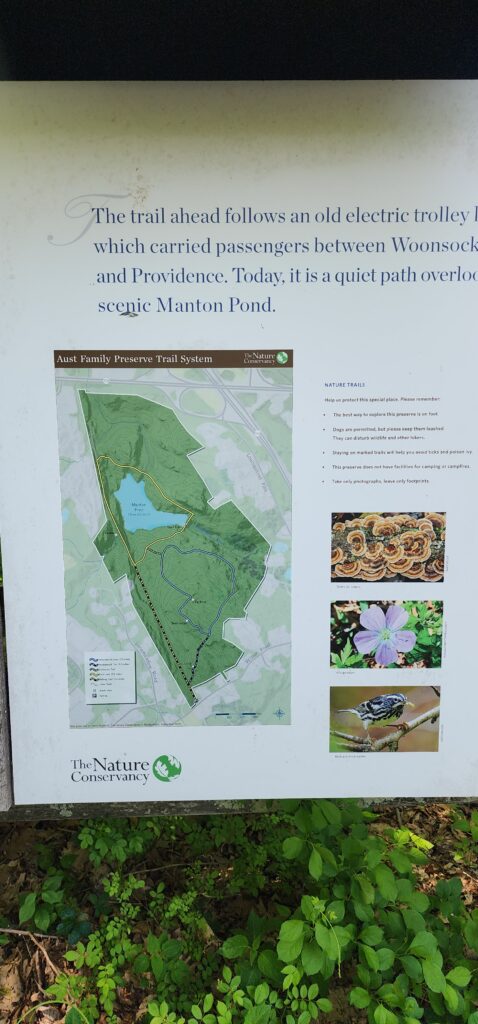
Map of the trail, these are helpful photos, yes. 
Walking up to the pond (right), homes (left) – both not pictured. 
View from the creek that feeds the pond. 
Walking across the pile of dirt that made the pond. 
Someone left this on the trail – you think they brought a spare? I also learned on this day that there is a different syle of poke all over the place, apparently the style I had on this day was a Hawaiian style. I don’t recall seeing other styles, ever, but anyways, it was good, with some spicy salmon, avocado, soy beans, brown rice, wasabi mayo and fish eggs topped with cashew ground up. This was for lunch. For dinner – I’d been slow cooking a meal I’d gotten from chipotle a few days before. I didn’t feel like tossing it is all. I had happened to show up right before the dinner rush apparently, and by the time I’d gotten a meal there were about 15 other people in line waiting for food. Just 3 people there to prepare food, though. I’d originally wanted to leave because they just didn’t have the staff present to serve the food, but I was talked out of this. By the time I ordered I suppose the girl had heard me rambling for a moment and so anyways she seemed pretty mad, visibly so at this point, so I mentioned at this point that that’s usually why I don’t queue to get fast food – because when we all stand in line like this, the folks get pretty frustrated, and anwyays I could practically feel the hate pouring into the food as the girl kept apologizing for no apparent reason, I was quite content, waiting, that is. It tasted about as I’d expected it to taste, but I only got through about a quarter of it before I’d decided I was full. I slow cooked it for about two days and it was very good after that. Aside from the brown rice, which seemed to have been partially pilferred .. the hull was thinner than I recall thinking brown rice should’ve been.
Dilution works well for continuing the cooking! Tuesday I went to Seekonk river north of Providence, Swan Point Graveyard, Blackstone Park, Good Burger scene shoot, the restaurant and planet fitness. So I drove up and down Blackstone Boulevard – very pretty views on this but I was driving and only got one good photo. There happened to be a movie scene being filmed on the road as I was passing through. I didn’t realize at first, i only saw a funky looking car and managed to snap a photo of it as I blew by at ten miles an hour or so. Check it out!
There were other, more sensible, folks just walking up and taking photos, too – not me! So anyways, I’d first navigated just to “Seekonk River” and Google thought that I was looking to park in the back of a retirement community. The staff eyed me as I parked there and looked for a better spot, only to find myself parking right alongside Seekonk (not SeeCock!) River, I walked along it for a bit before I found an entrance into Blackstone Park near what was identified as “Hockey Pond” and so I walked around the pond and then back to the car.

Seekonk River, Henderson Bridge (Right) not pictured, beat up old pier here. 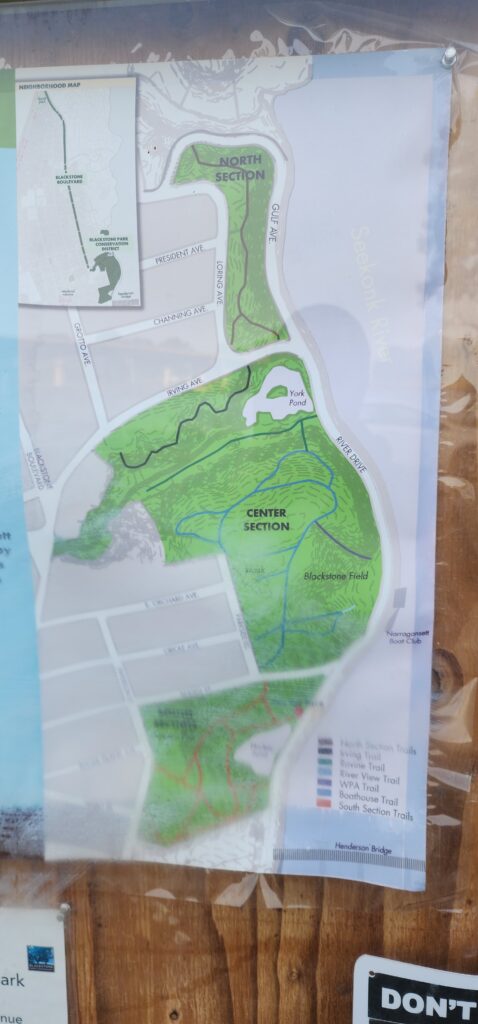
The map of Blackstone Park at the trailhead I entered, south section. 
The “Hockey Pond” 
I guess these things don’t do so well in the woods. So I got back to the car and then drove down Blackstone Boulevard, looking for a better view of the river, only to find myself driving through Swan Point Cemetery. Here I found H.P. Lovecraft’s grave (According to Google!), and a lucky turkey with her dedicated flock of males in pursuit.
Over the shoulder shot! 
Three male followers, there were at least two more. 
There was only the one female, that I could see. Wednesday I went to Patriot Park & Gillette Stadium & the nature trail & cranberry bog back there, and the Planet Fitness in North Attleborough MA, then went back to the hotel to do some laundry.

The Bog – Informational signage. 
Someone was, or is still, quite a talented woodcutter. 
Walkway leading to the bog. 
Walkway crossing swamp leading to bog farm. 
Another one of the nice wood carvings. 
Fenced area between swamp and farm, leading to nature trail. 
Cranberry Farm. 
In-motion shot of the loud squawky flying pig over the farm. 
Nature Trail behind Gillette Stadium 
Looking back over the swamp on the Nature Trail. 
Root Exposure on the Nature Trail. 
Embuttoned tree on the Nature Trail with exposed roots. 
Felled trees, with carvings, on Nature Trail. Swamp on Right. 
Crawly-leggy pig on the Nature Trail. Left to their own devices, these fellas make hills. 
Actually Gillette Stadium. 
Patriot Park Hospital & Restaurant shot, stadium on right (Not Pictured) 
Little square in Patriot Park 
North Attleboro Planet Fitness after the Rain After the gym, I went back to the hotel and went to sleep for the night. Thursday I went to Scialo Bros. Bakery, Telford Park, Whiting Pond, I took it easy because my knee was aching and i needed to pack for an early flight the next day. I had put the treadmill at a 6.5% grade and about 3.2 miles per hour, and usually I keep it under 3 miles an hour because my right knee will ache the next day due to injuries I’ve had since most of my life that I can remember. The bakery is located in Federal Hill, which felt to me like a Newburgh, NY downtown, but a lot nicer and also right next to the ocean. It’s got some of the best baked goods your money can still buy. Telford Park seemed more like a place to bring kids so I just stopped there briefly enough to plug in Whiting Pond. Whiting Pond boat launch is more of a quiet little fishing spot, but was perfect to end the trip on and eat the cookies I’d gotten from the bakery.

This’d be the side entrance. Also their parking lot. 
Not Pictured : Most beautiful woman in Rhode Island (Right) 
My quarry from the bakery 
Whiting Pond Picnic area & Boat Launch 
Whiting Pond fishing area. 
Having just eaten a chocolate chip cookie, an eclair and a brownie at Whiting Pond. Friday I traveled back, 12 hours of travel time. I left at 530 in the morning EST and got back in my place at 430 CST. The flights were nice. The second one was a little bumpy but for the most part I slept through them. I went to a place to eat on the layover in Georgia for a turkey wrap and they had decided that it was a good idea to put Pesto and some soft cheese in there. It was a very strange wrap, from a texture standpoint. Even the french fries were oddly cut – not straight, more like really thick half-potato chip shaped. Worth the meal for that experience, but overall the taste was not there. Possibly they could do with some better mayo or ketchup, or just better quality ingredients overall. I took an uber back from the airport and it was about 4 times more costly than usual, I guess this is the price of rush hour traffic. It took maybe an extra minute to get back though, so whatever. So from the start to the finish of this trip, there’s about another 23,000 words plus some 200+ more photos and even more words that I didn’t put on this site – this was just what I felt like putting on here to send the reminder that anything here’s very much a movie based on a book, in that this is only about 16 percent of my summary of the trip that I bothered to put here.
- Green Bay May 2023
I’m pre-writing some of this to see how it reads after I’m done here. I’m spending a week in Green Bay in May and I have got a few things planned coming up. I’m flying in Monday night and am staying at the Radisson near the casino next to the airport. The gym and pool and things are apparently all 24 hours during the times I’ll be there. So when I get there, it should be around 10PM. That night I’d like to at least locate the pool and the gym and see what all they have got going on there. The next morning I’d like to actually go to the gym and the pool there for a bit, then check out the casino.
So I got in on a Monday night, around 9pm. The layover was quite a quick flight out of Detroit for me, ended up having about 20 mintues to walk 15 minutes after the first flight was delayed twice. Once before the flight and another during the flight. Apparently it was a re-routed flight and crew, who knew? Anyways, I took the shuttle over to the hotel and they got me checked in quite prompty. The room itself was pretty nice, having one single king bed and having laminate throughout. Very roomy. I spent the night locating the pool and the gym. I had to let the fella at the desk let me in, and damn if that wasn’t the first time i connected that brisk Wisconsin accent to more than a few folks I’ve known through the years. Anyways, he let me into the gym because my card didn’t work to let me in there and I checked it out for suitability in the morning. The bike and treadmill were up to my standards, and so I went back to the room and fell asleep.
The next day I checked out Lambeau Field. The whole place itself seems to have just been originally an outdoor stadium that they put a massive operational facade on. It’s quite beautiful inside. In there was a massive metal football trophy, the entrances to the stadium and a restaurant or two. I saw a bunch of folks walking around with lanyards so I assumed they worked there. Anyways, while there I checked out the 1919 restaurant which was recommended to me highly by many folks at this point. The food there was wonderful, the cheese curds were some kind of orange cheddar. I had to ask the lady what kind of cheese they used for the cheese curds because they were great and she just came back saying it was an orange cheddar. I assume it had to be some local variety of cheddar because not too many cook like that in the deep fryer. Anyways I got the mango-something salad and it came with watermelon radishes, macadamia nuts, a very fatty vinegarette, crumbled feta, lettuce and of course bits of mangoes that appeared to have been pulverised into some uniform shape somehow. The salad tasted pretty good, but after a few bites I caught on to how fatty the dressing was and had to stop half way through the salad. Not that there was anything wrong with the salad – just that mine are usually consisting of just some lettuce, pepper and apple cider vinegar.
Anyways, downtown Green Bay was quite an event in itself. This direction being the one goes if they would like to get to the bay itself, in my opinion. While downtown, I was quite abruptly met with a full-pursuit police chase. A run down white van rolls past me, moving from left to right and I don’t catch on at first, but then there’s two full police SUV’s. These pass, but traffic does not move. So, I decide traffic is right and sit with it. Good thing I did because two more crusiers come barreling by, then I see the same white van only this time on the other side of the road traveling from right to left. It was at this time I realize that the driver was fleeing the police and was witnessing my first active police chase in over a decade. So in total there were 7 cop cars and they nailed that poor bastard about two blocks up. Anyways after this I headed over to a marina on the south side of Green Bay off Lake Michigan, because you can’t go to Green Bay without seeing the bay! The marina was neat, wildlife was abundant as some geese took refuge on a small island off the shore just out of earshot of most things but close enough to come back for food. There were gophers hanging out in some lumber by the breakwall. The breakwall was just covered in shells and drift-sticks (for reference – this is driftwood that doen’t qualify as driftwood, so it’s a drift-stick here). Got some nice photos of the day on this beautiful day and then came back to the hotel.
The jacuzzi was great – they actually let you run the thing in hour long increments! I also got to check out the gym and the bike there was really comfortable to run. After that Tuesday was about spent so I went back to the room becasue I had just found out earlier that day that I’d gotten accepted to Boston University for some reason only God knows and wanted to check out what that was all about. Anyways, on the next day I had some breakfast at the hotel. I didn’t realize at the time of me walking in there that it was apparently a fulls service restaurant and back which was not something I was expecting at this place at all. So I walk in there stinking like a gym and meanwhile the folks there are ready to start their day after breakfast. Anyways, getting back to the service side. I had some bacon and two over-hard eggs. Now I don’t know if you’ve ever had taken the time to order anything other than sunny side up or fried eggs or not, but it’s not often that you’re going to come to a place that can cook an egg over medium or over hard. These are things I feel like people should do, because nobody really wants to eat that fried egg by itself, but sunny side up seems like such a waste when you don’t get toast with your egg. For this, the over-hard egg is the proper selection more than not. Anyways, it was quite well cooked and the bacon had an increible taste and texture to it and was delicious too. I had to get out of there so I had to prod the lady a little bit by standing up and letting her know to please bring me the check and I did this and then left.
After that later in the day I checked out a place called Parker John’s BBQ and Pizza. It was wonderful barbecue. One difference between carolina BBQ pulled pork and here is that in NC, it’s a bit more moist and I think this is due to the juice being re-added to the meat after cooking it. I don’t believe the cooking method at this place had this step in there, but re-adding the broth really adds a level to the dish I don’t think this place was looking to offer. They did seem to cook it at a higher temperature too, similar to the one you would use for carnitas. I very much liked their mustard sauce. This meal also came with a side of beans and some cole slaw. They also stashed a cornbread with a pad of butter on the tray and then let you go at it. It was overall incredibly high quality barbecue and I would definitely go back to this place. The scenery was well matched to the style of the place too, wonderful things to look at. The waitresses had shirts on them that said “Smoke meat not meth” which I couldn’t help but blurt out laughing at due to the audacity of a restaurant giving it’s folks a shirt at all that said anything in particular about anything was a welcome sight and I enjoyed this most of all. If, for nothing else, say you go there and don’t even eat barbecue – do go there for the folks wearing this shirt. Great lunch place.
After that, later in the day on wednesday I checked out the Oneida Casino here. The door on the entrance informed me that it was the select casino partner of the Green Bay Packers. Seemed legit. So inside of this casino connected to the hotel is a neat array of cheap slot machines. A lot of them would let you spin for fifty or sixty cents, I was not able to locate anything that lets you spin for lower. So I took out forty dollars from the ATM and paid $1.50 for the fee for the convenience of having the machine there. I fed a farmville machine 20 dollars, and within moments I found myself leaving the remaining 50 cents with the machine. I then continued on to a green machine, another slot machine but this one I could pull the handle. So I fed this machine 20 dollars, and played a little bit on my phone because its spins were a dollar a piece so i wanted to space out the spins a little bit. I walked away from this machine with more than I fed it.
The next machine was something with some pumpkins on it. I had cashed out from before and fed the machine 20 dollars. I then found out the machine was halloween themed and otherwise had the same face card draws other machines would have and its persona was prominently displayed as a halloween witch that I don’t recall seeing before having sat at the machine. I had been drawn to the machine because I had seen some meme circulating about a dog and some baby pumpkins earlier that day and it had made me laugh. So i sat at that machine on recalling that, and walked away from the machine with $59 and 8 cents. I decided that I was done gambling, cashed out and left the casino. You know they still do vending machines with cigarettes in them there? Then I went and spent the next few hours going to the hotels gym, jacuzzi and pool .. in that order.
So the next day I woke up, had some breakfast here at the casino and had to explain the the lady that a fried egg is just a broken egg yolk that you fry up like an over hard egg. She told me that she would just tell them to break the yolk. I can tell you right now that if I walked into the right restaurant and asked for a fried egg, they’d know exactly what I’m asking for, and understand that I’m not asking for an over hard egg and that if i wanted an over hard egg that they would give me an over hard egg. Also apparently ordering two orders of the delicious-sounding bacon from yesterday translates to giving 8 of the scrappy thin cut poor tasting bacon I got today and so I’ll have to admit that I got bamboozled there. God, they even put the egg in a round thing too – it was super pretty! Anyways, around the middle of the day I made my way over to a place called El Sarape West Tequila Bar and Restaurant.
This place is your typical, fantastic mexican food joint that people belong at when eating lunch. So I walk in and I was instantly greeted with a bench signed by a bunch of Green Bay Packers players. Bench like this would be a part of history at some point in the future, much like most things now. Anyways, they got me in a seat pretty fast as it was emptier than I feel like it should have been for the time it was. The place had gotten pretty crowded by the time I was done eating. So I ordered the beef enchiladas with mole sauce and I don’t think I’ve tasted such a nice silky mole in many years, it was quite wonderful and I did like to dig through the shredded lettuce on a scavenger hunt to find just one more bite of the enchilada with that sauce. I highly recommend the mole. But really, if enchiladas aren’t your thing – don’t even bother picking up the menu just order what you like at this point because they are going to have it! They are also really generous with the chips and I’d be quite impressed if any of the salsa had come out of a can at all. This had to be the single place in Green bay that I didn’t try the cheese curds at. I’m sure they had them though, everywhere here does. So I got out of there after a bit, the oncoming onslaught of folks pouring into the door was taking more and more of the lady’s time from me and so timing to leave was about as right as it could have been.
So a little bit after this I went back to the gym at the hotel and the woman at the desk helped me get the door open to the gym. There was a fella on the ellipcial machine that had been there before when I first tried to open the door, who got about half off his elliptical by the time she’d gotten the door open, when she had spotted him and said “You’d think he could have just opened this for you”, and walked off. The fella was still a little startled so just as the door shuts I tell him, “No worries, I just like making them walk back here at this point to let me in the room,” the door’s been “broken” since Monday night when I was told “Oh we just don’t want peoples kids in there,” and, “The guy that fixes those things was on vacation since last week and just came back”, and half a dozen other stories I enjoyed hearing but not believing either. Anyways, a bit later I ended up at a place called Legend Larry’s.
I’d decided to go to Legend Larry’s because the cheese shop I’d wanted to go to at the time was closed before I’d made my way to it. Their loss I guess. So, Legend Larry’s feels like a local, townie bar far enough away from downtown that the locals can go there to enjoy it, but close enough to downtown that at least a few non-locals would straggle in there. Legendary for that, at least, sure. The door is absolutely un-decorated, double metal doors with no windows, signage and you would not otherwise think this to be the entrace to anywhere other than the kitchen, very unwelcoming feel. Then you go inside and feel like you should have been there yesterday, or that you already were, or have been all along. Something like that, legendary for sure, yeah. I don’t think I’ve gotten that kind of feeling from anywhere else that’s a wing bar. So then, there’s nobody to tell you to take a seat – you just gotta remember that you should take yours! So you do, only to sit down and find there to be those order menus and pens at each table for folks to select what they would like and drop it off at the bar which you’re supposed to figure out for yourself, also. This whole process was actually the neatest part of the whole visit. So I filled it out, same as you would with one of those all you can eat sushi places – only with chicken wings and appetizers! They also had shrimp in place of chicken wings, I was there for the wings though. I grabbed the 12 medium wings and the cheese curds. This is a good place.
Anyways, I’m out of here at noon tomorrow and don’t have much planned that I feel like putting on here. Next week I’ll be headed over to Massachussetts. Check out various pictures below:

This fella was hiding in a ditch by the Bay 
These were also near the ditch 
Check out the bay! 
This’d be the field – they added a massive facade to it a while back and more 
My view from the gym 
One of the gambling machines in the casino 
This is the hotel room I was in 
3/4 mile from the hotel there was a gas station, with this 
Here’s the bench 
This is the entire gym 
Legend Larry’s Ordering sheet 
Pool & Jacuzzi at the hotel - What brought you to Texas?
You ever been asked this question before? I get it all the time. I’ve said a lot of different answers too. Not because I have that many different answers, more that I can’t really answer that kind of question very fast and unless you’ve got yourself some context you’d think I’m just telling you different stories. That’s one neat thing so far I’ve figured out in Texas – you never really meet the same Texan twice. It does feel like I’ve lived here almost a decade even though I’ve only been coming and staying here for just a year. Anyways, that’s a different story full of stories.
One thing that brought me to Texas was the heat. I don’t much care for the humid weather I was dealing with in the southeast United States, and I don’t much care for the winter weather on the north part of the USA. That really narrowed it down to me. I had spent about two years in Oklahoma finishing college, and the climate there was about the favorite to date. So that’s one thing that brought me to Texas. The dry, hot heat, unrelenting. Back in Oklahoma when I was living there I was driving a 1970 Lincoln Continental (hereafter: hoopty). Anyways me and my hoopty could easily be found on the side of the highway cooling down, both myself and the car. The car had a brand new radiator and even that beast couldn’t keep itself cool enough when it came to bumper to bumper traffic on the highway in the midwest. It also didn’t have A/C. And the drivers window wouldn’t work so great. It was a good time. It was a hot time, too, but it was also a good time. I have a 2017 GMC Sierra 6.2L Denali now and the roads are much .. cooler .. to drive on, anyways.
Another thing that brought me to Texas was that I was looking to live in a large city. San Antonio is a city made up of smaller cities, and certainly checks this box off. The city is massive, and still incredibly affordable and has a lot to offer for being a city of this size. I lived about 40 minutes north of Manhattan as well but I’m not really looking to go back to New York. Taxes there are a bit too much for my tastes and I just don’t really want to live near another New Yorker at this time. I also really like that San Antonio is as close to Mexico as it is, as at one point I was seriously considering a long stay in South America and this spot is at least closer. I’ve been told by some folks here that San Antonio’s a lot like Mexico without all the problems – so it’s like Mexico would be then under different circumstances. This was told to me by a Mexican that moved here and lives nearby the same gym I go to. He even told me it looked a lot like it. Sure, outside of all the signs written in spanish and beautiful arched facades, I really only can take his word on this. It certainly looks different from other places I’ve lived at and I’ve certainly lived in quite a few cities. It’s a good look, this.
Something else that brought me to Texas was that I noticed a lot of folks were moving out this way. At one point I was watching a lot of different people play video games on a site called Twitch, and it seemed like just north of here in Austin there is some kind of serious development with regards to a lot of folks moving from California to there, and also New York to there too. So, I get a lot of the benefits of living in Austin without having to deal with the people from Austin, here in San Antonio. For one, an apartment is still quite affordable, comparably. I did look there in Austin, but the prices were a good 25% higher on average going from my memory. Also I don’t like tolls so much.
Texas also seems to have its own version of everything, too. Theres Whataburger to replace McDonalds, and HEB to replace Walmart and Wegmans. Texas editions of vehicles .. you get my point. If you don’t, then that’s fine go ahead and skip the paragraph, or not. But, are you starting to see the picture yet?
I’m living in a city of cities, so I can take a vacation while I’m on vacation, in a state where I’ll never meet the same person twice, where there’s a state brand of everything! I came here for the variety! My whole life I’ve only known the East Coast, except for the two years in Tulsa I spent largely studying my ass off trying to get that 3.96 I graduated with, only for it all to have gone away quicker than I could have graduated. I actually left to go back to the East Coast less than an hour after they handed me my diploma, and I guess I just wasn’t done here is all.
I wanted to go back, actually I never really wanted to leave. Family had fallen on some tough financial times about half way through my education in Tulsa, so I spent the next decade helping out where I could – close by. They are very far away from that situation now, but that’s just what you do for folks who now live in their own home with a retirement that’s well planned for them and not having any outrageous struggles that they’d’ve been in before that.
So another thing that brought me to San Antonio instead of another city in Texas besides the lower rent was that I did have a friend here. Note the past tense, not all things work out for everyone. Really, the idea of moving to a Texas city was a lot in itself to me and the thought of being able to make new friends easier by knowing at least one person in the area before going there was initially something that I was thinking was a good thing. This is a poor mindset for moving to a place though! I didn’t really know that moving here – I’ve met more folks just by looking for a job.
Speaking of jobs, one thing that also brought me here was that there seems to be a large culture centered around wrestling. I’ve always had an inclination to the sport, only it just never really was the only thing I was doing. Mostly this was because I was in the 300 – 340 lb range for over the last ten years. I didn’t even watch the stuff. Even more interesting about being so close to the border here is that you get a lot of crossover between American wrestlers and Mexican luchas and the whole thing is pretty cool. I even managed to join a gym here for a few months, feeling the risk was reasonable after having lost over 80 lbs in 2022. Training was going pretty good. I learned a lot from a few good people there. Then I got kicked out of there, no specific reason given to me, just kicked out, no contact. Guess I’ll never know, and that’s fine. There are other places out there but at this time the place I was training at moved to the other place I was considering training at. For the time being, I just go to the regular gym and work for money. Some day I might go back and train but for now I’m just fine not having to deal with that. One thing I did learn – a fella could pick this stuff up in his fifties if he wanted to.
Another thing that brought me to Texas is the expanding manufacturing industry here, specifically automobile and semiconductor manufacturing. Usually I just tell folks that computer chips brought me here, for lots of reasons. Mostly it’s the facial expressions, the look on the woman’s face at Scarlet’s by the airport here was priceless when I told her “computer chips brought me here”, I guess people have a lot to think about this. I mean sure, about these days computer chips bring people about everywhere so it doesn’t seem at first glance a great reason to move to San Antonio. Apparently, there’s about ten or so manufacturing plants for Samsung about to spring up in ten years just north of Austin. Or maybe it was a ten billion dollar plant. I don’t know, ten something. Point is that the kind of work I’m used to – manufacturing – is expanding and growing in the area. Electric cars are also being manufactured here. Tesla is making the Cybertruck here in their Gigafactory in Texas. It’s a very beautiful and stunning plant, by the way, I highly recommend the plant tour they give during mass interviews if they’re still doing those.
One other thing that brought me to Texas what that I always heard they drive fast here. I can certainly confirm that not only do they drive fast – there are generally more lanes in the highways and thruways than there are stupid drivers nearby. That was one thing that caused me lots of issues in North Carolina. Folks drive around like the outside of their car is made of bubble wrap and they can’t pop a single bubble. It’s nuts and it drove me nuts. Every single turn was made at less than 5 miles per hour. Every single time you tried to turn into oncoming traffic the cars had spaced themselves so critically apart from each other that it was too close to jump in line without potentially cutting the person off, but just at the point where they were not too far apart to then potentially cut the next driver off – it was maddening. It was just some of the slowest, poor driving I’ve ever seen. Like they all drive around living in a dreamlike trance state. I’ve never been one to be subject to road rage, instead choosing to quietly dwell on the poor driving skills of the folks around me in that state. Not saying I’m much better but if you haven’t experienced North Carolina driving I’d recommend it as much as i’d recommend a rusty saw removing your head from your neck. Highway driving was awful too, the entire state merged a mile or two back rather than zipper merging, and when they weren’t doing that they were consistently 15 mph below the speed limit on the highway in predominantly the left lane and there certainly were not enough lanes in the roads there. They also had a strange inclination to go the exact speed limit at all times for no apparent reason. Then they would get mad when they got passed on state highways and speed up and tailgate the fuck out of you after the passing zone. I just don’t get it! I’ve driven in a looooot of states and North Carolina is worse than Massachussetts. I think Mass. is a little more dangerous driving sure, what with folks dead-stopping to let someone into the road in a 45 mph zone, but damn if North Carolina didn’t have them beat everywhere else. So anyways, it’s just not like that here in San Antonio. Sure there’s normal congestion traffic occasionally, and the paint really doesn’t stay on the roads, but the flow of trafic is pretty good and comfortable here.
Sure I guess I could also say things like “the people are nice”, but I never liked hearing this myself. Let me rephrase that – it’s a good thing to hear! But, in general I think it’s a poor way to reinforce ones decision when used in conversation. We live in a high trust society, about every single person you’re going to meet is going to come off as nice, in general. Also as a general rule, if you’re looking for nice people, you’re probably going to find nice people. There’s a pretty good tendency to find what you’re looking for – wherever you happen to be! Anyways, that’s a bit of a separate story too. So, another good reason to pick the middle of Texas to live in is that it’s really only 2-4 hours to get anywhere you want to go in this state. The gulf is 2 hours away, Houston is 4 hours away, Mexico is 2 hours away, Austin is 45 minutes away. While 4 hours is kind of stretching it for a day trip – the point is that it’s a good location to make unplanned day trips and while most things are a 2 hour away flight, it’s substantially easier to make a 2-4 hour unplanned drive than it is to make any flight any time here in the US.
Another reason toward the timing to get over to Texas was that after over two years of insanity and restrictions I was just done. Done dealing with pharmaceuticals, done working, done doing just about anything. The main reason I left the first place I was working at was because they mandated their workers to be injected with what had been re-classified that year as a vaccine, despite it very much being a therapeutic level weak genetic modification. Had I stayed, and a lot of people did, I would have either gotten fired or alternatively I would have been roped into fucking absolute insanity. Not that I have a problem with the drug delivery system itself, but I’d rather see it get put to use in humans for useful things other than what it was introduced for. Like weight loss. Or Alzheimers prevention. Even just calling it what it actually is would be reasonable to me. Tons of other shit besides what it was. So, I let them know that as soon as they remove that requirement from their job postings then I might consider working there again. In the intervening two years, the requirement’s been removed, despite being told at the time it never would be. Anyways, I then went to a place that only required people be tested. But that didn’t necessarily fix anything. Restrictions were still in place and I was just hopping into someone else’s insanity. So it was great to me when I first started visiting here and everywhere was like downtown Raleigh, and nobody seemed to be talking openly about the bullshit that drove me the hell out of there.
This isn’t even a complete list, so far. It’s just the details of what I remembered in an off day here in Texas. A couple of other reasons I can’t even remember right now are something for business, and something for land, and something for the politics, but I don’t even remember those details right now. There were a shit ton of things that weren’t getting sorted through by sitting at a desk in North Carolina, I sure figured that out. I’ve got a good three years of logs going back to about September 2020 where I was writing something about moving to Texas though, so I was definitely planning this for a while. Probably even longer, I started logging things around early 2019 or late 2018 but I don’t feel like digging those archives out and checking out what I was planning there. Such is how things go though!
- Four Day Baked Beans
I wanted to keep a reminder to me somewhere about the best tasting beans I have had to date. Not saying it’s the tastiest recipe for beans ever made, just for me specifically, top five easily beans I’ve ever had. This includes beans served at the Tex-Mex places I’ve gone to here in Texas so that’s saying something at least. I have not really kept good track of the amount of places I’ve had beans at, overall either. If I had to guess it’s about a dozen or two places over the years. So anyways, being in the top 5, the recipe lets me have these things easily at home. The recipe is:
1.5 Lb Bacon
1.0 Lb Kidney Beans
0.5 Lb Black Beans
1-2 Tbsp Harissa or Berbere
3 Chicken Breast
I’m pretty sure the recipe can do without the chicken breast, but I was mostly looking for a way to make both beans and chicken breast taste good for me. I did! So, all I did was take the dried bags of beans, add it in a slow cooker, then lay the slab of bacon on top and stuff the chicken in on the sides. Then I poured in about a cup of water or so. Then I covered the meat with the Harissa seasoning (I used it from a brand called Spicewalla). After that I just let it cook for a few hours on high, then more on low, then I got tired of the strong smell of the stuff cooking while i was trying to sleep so I took it out and popped it in the fridge overnight.
Next morning I took it back out and set the cooker back on high, then moved it back and forth between medium and warm through the day. I stored the stuff in the fridge for the 2nd night too, because the great smell disturbed me when I was trying to sleep. So the third day, I noticed it didnt really smell any more. I also saw that the water was gone and there was basically just liquid bacon fat left.
So I let it cook all day on low, and then overnight on warm, and then the fourth day I put it back up to medium. It was starting to show that it was going to burn from basically frying in bacon grease at this point, the water was gone a while ago and the remaining fat was going into the beans.
By the end of the 4th day there was no liquid left, and the beans were amazing. The bacon and chicken had completely broken down at this point too, the entire meal was incredible to me. I paired it with some broccoli and chicken legs. I can say I’ll be cooking this again as soon as I can, the meal continued to get better day by day, I had been taking a cup or two away per day to eat at.
A modification here could be that if you wanted to cook the beans without adding much water, you could just take away the chicken breast and then cook down the bacon for a bit until the liquid part separates and then add the beans to that! I also think I might have used harissa seasoning instead of berbere, but either one makes a good pot of beans. One thing that is important is to make sure the bacon is not spiced itself! This will change the flavor quite a bit. Cured or uncured bacon is just fine, I had a little more luck getting the fat to break down completely with cured bacon.
In the end it kind of looks like this:


- Traveling
In a few weeks I’m going to start traveling pretty often. First on my list is Green Bay, Wisconsin. The location was picked for me quite randomly and I’ve made an educated guess or two. I have spent a lot of time traveling over the last year since leaving my last place of work in North Carolina. Initially I did quite a bit of flying in and out of San Antonio & Austin, TX areas due to there being a large airport in both those cities. This would have started in about June or July and ended when I finally decided to move here in August 2022.
Since then I have made a road trip out to Denver, Colorado for about a week. While there I had stayed at an airbnb location. On the way there I stopped in Missouri to see some family that I’d been planning on seeing for about a decade. After returning from Colorado I stayed here in Texas for a few weeks. There was a number of places I stopped at along the way, all logged elsewhere around that time, offline. While staying in Texas, I had spent a good three weeks in early October checking out San Antonio a bit more in depth. It’s essentially a city that’s made up of quite a few other cities, and I often describe it as much when talking to folks here.
At this time San Antonio is celebrating in what is called Fiesta San Antonio. I don’t much know where the tradition came from, this is quite a new experience to me. Essentially folks just throw parades, events, carnivals, fair’s all across the different cities in San Antonio and they have this thing where the people that go to it look for and wear Fiesta Badges reminiscent of something they took part in, or for performing some task, or sometimes just from having traded or paid for one – whatever the reason folks just cover themselves in these things as a way to hype up the festival. One of the more lively events here at this time was a parade on the riverwalk. I didn’t get a chance to see the parade directly this year but did spend some time on the riverwalk last week and found there to be quite a number of folded up plastic chairs for onlookers to see the parade floats that were being stored along the riverwalk under a building i had passed by at one point.
Anyways, my other part of traveling last year was going and traveling to New York through driving there in my truck. The sights were alright and I didn’t hit any snow. I do enjoy the driving so it was nice. I had also logged the bulk of this traveling offline and am only gonna summarize it here this time. So in New York I re-visited the southern Hudson Valley area, where I grew up, and visited a few estranged friends and stayed with family. It was a wonderful time.
After visitng New York on this long car trip I drove south to North Carolina, to re-visit the place I had spent the previous 6 years at. I stayed with family during this time and celebrated christmas here as I stayed for quite a few weeks this time. Since about January I have mostly just vacationing locally – a thing you can do when you live in a city of cities so you can travel while you’re traveling! I’ve also been logging most of this offline since then, too! I meant for this blog to be a place for me to write out the places I get to check out when I’m traveling away from San Antonio, at least at this time and so I would expect that come another week and a half that I’ve got some things to say about the Green Bay area!
- Gym Adventures 16Jan2023
So I’ve decided that the best way for me to learn the city is by going to random gyms inside of it. Learn the city means a lot of different things to different people. For me, I’m quite literally just talking about the roads. Simple. So yesterday I went to two different gyms: A Planet Fitness at 4400 Fredericksburg Rd and a Gold’s Gym at 255 E. Basse Rd Ste 310.
I first got to the Planet Fitness, walked in, got to the lockers and went to change and realized that I had forgotten my shorts and shirt. I’d taken the weekend to rest and for some reason had assumed that I had put these back in the bag earlier in the weekend. Anyways I drove back home, got two sets and put one as a backup in the truck. Then I drove back and worked out for 2 hours. 1 hour on the bike, and 1 hour on the treadmill. Both machines were in good condition and not bad. I then went and got a tan. I didn’t realize the tanner was on a timer, so I came out and accused the machine of being broken to the woman at the front desk. She told me they were on a 4 minute timer (not 3 or 5!) and so I said, “Okay thanks, I’ll head back now” and did.
After the tan I came back out and the 3 folks at the front desk were engaged with an angry old white dude complaining about not getting his moneys worth for something surely too much to ask for to begin with. I got the attention of one of the three visibly frustrated employees and asked for a hydromassage, during this short conversation the dude seemed to have calmed down and left. After the massage I went back, changed and then left. Overall not a bad gym, none of the folks there seemed overly creepy. The new years crowd is still rolling through. The parking lot was a small shopping center, not the greatest neighborhood but the facade of the building itself looked okay. I recall seeing an empty beer bottle standing up on what would appear to be the drivers side of an empty parking lot on my way out. No complaints here. The next stop was Gold’s Gym.
The whole place is located in a wonderful part of town, I think it’s called The Quarry. If not, it should be as a lot of places there indicated “so and so” at The Quarry. The upscale stores in the area along with the nicer restaurants indicated that the area was designed for a more luxurious living pace. The gym itself was next to a cinema inside a parking lot that rivaled the size of a mall parking lot. There were even a few parking lot security guards roaming around on bikes and what not. I couldn’t say it was the highest of the high end, like I didn’t see a Gucci store there, but definitely for the more bougie folks. Anyways I walk in theres a woman at the front desk, who tells me to have a good workout, so I say “thanks” while I scan the card and walk over to the locker room.
The one thing I can say about the entire gym is that there appeared to be very little concern overall for cleanliness, but it seemed to go with this specific gym. Like one could imagine the kinds of people that frequent it are the kinds of folks that don’t generally concern themselves with the messes they make, often as if they don’t make a mess at all. While I’m okay with that, it’s more of an observation than a stance and anyways the thing I noticed immediately was that there was only a sauna in the mens room. I was a little aggrivated by this because the place was advertised as having a steam room and steam rooms are my much preferred choice when dealing with these things. Anyways, I went and changed, noticed the floor was quite filthy, wet in a few spots. There was a guy that was frustrated a few lockers down from me, I overheard him muttering “god-damn i cant believe it” or something as he was fumbling with his drink bottle. So, I put my bag on the bench and he apologizes for taking up so much space, because he was also taking up the little alcove off to the side as well I guess. I said it was no problem I’d just take up the other half the bench, there being only two of us present at the time there and I needed a place to put my bag to ruffle through the contents and get my stuff out. So I changed, checked out the showers which were huge and nicely tiled, then went to the 2nd floor where all the working out is to be done apparently.
Up there there were free weights on one side and machines on the other. I went to the side with the machines, and sat on the recumbent bike and exercised for an hour. During this hour there was a dude on the bike in front of me who was one of the new years crew .. these folks stand out readily because they try a little harder than most folks and take more pictures. Anyways it was entertaining to watch him go while I sat there mostly just listening to music. He was pushing 140 rpm at times on that bike, for reference I burn more calories at about 40-45 rpm on a recumbent bike with a little more resistance in an hour, to the tune of 20% more per hour. Anyways, he wasn’t overweight, but had a pair of man tits that he covered up with a loose fitting jacket and it was really funny to watch his entire upper body flop around as he exercised as hard as he could on the bike, man-tits sloshing to and fro at the 100 rpm right along with him. Unfortunately it was one of those sights that was hard to avoid as the bike I was on was directly behind him and to the side.
Outside of the fella, there was some stretching mats off to my right a few folks would come to, and the bike also had a great view of the parking lot with a partially visible San Antonio skyline in the distance and it was nice to see this. I finished with the bike, and got some water, and then went to a treadmill, on the way there I got checked out by a pretty good looking pale brunette shortish irish chick on a treadmill further down. For reference, I’m a 6 foot flat, 255 pound blonde Western & Eastern European mix with a muscular build and heavily built legs and a decent tan, also adorable, and I can’t say I can blame her as folks doing aerobics seem to have an inclination for checking out people a bit more often. Anyways I got on the treadmill for about half an hour and was done exercising for the day .. totaling about 2000 calories according to the machines this day. So I got some more water and then when back to the locker rooms. I took a shower and then went into the sauna, which was my first mistake of the day apparently.
So I get in there and immediately I notice it’s just an electric heater dressed up with rock adornments that probably weren’t actually rocks at all. The rooms wood, so at least they got that right. There was not nearly enough space to sit down, only seating on half the rectangular room. Theres a wall with no seats, a dudes there just exercising and panting heavily and seemingly inappropriately in the corner with no seats. In the other corner a dudes just chilling in full clothes including shoes, they both were wearing shoes. The room wasn’t nearly hot enough to be considered a sauna and the floor was filthy. So I walk in in a bathing suit and covered in water and just sit down. In the fifteen minutes I spent in there, 4 or 5 other dudes walked in, all in fucking full clothing, nobody even took a shower. There was only one other dude that broke a sweat besides me in there during this time and it was the dude that was doing pushups who was the only one to leave during that time.
Anyways we all cram ourselves in there like sardines, strangely so because the room was certainly large enough to hold more than double the 7 of us in there or so, everyone wearing full ass clothing and not sweating besides me. The sauna is largely not just about going into the sauna, for reference. Sure the hot air is comforting, but the whole experience of the sauna is that you are to open up your sweat glands with hot water before going into it, this allows you to sweat for the duration in which you are inside of it, you do this with hot water from a shower or the like. Then you sit there for no less than ten minutes, sweating your ass off, then you exit and take a cold ass shower to immediately close your sweat glands. I did this. Everyone else during this short moment just wandered in wearing full ass clothing like off the street and I guess it’s, for me, about the most bizarre sauna experience I’ve ever had. Like they wanted to experience what a sauna would be, rather than go into the sauna.
Anyways, I got a shower on my way out of there and went to my car in the parking lot and left. I probably won’t be returning to this gym, mostly because it’s needing a steam room. The lower end recumbent bike I was on was in good condition, at least, and the medium end treadmill was in decent condition. If I do go back, it will be to check out the very nice area as it seems to be a place where one could come across some quality people rather easily.
- The Importance of Writing
For the last five years, I’ve been writing in a laptop. Mostly logging, and sometimes, lately more often than not, it’s been topic oriented. In these past five years, I’ve managed to write well over a million words. I considered it mostly practice, so that i could do this one day. Some folks just want to write and do so, some do it methodically, clearly needlessly complicating this that otherwise would be easy.
The thing is, I wanted to come up with a way I write before I started writing publicly. I still have very little to say about much of anything, I do find out. But writing, I can do. This practice of mine, started mostly on a spreadsheet. I played around with and made different formats of spreadsheets so as to organize my writing over the years. So much so that i don’t much remember my first attempts at writing. I think I had actually tried to self-host my own website on a server running in my apartment at the time.
I found out shortly that these things require daily maintenance, sometimes. Regardless, they do need a skilled hand at selecting the right setup so that the site be able to endure throughout the time it’s intended to run. So my intention is to run the thing for at least a few years. I managed a few months, before a bad update lead me to a site that no longer worked.
Further updates just led me to a local site that also was largely unresponsive, until i just took the whole thing down and continued the process inside of some spreadsheets. I still have a copy of that old hard drive with my first attempts at writing much of anything in particular and I believe it’s labeled backup August 2018 or something like that. So after 4 long years of writing hundreds and hundreds of thousands of words to largely nobody that would ever read them, for the sake of trying to organize the way I was thinking, I decided that there was not going to be a good way for me to organize much all of anything and I should just go ahead and write on the internet instead sometimes too.
I can’t really say it’s been life changing, so much as I can say that if I don’t spend a few nights a week writing and logging I tend to forget quite a few things and just go on about my life as if these things never really occurred to me in the first place. I suppose a bunch of folks are like that out there, ideas coming to them and leaving them as they please. Well not this time, only some of them slip away from me now! Interesting to note here is that since creating this website a week or two ago, I’ve already written over 15k words, elsewhere. Not that I’m necessarily aiming for a word count, I just recall so many times struggling night after night back in school to even come up with sometimes 200 of them at times. They seem to just fall out of my head at this point. Granted, back in school the 200 words were likely of higher quality, the point I’m making here to nobody in particular is that it’s not a competition to make the largest amount of words .. is all.
Anyways, in my logs I have found that there are often a number of things that I can recall in reasonably good detail by going through situations again mentally at the end of the day. Reasonably good detail being whatever happens to come to mind at the time and I suppose at this age I’m more likely to spend 1000 words saying nothing about anything in particular than I am 50 words giving a good description that’s to the point.